This article is general education, not investment, tax, or legal advice.
Introduction
Every upstream project starts with one blunt question: is there commercially viable oil or gas underground, and can you get it out at a profit? That question drives billions of dollars in decisions every year, yet the process behind it stays a mystery to most people outside the industry.
Exploration and production, or E&P, is the upstream half of the oil and gas business. It covers everything from geological surveys to the final barrel pumped from a well. That scope is distinct from midstream (pipelines, storage) and downstream (refining, retail) segments that follow.
This article walks through the exploration process, production phases, the technology reshaping modern drilling, and the risks operators face. It also covers how accredited investors can gain direct exposure to upstream projects through partnership structures like those offered by PetroVybe.
Key Takeaways
- E&P covers the full cycle: search, drilling, extraction, and well abandonment
- Exploration uses seismic and geological data to reduce uncertainty—not eliminate it
- Production hinges on well completion, extraction, and continuous reservoir management
- Rising US electricity demand from AI data centers is elevating demand for domestic natural gas
- Accredited investors can access upstream projects with IDC and depletion tax advantages
What Is Oil and Gas Exploration and Production?
E&P is the process of finding hydrocarbon reserves and extracting them. It is the foundation the rest of the oil and gas business depends on.
The industry splits into three segments:
- Upstream (E&P): Locating and producing oil and natural gas
- Midstream: Transporting and storing what's produced
- Downstream: Refining and marketing finished products
Only the upstream segment is covered here.
E&P companies range widely in size and scope. Supermajors run global portfolios worth hundreds of billions. Independents focus on specific basins where they've built expertise.
PetroVybe, for example, operates in the Gulf Coast Basin with a 58,000-acre position in Lavaca County, Texas. That position is backed by roughly 400 producing legacy wells and more than 57 planned new wells.
The Exploration Process: From Basin to Discovery
Geological and Seismic Surveys
Before anyone drills, geologists study sedimentary basins looking for three things: source rock (where hydrocarbons formed), reservoir rock (where they'd collect), and a trap or seal (what keeps them from escaping).
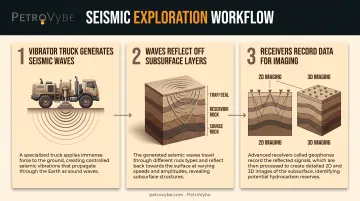
Seismic imaging does the heavy lifting here. A truck-mounted vibrator sends sound waves into the ground; those waves bounce off rock layers with different densities and get recorded by receivers on the surface.
2D surveys produce individual vertical slices. 3D surveys stack many closely spaced lines into a full volume, giving geologists a sharper picture of faults and structures.
Building and De-risking the Prospect
Once the geophysical data comes together, it becomes a mapped "prospect" with an estimated chance of success. That estimate is called geologic risk.
Seismic imaging shows structure and rock-property contrasts. It doesn't prove hydrocarbons are actually there. Drilling remains the only way to confirm a discovery.
Dry-hole risk still varies widely by prospect, operator, and basin—there is no single reliable national rate for US onshore wells.
Exploratory and Appraisal Drilling
- Wildcat wells test unproven territory where planners have limited direct information about subsurface conditions
- Wireline logging measures rock and fluid properties downhole, helping confirm whether hydrocarbons are actually present
- Appraisal wells follow a successful wildcat to size the discovery before operators make a final investment decision
Prospect selection is where operator skill shows up most clearly. PetroVybe's Chief Geophysicist, Michael Stamatedes, brings a documented 75.2% prospect-selection success rate over a 48-year career, against industry peer averages often cited below 40%. Disclaimer: these results were achieved at prior companies.
Bringing a Discovery to Production
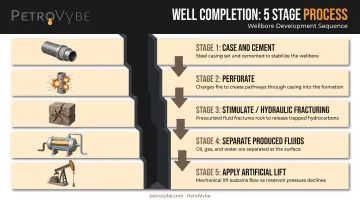
Turning a confirmed discovery into a producing well involves several distinct steps:
- Case and cement: Steel casing goes in, cement is pumped behind it, and a cement-bond log verifies the seal prevents fluid movement between zones
- Perforate: Shaped charges punch through casing and cement into the target formation
- Stimulate when needed: In low-permeability rock, hydraulic fracturing opens flow pathways held open with proppant
- Separate produced fluids: Surface separators split the well stream into oil, gas, and water
- Apply artificial lift: When reservoir pressure drops, rod pumps or electric submersible pumps keep fluid moving
Production doesn't stop once a well comes online. Ongoing reservoir management, periodic workovers, and secondary or tertiary recovery techniques extend producing life and maximize output over the full hold period.
Economics ultimately come down to cost per barrel or Mcf versus the margin available at current commodity prices. A well that is technically successful can still fail financially if lifting costs and workovers outrun the margin.
Technologies Transforming Modern E&P
Horizontal Drilling's Real Impact
Directional and horizontal drilling unlocked resources that vertical wells simply couldn't reach efficiently. According to the EIA, average lateral length in the Permian Basin grew 77%, from 6,149 feet in 2015 to 10,867 feet in 2025.
Over that same window, regional production jumped 284%, from 2.9 million to 11.2 million barrels of oil equivalent per day.
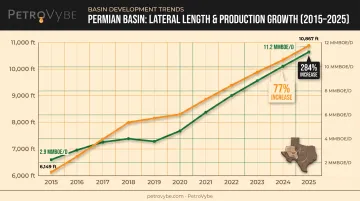
That's not proof lateral length alone drove the increase, but it shows how closely the two trends track.
Data Analytics and AI
Modern E&P runs on data. Per the Society of Petroleum Engineers, AI tools now assist with:
- Seismic denoising
- Fault interpretation
- Ranking drilling targets from seismic attributes, well history, and geological data
That said, no published source quantifies exactly how much AI reduces dry holes. Human geoscience judgment still matters. PetroVybe's approach reflects this blend: the team uses AI-informed underwriting that folds real production data and updated cost assumptions back into the model over time.
Environmental Monitoring
Methane detection sensors and emissions monitoring equipment have become standard as regulatory scrutiny tightens. Operators use them to track and report environmental footprint in near real time, cutting compliance risk and catching operational issues sooner.
Risks, Regulation, and Environmental Considerations
E&P remains a capital-intensive, boom-bust business. Drilling and completion costs in major US onshore plays fell 25-30% between 2012 and 2015 according to EIA research, showing how quickly project economics can shift with commodity cycles and service costs.
Regulatory oversight comes from multiple layers:
| Agency | Role |
|---|---|
| State commissions (e.g., Texas RRC) | Regulate drilling, production, waste prevention |
| EPA | Enforces methane emissions rules under the Clean Air Act |
| BLM | Manages federal onshore leasing programs |
Beyond compliance, operators also carry environmental duties on emissions, produced water, and site reclamation. Most manage those risks through:
- Well design standards that protect groundwater
- Spill prevention and response planning
- Third-party engineering reviews of reserves and operations
PetroVybe, for instance, cites independent engineering validation behind its $48 million PV-09 proved-reserves valuation, prepared by Lee Keeling & Associates, Tulsa, March 2026, along with a clean 2025 audit from an outside auditing firm.
Why Natural Gas E&P Matters for Investors Today
US data-center electricity consumption climbed to 176 terawatt-hours in 2023 and is projected to reach 325-580 terawatt-hours by 2028, according to the Department of Energy.
Natural gas already supplies over 40% of that electricity. The International Energy Agency expects gas to add more than 130 terawatt-hours of annual generation capacity through 2030.
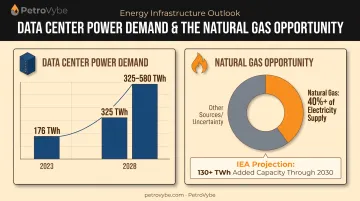
That demand is why domestic gas development matters for investors who want direct exposure—not only public energy equities.
PetroVybe is a private Texas-based natural gas development company that gives accredited investors direct access to early-stage E&P assets across the East Texas and Gulf Coast Basins. Instead of buying shares in a public oil company, partners participate in project economics through limited partnership units.
The structure includes:
- Tax deductions against active income (94% for 2025 partners). This treatment requires the investor to elect general partner status in the Subscription Agreement and may be limited in a given year by the excess business loss limitation under IRC §461(l). Prior result; not a promise of any future deduction.
- Targeted 10-year MOIC of roughly 2.2x–5.8x, with IRR near 26%
- Third-party engineering validation of reserves and reported performance
Direct participation carries real risk, including dry holes, commodity price swings, and project-specific delays. Figures above are projections, not guarantees. Investment is limited to accredited investors.
Frequently Asked Questions
What is an oil and gas exploration company?
An oil and gas exploration company is an upstream firm that searches for, evaluates, and drills for hydrocarbon reserves. That group includes supermajors, national oil companies, and independents—separate from midstream (transport) or downstream (refining) companies.
What is the difference between exploration and production?
Exploration is the search-and-discovery phase, using seismic data and test wells to find hydrocarbons. Production is the extraction-and-sale phase that follows once a discovery is developed into producing wells.
What are the main stages of oil and gas development?
Four core stages: exploration (finding prospects), well construction (drilling and completion), production (extraction and sale), and abandonment once reserves are depleted.
How risky is oil and gas exploration?
Exploration wells require large upfront capital, and dry holes are common. Risk depends heavily on the prospect, basin, and the operator’s technical track record.
Can individual investors get involved in oil and gas E&P?
Yes, but typically only accredited investors, through private development partnerships like PetroVybe rather than public company stock. Minimum capital and net worth requirements apply.
What technologies are used to reduce exploration risk?
Seismic imaging, AI-driven data analytics, and directional drilling all help operators target the most promising prospects and improve discovery odds, though none eliminate risk entirely.
Informational requests only. PetroVybe projects are offered solely to verified accredited investors. Submitting this form does not create an investment or advisory relationship.