Introduction
Choosing the wrong investment fund type is expensive in ways that don't show up immediately. The costs accumulate quietly—through tax drag, mismatched liquidity, or fees that erode returns before you see them. With mutual funds, ETFs, closed-end funds, hedge funds, and private placements all competing for investor attention, the options are genuinely confusing.
And the stakes matter. According to the ICI Investment Company Fact Book, US-registered investment companies held $33.9 trillion in net assets at year-end 2023 across 16,038 registered funds—a number that reflects just how many choices exist before you even reach the private markets.
Navigating that volume requires a clear framework. This guide covers each major fund type—what it is, who it's built for, and the tradeoffs that matter most when allocating capital:
- Mutual funds — pooled retail vehicles with daily liquidity
- ETFs — exchange-traded flexibility with tax efficiency advantages
- Closed-end funds — fixed-share structures that trade at premiums or discounts
- Hedge funds — active, often leveraged strategies for accredited investors
- Private placements — direct participation structures outside public markets
Key Takeaways
- Investment funds pool capital into diversified portfolios—but structure, liquidity, and eligibility vary widely across fund types.
- Public vehicles like mutual funds and ETFs are open to most investors; private structures require accredited status and unlock tax advantages no public fund can match.
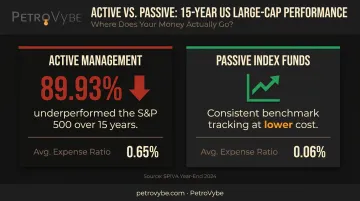
- 89.93% of actively managed US large-cap funds underperformed the S&P 500 over the 15 years ending December 2024.
- Accredited investors can access direct participation structures like oil and gas development, where IDC deductions apply against active income including W-2 earnings.
- Net after-tax return is the only comparison metric that matters—gross stated performance tells you little.
What Is an Investment Fund?
An investment fund is a pooled capital vehicle: multiple investors contribute money that is collectively managed to purchase a portfolio of assets—stocks, bonds, commodities, or other securities—under a stated objective and strategy. Investors own shares of the fund, not the underlying securities directly.
Fund managers (or passive algorithms) make buy and sell decisions on behalf of shareholders. Performance, fees, and tax treatment vary significantly depending on the fund's structure and management approach.
Why Fund Type Matters
Two investors can own funds with identical underlying holdings and end up with dramatically different net returns—purely because of structural differences in how gains are realized and distributed. Fund type determines:
- How shares are priced and traded (intraday vs. once daily at NAV)
- Who is eligible to invest (retail vs. accredited investors only)
- What fees apply (expense ratios, carried interest, performance fees)
- How gains are taxed—the variable that most investors underestimate when comparing funds
A fund with a lower stated return but superior tax treatment can outperform a higher-yielding alternative on an after-tax basis. That's why the comparisons that follow in this guide account for structure, not just headline returns.
Types of Investment Funds
Investment funds span a spectrum from broadly accessible public vehicles to restricted private structures. The right type is determined by your eligibility, goals, liquidity needs, and tax strategy—not familiarity.
Mutual Funds
Mutual funds are open-end investment vehicles priced once daily at net asset value (NAV). They come in dozens of sub-strategies: growth, income, balanced, target-date, money market—each optimized for a different investor outcome.
Who they suit: Everyday investors seeking professional management, diversification, and access through brokerage accounts or retirement plans (401(k), IRA). Low minimums and daily liquidity make them widely accessible.
The numbers:
- 8,582 mutual funds held $25.5 trillion in net assets at year-end 2023
- Average expense ratio: 0.65% for actively managed equity funds, 0.06% for index funds
- 45% of equity mutual-fund share classes distributed capital gains in 2023—taxable even if reinvested
Key limitations:
- No intraday trading—purchases and redemptions receive the next calculated NAV
- Capital gains distributions can trigger tax bills even when you haven't sold shares
- Long-term active management performance is poor: over 15 years, 89.93% of active US large-cap funds underperformed the S&P 500
Exchange-Traded Funds (ETFs) and Index Funds
ETFs trade on stock exchanges like individual stocks, priced in real time throughout the trading day. The majority are passively managed index funds tracking benchmarks like the S&P 500 or Nasdaq at significantly lower expense ratios than active mutual funds.
Who they suit: Cost-conscious, long-term investors seeking broad market exposure with minimal friction and strong tax efficiency.
The numbers:
- 3,304 US ETFs held $8.1 trillion in net assets at year-end 2023
- Average expense ratio: 0.15% for index equity ETFs
- In 2023, only 4.5% of ETFs distributed capital gains, compared to 23% of mutual funds
This structural advantage stems from ETFs' in-kind creation/redemption mechanism. When authorized participants redeem creation units using baskets of securities rather than cash, the ETF avoids realizing portfolio-level gains — a distinction documented by the SEC.
Key limitations:
- Full exposure to market-wide volatility with no active management buffer
- ETFs can briefly trade at a discount to NAV during stress periods—investment-grade bond ETFs reached discounts of 6-10% in March 2020
- No personalized tax structuring beyond account type
Closed-End Funds
Closed-end funds issue a fixed number of shares through an IPO and then trade on a stock exchange. Unlike mutual funds, no new shares are created when investors buy in—share price is driven by market supply and demand, which can diverge significantly from the fund's NAV.
Who they suit: More sophisticated investors comfortable analyzing NAV discounts as potential buying opportunities and willing to hold less liquid assets.
Key characteristics:
- 382 traditional closed-end funds with $249 billion in assets at year-end 2024
- Bond funds represent 60% of traditional CEF assets
- Average leverage: 28% overall (29% for bond funds, 26% for equity funds)
- Commonly hold municipal bonds, emerging market securities, and alternative income streams
Key limitations:
- Leverage amplifies both gains and losses
- The premium/discount dynamic adds complexity that most retail investors underestimate
- Liquidity can be thin for smaller or niche funds
Private and Alternative Investment Funds
Private and alternative investment vehicles — hedge funds, private equity funds, and direct private placements — operate with fewer regulatory constraints than public funds. Access is restricted to accredited investors under SEC Regulation D, Rule 501(a).
Qualification requires one of the following:
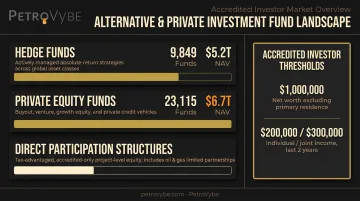
- Net worth above $1 million (excluding primary residence)
- Income above $200,000 individually / $300,000 jointly in each of the two preceding years
Who they suit: Accredited investors with longer time horizons, higher risk tolerance, and capital they don't need liquid for years.
The landscape:
- SEC Form PF data (Q2 2024) covered 9,849 hedge funds with $5.2 trillion NAV and 23,115 private equity funds with $6.7 trillion NAV
- Hedge fund fees have shifted from the historical "2-and-20" to roughly 1.35% management / 16% incentive on average
What direct participation structures offer that funds cannot: Some private structures — such as direct oil and gas development investments — carry tax advantages no fund wrapper can replicate. Intangible Drilling Cost (IDC) deductions offset active income including W-2 earnings and capital gains, not just passive income. That distinction eliminates the primary restriction that limits most real estate and fund-based alternatives.
PetroVybe's direct participation model in South Texas natural gas development illustrates the scale of this advantage. Partners in 2024 achieved 94% tax deductions against active income; 2025 partners achieved 91%. The deduction stack breaks down as:
- ~70% first-year IDC deduction (largest component)
- Depletion allowances layered on in subsequent years
- Operational deductions contributing additional offset
All of this flows through via K-1 directly to the partner — not through a fund-level tax document.
Key limitations:
- Higher minimum investments (PetroVybe requires $100,000 in liquidity)
- Capital may be locked up for years — plan for at least a 2-3 year hold before first distributions in development structures
- Complex due diligence requirements
- Not appropriate for capital you may need to redeem on short notice
How to Choose the Right Investment Fund Type
The right fund type is determined by individual circumstances—not by what's most marketed. Work through these factors before committing capital.
Clarify Your Investment Objective First
Different goals map to different structures:
| Goal | Fund Types to Consider |
|---|---|
| Capital growth | Growth mutual funds, broad index ETFs |
| Regular income | Income mutual funds, closed-end bond funds |
| Capital preservation | Money market funds, short-duration bond ETFs |
| Tax reduction + growth | Direct energy investments, private placements |
| Portfolio diversification | Closed-end funds, private equity, direct participation |
Assess Your Tax Situation Explicitly
Public fund types offer limited tax planning flexibility beyond choosing account type (IRA vs. taxable). The meaningful levers are:
- ETFs over mutual funds for lower capital gains distributions
- Tax-loss harvesting within taxable accounts
- Retirement account wrappers
Accredited investors with high active income or significant capital gains have an additional option: private structures that deliver deductions against income that no publicly traded fund can touch. The IDC deduction in oil and gas development—available through direct participation structures—is not restricted by passive activity loss rules. It applies to W-2 earnings and capital gains directly.
Evaluate Liquidity Requirements Honestly
Know what portion of your capital must stay accessible within 30-90 days versus what you can commit for 5-10 years.
- Short-term liquidity needs: Open-end structures only—mutual funds, ETFs, money market funds
- Medium-term capital: Closed-end funds or less liquid strategies
- Long-horizon capital: Private vehicles where reduced liquidity is the trade-off for higher return potential or tax advantages
Factor In Accredited Investor Status
Based on 2022 Survey of Consumer Finances data, the SEC estimated that 18.5% of US households met the accredited investor financial criteria. If you qualify, the additional fund universe is substantial.
Before pursuing private vehicles, confirm:
- You meet income or net worth thresholds (and can verify through a CPA, attorney, or licensed financial advisor)
- The minimum investment fits your overall allocation without concentrating too much in one illiquid position
- You have adequate liquidity elsewhere for life needs during the hold period
Weigh Management Fees Against Net Returns
| Fund Type | Typical Fee Structure |
|---|---|
| Index ETF | 0.03-0.20% expense ratio |
| Active mutual fund | 0.50-1.0%+ expense ratio |
| Closed-end fund | 1.0-1.5% + leverage costs |
| Hedge fund | ~1.35% management + ~16% incentive |
| Private placement | Varies—review the offering documents for full disclosure |
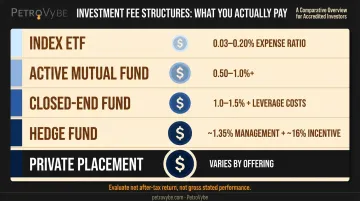
Justify higher fees only when the strategy delivers returns, tax advantages, or risk profiles that lower-cost alternatives cannot match. Use net-of-fee, after-tax return as your benchmark—not gross stated performance. That single standard cuts through most of the noise in fund selection.
What to Check Before Finalizing Your Investment Fund Choice
A few common mistakes worth avoiding:
Don't choose by familiarity. Defaulting to a mutual fund or ETF when a different structure better serves your tax or income goals is one of the most costly passive decisions an investor makes. Inertia isn't a strategy.
Look at the full cost picture. Expense ratios are only the starting point. Factor in:
- Tax drag from capital gains distributions (23% of mutual funds distributed gains in 2023)
- Redemption fees and trading costs
- For private vehicles: management fees, carried interest, and the cost of illiquidity itself
Verify independently before committing. For public funds, check independent performance ratings and audited data. For private placements, the SEC advises investors to request the broker's due diligence report—a broker recommending a Regulation D offering must independently review it, not rely solely on issuer representations.
That verification process is easier when operators build transparency into their structure from the start. PetroVybe, for example, makes a Data Drive available to prospective accredited investors that includes:
- Offering documents and 10-year proforma P&L statements
- Redacted K-1 samples and KYB/KYC compliance documentation
- Three independent reserve engineering reports, including the third-party verified $48 million proved reserves valuation (PV-09) for PetroVybe ONE
Operator licenses and API numbers are also publicly verifiable through the Texas Railroad Commission at rrc.texas.gov.
This goes well beyond what most Regulation D operators provide upfront. If a private placement operator can't or won't match this standard of documentation, treat that as a red flag before committing capital.
Conclusion
Investment funds span a wide spectrum—from broadly accessible mutual funds and ETFs to restricted private structures with significant tax advantages and return potential. Each type serves a distinct investor profile defined by goals, tax situation, time horizon, and eligibility.
The most important step is aligning fund type to your actual financial circumstances rather than defaulting to the familiar.
For accredited investors willing to look beyond public markets, direct participation structures—such as oil and gas development partnerships—occupy a distinct category. Because these vehicles pass Intangible Drilling Cost (IDC) deductions directly to partners, they can offset active income including W2 earnings and capital gains. Publicly traded funds are structurally unable to deliver that benefit. If heavy tax liability and long-term income generation are both priorities, that's the combination worth examining.
Frequently Asked Questions
What are the different types of investment funds?
The main categories are mutual funds (open-end, daily NAV pricing), ETFs (exchange-traded, real-time pricing), closed-end funds (fixed shares, exchange-traded), and private/alternative vehicles including hedge funds, private equity funds, and direct private placements. Each differs in structure, liquidity, management style, fees, and investor eligibility.
What is the difference between a mutual fund and an ETF?
Both pool investor capital into diversified portfolios, but ETFs trade on exchanges throughout the day at real-time prices while mutual funds price once daily at NAV. ETFs also typically carry lower expense ratios and generate far fewer taxable capital gains distributions—4.5% of ETFs distributed gains in 2023, compared to 23% of mutual funds.
What is the difference between actively managed and passively managed funds?
Actively managed funds employ professional managers making buy and sell decisions aiming to outperform a benchmark—at higher cost. Passively managed funds track an index with minimal human intervention and significantly lower expense ratios. Over 15 years, nearly 90% of active large-cap US funds trailed the S&P 500—a consistent pattern that favors passive strategies.
What are hedge funds and who can invest in them?
Hedge funds are lightly regulated private investment vehicles available only to accredited investors, using strategies—long/short equity, leverage, derivatives—unavailable in retail fund structures. High minimums and lock-up periods of one year or more are standard; the SEC reported the hedge fund universe held approximately $5.2 trillion in NAV as of Q2 2024.
How do I choose the right investment fund for my goals?
Align fund type with your objective (growth, income, tax reduction), time horizon, liquidity needs, accredited investor status, and fee sensitivity. Evaluate net after-tax returns—not gross stated performance—since private structures can offer tax advantages on active income that public funds cannot replicate.
Are there investment options for accredited investors that sit outside traditional fund structures?
Yes. Accredited investors can access direct private placements—including oil and gas development investments—where IDC deductions apply against active income including W-2 earnings and capital gains, an advantage that traditional fund structures like mutual funds or ETFs cannot replicate. These structures require longer hold periods but offer tax efficiency and return potential in a distinct category.