This article is general education, not investment, tax, or legal advice.
Introduction
The US now pumps more crude oil than any nation in recorded history. In 2025, production hit 13.6 million barrels per day, according to the Energy Information Administration, edging past the prior record set just one year earlier.
That volume is reshaping more than gas station prices. Record U.S. output now sits alongside surging electricity demand from AI data centers, and accredited investors are looking past index funds toward tangible energy assets they can own directly.
This article breaks down current production data, the states and basins driving output, what's fueling the growth, and how accredited investors are participating directly in the boom.
Key Takeaways
- US crude production hit a record 13.6 million barrels per day in 2025—the highest national total on record
- Texas, New Mexico, and the Permian Basin drive most U.S. output
- Fracking and horizontal drilling unlocked the reserves that made this boom possible
- Rising output strengthens energy security and creates tax-advantaged paths for direct upstream investment
How Much Crude Oil Does the US Produce Today?
America's 2025 output of 13.6 million barrels per day beat the previous record of 13.2 million b/d set in 2024. The record extends a climb that began after 2008, when domestic production hit a 40-year low of roughly 5 million barrels per day.
Shale technology reversed that decline entirely.
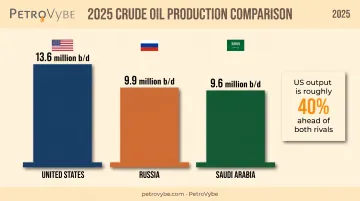
The US has led global production since 2018, when it overtook Russia. In 2025, the gap widened further:
- United States: 13.6 million b/d
- Russia: 9.9 million b/d
- Saudi Arabia: 9.6 million b/d
That puts US output roughly 40% ahead of both rivals, per EIA data.
Efficiency, Not Just Expansion
Rig counts actually fell in 2025. Lower-48 active rigs dropped 5%, yet crude production still climbed 3%. Longer laterals, better completions, and smarter drilling are doing more with less equipment.
On the import side, the US produces more crude than it consumes in gross terms, but still brings in specific grades that domestic refineries need for their processing mix. Net petroleum imports hit a record low in 2024, though the country isn't fully self-sufficient on a barrel-by-barrel basis.
Which States and Basins Lead Domestic Production
Top Producing States
Five states account for roughly 74% of all US crude production, based on 2024 EIA figures:
| State | Share of US Production |
|---|---|
| Texas | ~43% |
| New Mexico | ~15% |
| North Dakota | ~9% |
| Colorado | ~4% |
| Alaska | ~3% |
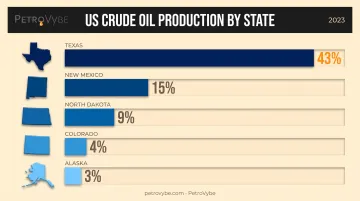
Texas dominates by a wide margin, with the Railroad Commission of Texas overseeing statewide oil and gas operations, including pipeline safety, drilling permits, and critical gas infrastructure enforcement.
Which US State Has the Most Untapped Oil?
The Permian Basin, spanning West Texas and southeastern New Mexico, supplied 48% of total US crude output in both 2024 and 2025. USGS estimates put undiscovered, technically recoverable oil in the Delaware Basin portion alone at a mean of 46.3 billion barrels, with the Midland Wolfcamp assessment adding another 20 billion barrels.
Because these formations straddle both states, no single state can claim exclusive rights to "most untapped oil." Texas and New Mexico share that title.
Beyond the Permian, the Gulf Coast Basin and Eagle Ford Shale remain major contributors. Eagle Ford natural gas output grew 10% since 2020 even as oil held near 1.1 million barrels per day. That corridor includes Lavaca County, Texas, where PetroVybe operates its south-central Texas footprint.
What's Driving the Production Boom
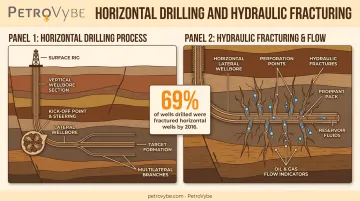
Two technologies made the US production boom possible:
- Horizontal drilling: lets operators access rock formations laterally across a single well pad, increasing reservoir contact.
- Hydraulic fracturing: cracks tight rock formations to release trapped hydrocarbons.
By 2016, hydraulically fractured horizontal wells made up 69% of wells drilled and 83% of total footage drilled nationally.
But drilling new wells isn't optional maintenance. Older horizontal wells lost 4.3 million barrels per day during 2024 alone, almost entirely offset by 4.4 million b/d from new wells. Production growth requires constant reinvestment, not a one-time drilling event.
The NGL Advantage
Crude isn't the only prize coming out of these wells. US associated natural gas production averaged 18.5 billion cubic feet per day in 2024, with the Permian contributing 12.5 Bcf/d alone.
Natural gas liquids extracted alongside crude often command premium pricing versus dry gas, which is why operators in liquids-rich plays tend to see stronger margins.
Why Rising Domestic Production Matters for Energy Security and Affordability
Domestic supply acts as a buffer against global disruptions. When Middle East conflicts threaten shipping lanes or OPEC+ cuts output, US producers can respond without waiting on foreign governments.
Oil drilling also feeds your electric bill. Natural gas tied to oil production supplied 42% of US electricity generation in 2024, and EIA forecasts it will remain near 40% in 2025. That link matters now:
- AI data centers are driving unprecedented electricity demand
- Grid operators need reliable, dispatchable power, not just intermittent sources
- Natural gas-fired generation fills that gap faster than most alternatives
Affordability shows up at the pump as well. Regular gasoline averaged $3.10 per gallon in 2025, down $0.21 from the prior year. EIA attributes the drop to lower crude prices and global oversupply concerns. Domestic output influences prices, but it still moves with world markets.
Is US Oil Production Sustainable Long-Term?
Forecasts diverge on timing, not on whether US oil stays in the mix.
One widely cited EIA outlook projected shale oil could peak near 10 million barrels per day around 2027.
The newer Annual Energy Outlook is more measured. Most 2050 scenarios land between 12.4 and 12.7 million b/d—roughly today's levels—with a slight dip in the early 2030s and renewed growth toward 2040.
Context that matters:
- A "peak" means a plateau with slower growth, not a collapse
- 2050 case ranges span 6.4 to 18.7 million b/d, driven by prices and drilling productivity
- Steep decline curves mean today's efficiency gains eventually hit diminishing returns
Nobody can pin the exact year growth flattens. What the outlooks do show: US production holds near current scale for decades under most scenarios.
Investing in America's Domestic Oil Boom
Record national production doesn't automatically mean every investment opportunity is a good one. But it does mean accredited investors now have a real alternative to publicly traded energy stocks: direct participation in development projects.
This is where PetroVybe operates. The company focuses on Natural Gas Liquids development across South Texas and the Gulf Coast Basin, positioning its wells to help meet the electricity demand surge tied to AI infrastructure growth.
What makes direct development different:
- Investors hold limited partnership units, not shares in a public company
- Returns come from actual well production, not stock price movement
- Tax treatment applies to the individual investor's income situation
The Tax Angle Most Investors Miss
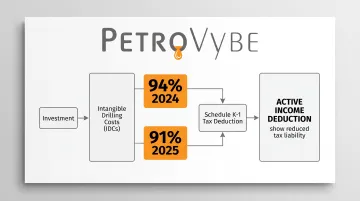
That partnership structure is also what unlocks the tax treatment most stock investors never see. Intangible Drilling Costs (IDCs) typically represent a first-year deduction target of approximately 70–80% of invested capital in a new drilling project. Unlike many deductions, IDCs aren't restricted to passive income—they can offset W-2 earnings and capital gains directly. This treatment requires the investor to elect general partner status in the Subscription Agreement and may be limited in a given year by the excess business loss limitation under IRC §461(l).
PetroVybe partners reported a 94% first-year tax deduction against active income in 2025, followed by a in 2025. Prior result; not a promise of any future deduction. That deduction flows through a Schedule K-1 and can be taken in year one or spread across five years.
Why Technical Validation Matters
Before committing capital, investors should ask who's validating the reserves and who's running operations. PetroVybe's project includes:
- An independent 2025 audit from Weaver
- A third-party engineered reserve valuation of $48 million on a PV-09 basis. Prepared by Lee Keeling & Associates, Tulsa, March 2026.
- Leadership including a Chief Geophysicist with a 48-year track record and a COO who scaled a $5 billion asset to 35,000 BOEPD over eight years
None of this eliminates risk. Direct development still carries geology, operator, and commodity-price exposure that public energy stocks don't package the same way. For accredited investors weighing a K-1 partnership against a mutual fund of energy tickers, the comparison is production economics and tax treatment—not share-price momentum.
Frequently Asked Questions
What percent of US oil is domestically produced?
The US leads the world at 13.6 million barrels per day in 2025 and is a net petroleum exporter, so most supply is met at home. Refineries still import specific crude grades they need, which means production leadership is not the same as 100% self-sufficiency.
Which US state has the most untapped oil?
Texas and New Mexico share this distinction through the Permian Basin, which straddles both states. USGS estimates place undiscovered recoverable oil in the Delaware Basin portion alone above 46 billion barrels.
Why has US oil production grown despite fewer active rigs?
Longer horizontal laterals, improved completion techniques, and automation let operators extract more oil per well. Lower-48 rigs fell 5% in 2025 while crude output still rose 3%.
Is US oil production expected to peak soon?
One EIA forecast suggested a shale peak near 2027, but newer outlooks point to a plateau near current levels through 2050 rather than a sharp decline.
How does domestic oil production affect gas prices?
Higher domestic supply generally pushes prices down when it outpaces demand growth. Gasoline averaged $3.10 per gallon in 2025, roughly 21 cents lower than the prior year.
Can everyday investors get involved in domestic oil and gas production?
Direct development partnerships like PetroVybe's are limited to accredited investors under SEC rules. Eligible investors can participate through limited partnership units with tax-advantaged structures tied to active income.
Informational requests only. PetroVybe projects are offered solely to verified accredited investors. Submitting this form does not create an investment or advisory relationship.