

Introduction
Every year, the IRS reports a $696 billion gross tax gap, with a voluntary compliance rate of just 85%, according to IRS tax gap data.
That figure measures unpaid taxes, not overpayment. But it signals a deeper problem: a tax code so complex that most high earners never claim every deduction legally available to them.
Even a modest 5-10% in avoidable taxes, left unaddressed, compounds fast. Over a decade, that's tens or hundreds of thousands of dollars in lost investable capital, delayed retirement dates, or a smaller legacy for your kids.
This guide breaks tax minimization into three layers: the financial decisions you make before income hits your account, how you manage your portfolio afterward, and the structural choice of what you actually invest in.
TL;DR
- Tax liability builds through withholding, quarterly payments, and capital gains events
- Income type, filing status, and asset-sale timing drive your effective rate
- Strategies fall into three buckets: pre-income moves, ongoing management, and vehicle selection
- W2 earners with capital gains often have fewer deductions than active industry investors
- Always validate strategies with a qualified tax and financial advisor
How Tax Liability Typically Builds Up
Tax liability isn't a single bill that shows up in April. It accumulates continuously through paycheck withholding, quarterly estimated payments, and capital gains realized throughout the year.
That accumulation compounds in ways most taxpayers don't see coming. As W2 income rises, earners get pushed into higher marginal brackets. At the same time, surtaxes like the 3.8% Net Investment Income Tax (NIIT) kick in at fixed thresholds, according to the IRS's NIIT guidance.
Here's the catch: NIIT thresholds ($200,000 single, $250,000 married filing jointly) are not indexed for inflation. More taxpayers cross them every year simply because nominal income rises, even when real purchasing power stays flat.
Much of this stays invisible until tax season, when several factors surface at once:
- Bracket creep pushes rising W2 income into higher tax tiers
- Phased-out deductions shrink available write-offs as income climbs
- Missed contribution deadlines forfeit tax-advantaged savings opportunities
Together, these factors turn what felt like a manageable year into a surprisingly high bill.

Key Drivers of a High Tax Burden
Three factors determine how much of your income the IRS keeps.
Income composition matters most. Active W2 or business income is taxed at ordinary rates up to 37%. Passive or portfolio income, by contrast, can access preferential capital gains rates or specific deductions unavailable to salaried earners.
Timing plays a major role, including:
- When income is recognized (this tax year vs. next)
- When losses are harvested against gains
- How long an asset is held before sale (short-term vs. long-term treatment)
Account structure changes your effective rate on the same dollar of return. Whether savings sit in a taxable brokerage account, a tax-deferred 401(k), or a tax-exempt Roth IRA fundamentally changes what you keep.
Here's the uncomfortable truth for high-income W2 earners: with limited itemized deductions and income taxed at the top of the bracket, they typically have the fewest levers available. That's exactly why deductions tied to active-income-eligible investments become disproportionately valuable for this group.
Tax Minimization Strategies
Effective tax minimization requires layering strategies across three levels: decisions made in advance, ongoing account management, and the structural choice of what you invest in. Most people only address the first layer. The other two are where meaningful savings often hide.
Strategies That Change Financial Decisions
These moves happen before or at the moment income is earned:
- Max out 401(k), IRA, and HSA contributions before deadlines to shelter income at the source
- Time asset sales to qualify for long-term capital gains rates instead of short-term ordinary rates
- Bunch charitable contributions into a single year (or use a donor-advised fund) to clear the itemization threshold
- Elect pass-through entity tax treatment where available, to work around the individual SALT deduction cap
- Defer bonus income or RSU vesting into a lower-income year, where plan rules allow
Note: RSUs generally can't use an 83(b) election since they're an unfunded promise, not transferred property. Deferral elections for bonuses typically must be arranged before the service year under Section 409A rules.
Strategies That Change How Investments Are Managed
Once income is earned and invested, ongoing management determines how much tax drag you carry:
- Tax-loss harvesting year-round to offset realized gains and up to $3,000 of ordinary income annually
- Asset location, holding tax-inefficient assets (bonds, high-turnover funds) in tax-deferred accounts and tax-efficient assets in taxable ones
- Partial Roth conversions in lower-income years to shrink future required minimum distributions (RMDs)
- Qualified charitable distributions (QCDs) from IRAs after age 70½, satisfying RMDs without adding to taxable income
- Watching wash-sale rules carefully so harvested losses stay deductible
Strategies That Change the Investment Vehicle Itself
This is where the biggest, and most overlooked, tax advantages live. Instead of managing what you already hold, you choose asset classes engineered with built-in deductions from day one.
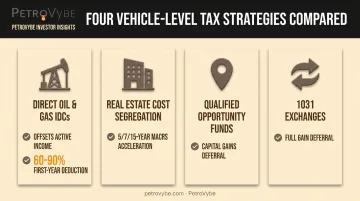
**Direct oil and natural gas development** is the clearest example. Under Section 263(c), investors with a working interest in a qualifying well can elect to expense Intangible Drilling Costs (IDCs) rather than capitalize them. Historically, the industry association IPAA has estimated that IDCs represent 60-80% of total well costs, according to IPAA's cost breakdown.
What makes this different from nearly every other deduction: for qualifying working-interest holders, IDC deductions are not restricted to passive income. That means they can offset active W2 wages and capital gains directly, not just passive rental income the way real estate losses typically do.
This is the specific gap PetroVybe was built around. Through its PetroVybe ONE partnership, structured for accredited investors under SEC Regulation D 506(c), partners have historically received substantial first-year deductions:
| Year | First-Year IDC Deduction Against Active Income |
|---|---|
| 2024 | 94% |
| 2025 | 91% |
On a $100,000 investment, that's a $91,000-$94,000 deduction flowing through a K-1, applicable to W2 income or capital gains in the year it's incurred, or spread over five years if that suits the investor's planning better.
Other vehicle-level strategies worth knowing:
- Real estate cost segregation, which separates qualifying property into 5-, 7-, or 15-year MACRS classes instead of the standard 27.5- or 39-year schedules, unlocking bonus depreciation faster
- Qualified Opportunity Funds, which defer (and can reduce) capital gains tax when realized gains are reinvested into designated economic zones
- 1031 exchanges, which roll real estate gains into a replacement property, deferring the tax bill entirely until the new property is eventually sold
Vehicle-level strategies require accredited investor status or specialized structuring. Before committing capital anywhere, verify the underlying asset through independent reserve reports, audited financials, or third-party engineering review.
PetroVybe's own asset base, for instance, carries a $48 million PV-09 reserve valuation from a licensed third-party engineering firm, backed by a clean 2025 audit. That's the level of documentation any serious due diligence process should demand.
Conclusion
Minimizing taxes means aligning three layers at once: the decisions you make before income arrives, how you manage what you already hold, and which vehicles you choose to put new capital into. No single maneuver accomplishes this alone.
Most high-income earners have already maxed out layer one.
Fewer have explored layer three, where deductions like IDCs from direct energy development (the kind PetroVybe structures for accredited investors) can offset active income in ways a 401(k) simply can't.
Work with both a tax professional and a financial advisor to identify which layer holds the most unused opportunity for your situation. Act on it before the tax year closes, not after.
Frequently Asked Questions
What is a tax minimization strategy?
It's any legal method used to reduce taxable income or overall tax liability. This ranges from deductions and credits to account structuring and specific investment vehicle choices.
What is the best way to minimize taxes?
There's no single "best" way. The most effective approach combines maximizing available deductions with careful timing of income and gains, then layering in tax-advantaged vehicles suited to your income type.
What is the $600 rule?
This refers to an IRS reporting threshold for platforms like payment apps issuing Form 1099-K. Under current law, the federal threshold reverted to more than $20,000 and 200 transactions, and it affects income reporting, not deduction strategy.
How can high-income W2 earners reduce their taxes?
They benefit most from maxing out retirement and HSA contributions while timing capital gains around long-term thresholds. Active-income-eligible deductions, such as those from direct energy development investments, offer another lever.
Is tax minimization legal?
Yes. Tax minimization, or avoidance, is fully legal when it uses IRS-sanctioned deductions and credits. It's distinct from tax evasion, which involves concealing income or falsifying deductions, and is illegal.
Can alternative investments like oil and gas development reduce taxable income?
Yes. IDC deductions from qualifying oil and gas development partnerships can offset a significant percentage of active income in the first year. This tool is available to accredited investors and isn't something standard portfolio strategies can replicate.