These pressures are colliding in 2026, and oil and gas investing sits right at the intersection. Global data-center electricity use jumped 17% in 2025 alone, and the International Energy Agency projects that consumption will roughly double by 2030 as AI workloads scale up. A meaningful share of that growth runs on natural gas.
"Investing in oil and gas" isn't one decision. It ranges from buying a single ETF share for under $60 to committing six figures to a private drilling partnership with a decade-long hold. Returns, risk, and tax treatment vary enormously depending on the path you pick.
This guide covers the step-by-step process, the real vehicles available, what drives returns, who this fits, and the mistakes that sink new investors before they start.
Key Takeaways
- Oil and gas investing ranges from liquid stocks and ETFs to illiquid mineral rights and private partnerships
- OPEC+ decisions, geopolitical risk, and AI-driven gas demand will shape 2026 returns across every vehicle
- Direct drilling participation unlocks tax deductions that public stocks and ETFs can't offer, up to 90%+ against active income
- The right vehicle depends on your goals, liquidity needs, and accredited status - not the "best" stock pick
How to Invest in Oil and Gas in 2026: A Step-by-Step Process
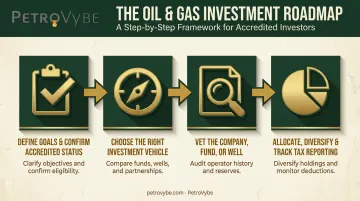
Step 1: Define Your Goals and Confirm Investor Status
Before you deploy a dollar, get specific about what you actually want:
- Passive income - regular cash distributions from royalties, working interests, or partnership units
- Tax deduction - offsetting active income (W-2 wages, capital gains) through drilling-related write-offs
- Long-term appreciation - riding equity value or asset growth over years
- Short-term trading gains - capitalizing on commodity price swings
If private funds, working interests, or development partnerships are on your radar, confirm accredited investor status first. Under SEC rules, that means net worth above $1 million (excluding your primary residence) or income above $200,000 individually ($300,000 jointly) in each of the prior two years.
Most of these offerings are SEC-restricted, and issuers must verify your status through a third party, not just a self-certification checkbox.
Step 2: Choose the Right Investment Vehicle
Your risk tolerance and available capital should drive this decision, not the other way around. Conservative investors often gravitate toward ETFs. Investors prioritizing tax efficiency tend to look at direct drilling participation instead.
Entry points differ wildly:
| Vehicle | Typical Minimum |
|---|---|
| Energy sector ETF (such as XLE) | ~$59 per share |
| Diversified energy ETF (such as VDE) | ~$163 per share |
| Private oil and gas fund | $5,000-$10,000+ |
| Direct development partnership unit | $100,000+ (accredited only) |
There's no universal "right" minimum. There's only the right fit for your liquidity and goals.
Step 3: Vet the Company, Fund, or Well/Prospect
This is where most losses happen, and it's entirely avoidable with basic homework:
- Pull the operator's production history and any independent reserve reports (a licensed third-party engineering firm should have validated the numbers)
- Verify state operator licensing - in Texas, that means checking the Railroad Commission database directly
- Look for a management track record with specific, sourced numbers (not vague claims)
- Check third-party investor review platforms like Invest Clearly for verified, dated feedback
A geophysicist's historical well-selection success rate matters more than most investors realize. Industry averages hover below 40%; ask any operator for their supportable number before writing a check.
Step 4: Allocate, Diversify, and Track Tax Reporting
Never concentrate capital in a single well, stock, or prospect. Spread exposure across multiple wells, geographies, or a fund basket instead. One dry hole shouldn't determine your entire return.
Work with a tax professional every year, not just at filing time, to apply deductions like:
- Percentage depletion (up to 15% for qualifying independent producers)
- Intangible Drilling Costs (IDCs), which can be expensed in the year incurred if elected properly
- Tangible Drilling Costs (TDCs) - equipment and tangible asset costs, typically depreciated over the applicable schedule
These rules carry real limits around taxable income, basis, and at-risk amounts, so annual planning beats guesswork.
Ways to Invest in Oil and Gas in 2026
There's no single "best" vehicle. Each one below carries a distinct liquidity, risk, and tax profile.
Oil and Gas Stocks and ETFs
Major integrated producers like ExxonMobil and Chevron, or diversified funds like XLE and VDE, offer liquidity and low barriers to entry. XLE holds just 21 positions with ExxonMobil and Chevron making up over a third of the fund, while VDE spreads across 111 stocks for broader diversification.
This route suits investors wanting market exposure without operational headaches, though returns still track broader commodity and equity sentiment.
Mineral Rights and Royalty Interests
Owning mineral rights entitles you to a share of production revenue without covering drilling or operating costs. That sounds like free money, but it isn't risk-free. Value depends heavily on:
- Decline curves and reserve estimates specific to the basin
- Title and lease terms
- Operator activity levels on the acreage
A royalty is cost-free, not production-risk-free.
Working Interests in Oil and Gas Wells
A working interest gives you a direct stake in a well's production and profits, but also liability for a proportional share of drilling and operating expenses. This is high-risk, high-reward territory. The SEC has specifically warned that private oil and gas offerings can involve limited disclosure, cost overruns, and total loss of principal. Generally not recommended without deep technical or industry expertise.
Private Oil and Gas Development Partnerships
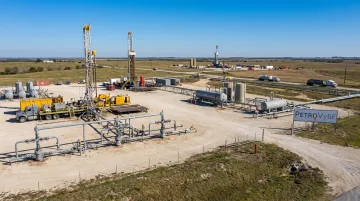
These are pooled-capital vehicles, typically limited to accredited investors, that fund drilling and development on specific projects. Firms like PetroVybe give accredited investors direct entry into natural gas development in South Texas' Gulf Coast Basin, pairing professional operational management with substantial first-year tax deductions against active income.
PetroVybe's flagship project operates roughly 400 acquired wells across 58,000 acres in Lavaca County, backed by a $48 million third-party engineered reserves valuation and a clean independent audit. Partners saw 94% deductions against active income in 2024 and 91% in 2025.
Before committing capital to any partnership like this, evaluate:
- The operator's technical leadership and documented track record
- Independent reserve validation from a licensed engineering firm
- State operator licensing (verifiable through public regulatory databases)
- Third-party investor reviews with verified accreditation status
Master Limited Partnerships (MLPs) and Midstream
Publicly traded pipeline and midstream partnerships offer steadier distributions than upstream producers, since pipeline revenue doesn't depend as directly on commodity price swings. MLPs pass profits through to partners rather than paying entity-level tax, but that convenience comes with K-1 reporting complexity and basis tracking that trips up a lot of first-time investors.
Oil Futures and Options
Direct commodity exposure for experienced traders chasing short-term price moves. Standard WTI contracts represent 1,000 barrels; standard Henry Hub natural gas contracts represent 10,000 MMBtu. Margin requirements vary with volatility and are never a cap on your maximum possible loss. This lane requires a margin account and a genuinely high risk tolerance: it's not a starter vehicle.
Key Factors That Affect Your Oil and Gas Investment Returns
Outcomes on every vehicle above depend heavily on the same underlying variables.
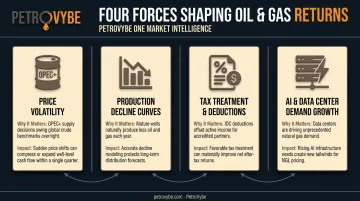
Oil and Gas Price Volatility
Why it matters: Prices move on OPEC+ supply decisions, geopolitical tension, and shifting global demand. In July 2026, participating OPEC+ countries announced a 188,000 barrel-per-day production adjustment for August, while retaining authority to pause or reverse course as conditions shift.
Impact: This directly affects royalty income, stock valuations, and the economics of any active well. Stress-test your assumptions against policy reversals, not just a single forecast.
Production Decline Curves
Why it matters: Well output typically drops sharply after an initial production peak, then flattens out over years.
Impact: Overestimating long-term output can inflate expected returns for royalty and working interest investors. The specific decline curve, production history, and terminal-decline assumption used matter enormously. A basin-wide average won't tell you much about one specific well.
Tax Treatment and Available Deductions
Why it matters: IDC and depletion deductions can offset a large share of active income, but only certain vehicles qualify, and there's no automatic industry-wide percentage.
Impact: IRS guidance allows an election to expense qualifying IDCs, subject to basis, at-risk, and passive-loss limits. Structures matter here. PetroVybe's partners, for example, have documented deductions in the 90%+ range against active income in both 2024 and 2025. That's a materially different outcome than a passive ETF position could ever generate, since ETF gains don't come with drilling-cost deductions attached.
AI and Data Center-Driven Demand Growth
Why it matters: Rising electricity demand from AI and data centers is increasing natural gas consumption for power generation, since gas already supplies close to half of U.S. grid electricity.
Impact: The U.S. Energy Information Administration forecasts electric-power-sector gas use climbing roughly 4% in 2027 versus 2026, and some developers are now building onsite gas generation to bypass grid bottlenecks entirely. This trend supports natural gas pricing and development economics, but it's a demand tailwind, not a guaranteed return. Project-specific execution still decides outcomes.
Is Investing in Oil and Gas Right for You in 2026?
Oil and gas investing isn't universally suitable. It fits investors with specific risk tolerance, tax planning needs, or diversification goals, not everyone.
Typical fit:
- High-income W-2 earners looking to offset a heavy tax burden
- Investors holding capital gains who want tax-efficient placement
- Anyone seeking inflation-hedged passive income beyond the usual stocks, bonds, and real estate mix
- Investors with $100,000+ in liquidity comfortable with multi-year hold periods
Poor fit:
- Needing high liquidity on short notice
- Lacking the risk tolerance for commodity price cycles
- Unable to wait multiple years before distributions begin
- Unwilling to complete operator-level due diligence before committing funds
If you fall into the first group, your next step is choosing which vehicle matches your specific goals.
Common Mistakes to Avoid When Investing in Oil and Gas
Most losses in this space trace back to a handful of avoidable errors:
- Skipping due diligence on an operator's track record, reserve reports, or state licensing before committing capital
- Ignoring production decline curves and overestimating long-term royalty or working interest income
- Concentrating risk in a single well, stock, or prospect instead of diversifying across wells, geographies, or vehicles
- Neglecting tax planning by skipping professional guidance and missing structured deductions like IDCs and depletion that could materially change your after-tax return
None of these mistakes require industry expertise to avoid. They just require slowing down before you wire money.
Frequently Asked Questions
Is investing in oil and gas a good idea?
It can be a strong diversification and tax-efficiency tool for the right investor profile. Success depends heavily on vehicle choice, due diligence, and your personal risk tolerance.
What are the best oil and gas stocks to invest in?
Widely covered large-cap names include ExxonMobil and Chevron, both integrated producers with upstream and downstream operations. "Best" really depends on your risk appetite and desired exposure - upstream, midstream, or integrated.
Does Warren Buffett invest in oil and gas?
Yes. Berkshire Hathaway's 2025 annual report confirms material public equity stakes in Occidental Petroleum and Chevron. These are long-held, disclosed positions, not speculative trades.
How much money do I need to start investing in oil and gas?
Public stocks and ETFs can start with the cost of one share, often under $200. Private partnerships, like PetroVybe's oil and gas development units, typically require accredited investor status and minimums around $100,000.
What is the safest way to invest in oil and gas in 2026?
Diversified ETFs and mutual funds are considered lower-risk than single wells, working interests, or futures trading, since they spread exposure across dozens of companies. They're still not free of commodity or sector risk.
Can non-accredited investors participate in private oil and gas deals?
Most private development partnerships and funds are restricted to accredited investors under SEC rules. Public stocks, ETFs, and some mineral rights listings remain open to all investors regardless of accreditation status.