That step belongs to petroleum exploration and production (E&P) companies. They're the businesses that find hydrocarbons underground, drill for them, and pull them out of the earth. Everything else in the energy supply chain, pipelines, refineries, retail, depends on what E&P companies do first.
This guide breaks down what E&P companies actually do, the four phases of their work, what separates strong operators from weak ones, and why accredited investors are paying closer attention to this sector.
Key Takeaways
- E&P companies operate upstream, locating and extracting hydrocarbons before transport or refining begins.
- The E&P lifecycle runs through four phases: exploration, well construction, extraction, and abandonment.
- Geological expertise and disciplined capital management separate profitable operators from those drilling dry holes.
- Accredited investors can access E&P projects directly for tax efficiency, portfolio diversification, and passive income.
What Is a Petroleum Exploration and Production Company?
A petroleum exploration and production company searches for, drills, and extracts crude oil and natural gas reserves. It's the business that does the work before oil or gas ever touches a pipeline, refinery, or retail pump.
The American Petroleum Institute captures this early-stage role in its industry segmentation: Upstream, Natural Gas Markets, Midstream, Downstream, and Service, Supply, and Technology. E&P companies fall squarely into Upstream, the segment covering the search for and production of crude oil and natural gas.
Operationally, E&P work spans a wide range of activities:
- Land surveys and lease acquisition
- Geological and seismic analysis
- Drilling and well construction
- Active production and extraction
- Well abandonment once reserves are depleted
E&P companies aren't a single archetype. The sector spans multiple company types, each operating at a different scale:
- Supermajors like ExxonMobil, with integrated global operations
- National oil companies, often state-owned and tied to sovereign reserves
- Independent developers, who specialize in specific basins or plays
A company focused exclusively on the Gulf Coast Basin operates very differently than a multinational with assets on four continents, but both fall under the E&P umbrella.
Despite these differences in scale, every E&P company shares the same core function: creating value at the very start of the oil and gas chain. Reserves must be discovered and proven before a single drop moves through a pipeline or a refinery processes anything. Get the exploration and production stage wrong, and there's nothing downstream to sell.
The Core Phases of E&P Operations
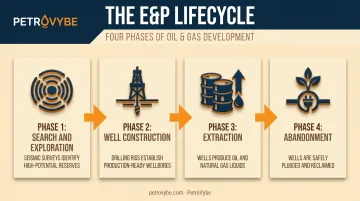
E&P work follows a predictable lifecycle, even though timelines and technology vary by project. Four phases define it: exploration, well construction, extraction, and abandonment.
Search and Exploration
Before anyone drills, geologists study rock formations and land surveys to estimate where oil and gas reserves might sit and how large they could be. Seismology plays a central role here: engineers send vibrations or seismic waves into the ground and analyze how they bounce back to map subsurface structures.
Three-dimensional seismic data has reduced uncertainty compared to decades past, but it doesn't eliminate risk entirely. An exploratory well is still required to confirm hydrocarbons actually exist in commercially viable quantities. This is the phase where geological expertise pays off, or costs a company millions in dry holes.
Well Construction
Once a prospect looks promising, engineers move into well construction. This involves:
- Drilling the wellbore to the target depth and formation
- Inserting steel casing to stabilize the well and prevent contamination
- Sampling core to verify reservoir characteristics
- Determining well count and layout, whether onshore or offshore
Engineers also decide extraction methods and platform placement during this phase, factoring in reservoir pressure, depth, and terrain.
Extraction
Extraction is where oil and gas actually come out of the ground. Depending on the site, product gets processed on location or transported by pipeline to a refinery for further handling.
Horizontal drilling has transformed this phase. The EIA reports that horizontal wells produced 94% of Lower-48 crude oil and 92% of Lower-48 natural gas as of December 2024, compared to traditional vertical wells.
The tradeoff: horizontal wells typically see initial output decline by 50% to 75% in their first year. This means continued capital investment is often necessary to sustain production.
Abandonment of Wells
Once a well's reserves run dry, it isn't simply abandoned. Operators plug and seal the well, then restore the surrounding site to protect groundwater and surrounding land.
In Texas, this process is governed by Statewide Rule 14 for plugging and Rule 15 for inactive wells. Financial assurance requirements are built in to make sure the liability doesn't fall on taxpayers.
Upstream vs. Midstream vs. Downstream: Where E&P Fits
E&P companies operate exclusively in the upstream segment. Two other segments handle everything that happens after oil and gas leave the ground.
| Segment | What It Does | Relationship to E&P |
|---|---|---|
| Upstream (E&P) | Locates, drills, and extracts oil and gas | The starting point |
| Midstream | Gathers, processes, transports, and stores hydrocarbons | Receives product from E&P via pipeline |
| Downstream | Refines crude and markets finished products | Sells the end product to consumers |
Once oil or gas is extracted and processed at the wellsite, E&P companies typically hand production off to midstream partners for transport via pipeline. From there, downstream companies refine crude into gasoline, diesel, and other products, or process natural gas into usable fuel.
Within the upstream segment, not all production is equal. Some E&P companies, particularly natural gas developers, focus specifically on Natural Gas Liquids (NGLs) rather than standard dry gas. NGLs command premium pricing compared to dry gas, meaning a liquids-weighted production mix can generate higher margins per unit produced.
That pricing spread isn't fixed. It moves with the market, but it's a real and recurring advantage for operators positioned to capture it. PetroVybe's south-central Texas wells are developed specifically around this liquids premium, targeting NGL-rich formations rather than standard dry gas plays.
What Separates a Successful E&P Company From the Rest
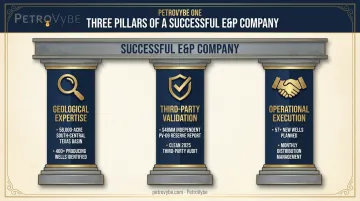
Not every E&P company performs the same. Some drill wells that produce for decades. Others drill dry holes and burn through investor capital. The difference usually comes down to three things: geological expertise, third-party validation, and disciplined execution.
Geological Expertise Is the Biggest Differentiator
Site selection determines whether a prospect becomes profitable or becomes a write-off. Poor geological analysis leads directly to dry or underperforming wells. No amount of drilling technology fixes a well drilled in the wrong spot.
PetroVybe, a private Texas-based E&P developer, illustrates this well. Its Chief Geophysicist, Michael Stamatedes, has a 48-year track record in the industry and a documented 75.2% well success rate, compared to an industry peer average that PetroVybe cites as hovering below 40%.
A former geology leader at ExxonMobil, Stamatedes has led exploration work resulting in over 3 trillion cubic feet of natural gas discoveries. This is a career-long, verifiable record that any serious geophysicist should be able to substantiate.
Third-Party Validation Builds Confidence
Independent reserve reports matter because they remove the guesswork (and the bias) from asset valuations. PetroVybe, for example, uses licensed third-party engineering firms to produce reserve valuations, including a $48 million PV-9 proved reserves valuation for its South Texas project. That kind of independent review gives investors a way to verify claims without relying solely on the operator's own numbers.
Operational Execution and Deal Sourcing Matter
Off-market acquisition relationships give some operators a real edge. PetroVybe's President and COO, Blaine Yeary, scaled a $5 billion asset from zero to 35,000 BOEPD over eight years, a track record built on deep relationships with landowners, operators, and industry insiders.
Access to off-market deals, rather than competitive auctions, typically means better pricing and less competition at the point of acquisition. Combined with disciplined financial modeling, this is what separates operators who scale responsibly from those who overextend.
Why Accredited Investors Are Turning to E&P Development Projects
Direct participation in E&P development offers a different risk and reward profile than buying oil and gas stocks. A few structural advantages explain the growing interest.
The Tax Mechanics Are Genuinely Unique
Intangible Drilling Costs (IDCs), things like wages, fuel, and supplies used in drilling and preparing a well, can often be deducted under IRC 263(c).
What makes this compelling for high-income investors is that a qualifying working interest held without limited liability is treated as nonpassive income under IRS Publication 925. That classification means IDC deductions can offset active income, including W-2 earnings and capital gains, not just passive income like most other investment vehicles allow.
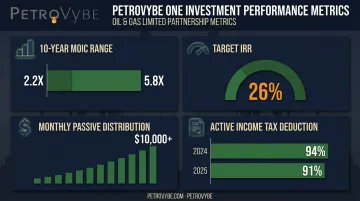
PetroVybe partners, for example, received a 94% tax deduction against active income in 2024 and a 91% deduction in 2025. These figures are entity- and structure-specific: basis limits, at-risk rules, and AMT calculations still apply, so investors should always confirm treatment with a CPA before assuming a deduction applies to their situation.
Direct Participation Puts Investors at the Entry Point
Buying an energy stock gives exposure to a company's overall performance, dividends, share price, market sentiment. Direct participation in E&P development is different. Investors are exposed to the actual value-creation process: locating reserves, drilling wells, and generating production revenue.
PetroVybe structures this through investment partnership units, with a $100,000 minimum investment and mandatory accredited investor verification under SEC Regulation D 506(c).
The projected returns illustrate the scale of opportunity:
- Targets a 10-year MOIC range of approximately 2.2x to 5.8x
- Aims for an IRR near 26%
- Projects monthly passive distributions peaking above $10,000 per unit during peak production
- Concentrates operations across roughly 400 producing wells and 57+ planned new wells on a 58,000-acre basin in Lavaca County, Texas
Transparency Reduces the Guesswork
PetroVybe backs its offering with independent reviews on Invest Clearly, a clean 2025 audit from Weaver, and licensed third-party engineering reports, giving prospective investors multiple channels to verify claims before committing capital. For accredited investors looking to diversify beyond stocks, bonds, and real estate, that layer of independent verification is often what separates a credible opportunity from a risky one.
Frequently Asked Questions
What does a petroleum exploration and production company do?
E&P companies search for, drill, and extract oil and natural gas reserves. They operate in the upstream segment of the energy industry, handling everything before oil or gas reaches midstream transport or downstream refining.
What is the difference between exploration and production in oil and gas?
Exploration involves locating potential reserves through land surveys, geological studies, and seismic analysis. Production involves the actual drilling and extraction of hydrocarbons once reserves are confirmed to be commercially viable.
Is exploration and production considered upstream or downstream?
E&P is entirely upstream. Midstream handles transportation and storage, while downstream covers refining and marketing. Both are distinct stages that happen after E&P companies finish their work.
What are the 3 stages of the oil and gas industry?
The three stages are upstream (exploring and extracting), midstream (transporting and storing), and downstream (refining and marketing to consumers).
What skills or resources does an E&P company need to succeed?
Success depends on strong geological and geophysical expertise, access to drilling technology, disciplined capital management, and independent third-party validation of reserves and financials.
Can accredited investors participate directly in E&P projects?
Yes. Private developers like PetroVybe offer accredited investors direct participation in E&P projects through limited partnership units, often with active-income tax deductions and long-term passive income potential.