
Introduction
Most investors focus on returns and overlook what actually lands in their pocket after taxes.
You can pick the perfect fund and time the market well, and still watch 20% to 40% of your gains disappear into federal, state, and capital gains taxes without the right structure.
Tax-efficient investing isn't just fund selection. It spans account type, timing, asset location, and, for high earners, alternative asset classes that offset active income in ways mutual funds never can.
This guide covers the traditional playbook: asset location, loss harvesting, tax-advantaged accounts, and charitable strategies. Then it covers something most financial blogs skip entirely: a strategy high-income earners use to directly cut taxes on W-2 wages and business income, not just investment gains.
Key Takeaways
- Unmanaged taxes can erode a meaningful share of your annual investment returns
- Account type (taxable vs. tax-advantaged) matters as much as asset selection
- Loss harvesting and municipal bonds reduce taxes on investment income, not active income
- High earners with W-2 or business income need strategies like IDC deductions from energy development projects
- Real tax efficiency combines account strategy, asset selection, and legacy planning
Why Taxes Quietly Erode Your Investment Returns
Every year you hold investments in a taxable account, you're paying a toll. Financial analysts call it tax drag — the gap between your pretax return and what actually lands in your pocket.
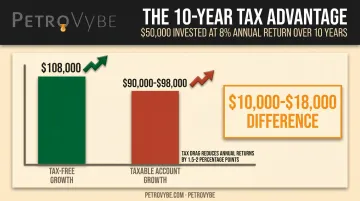
Consider $50,000 invested for 10 years at an 8% annual return. Grown tax-free, it becomes roughly $108,000.
Now knock 1.5 to 2 percentage points off that annual return for taxes on dividends, interest, and capital gains distributions. Your ending balance drops to somewhere between $90,000 and $98,000, a difference of $10,000 to $18,000, and that's before you've sold a single share.
This isn't hypothetical. Russell Investments' analysis found that the average U.S. equity fund carries a tax drag of roughly 2.0% annually, enough to cut a hypothetical 10% pretax return down to about 8%. Compounded over decades, that difference is the gap between a comfortable retirement and a great one.
Two Different Tax Problems
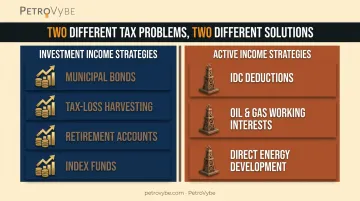
Most investors conflate two separate issues: investment income taxes (capital gains, dividends, and interest from your portfolio) and active income taxes (W-2 wages, self-employment earnings, and business profits).
Here's the catch: tax-loss harvesting, municipal bonds, and maxed-out retirement accounts almost exclusively target the first category. If your tax bill is driven by a high salary or a profitable business, those tools barely move the needle.
Tax planning also isn't a once-a-year event. Investors who treat it as a year-round discipline, rebalancing with tax lots in mind, harvesting losses during volatility, timing Roth conversions, consistently outperform those who scramble every April.
That said, taxes should never be the only reason you buy or sell an asset. Layer tax strategy on top of sound investing, not instead of it.
Foundational Tax-Efficient Investing Strategies
Tax-Aware Asset Location and Account Selection
Asset location means matching each investment to the account where it's taxed most favorably.
- Tax-inefficient assets (bonds, REITs, actively managed funds generating frequent short-term gains) belong in tax-advantaged accounts like a 401(k) or IRA
- Tax-efficient assets (index funds, municipal bonds, stocks you plan to hold long-term) work better in taxable brokerage accounts
Take a dividend-paying stock yielding 4%. Held in a taxable account, a high earner might lose 20-37% of that yield to taxes each year.
Held in a traditional IRA, that same dividend compounds untouched until withdrawal. Vanguard's research estimates thoughtful asset location adds 0.05% to 0.30% in additional after-tax return annually, modest per year but meaningful when compounded over a 20-year horizon.
Tax-Loss Harvesting and Smart Investment Selection
Tax-loss harvesting means selling an investment at a loss to offset gains elsewhere in your portfolio.
Here's how the offset works:
- Realized losses first cancel out realized capital gains, dollar for dollar
- Remaining losses can offset up to $3,000 of ordinary income per year
- Any leftover loss carries forward indefinitely to future tax years
Watch the wash-sale rule. If you buy a "substantially identical" security within 30 days before or after the sale, the IRS disallows the loss entirely. Selling a tech ETF at a loss and immediately buying the same ETF back triggers this rule. Wait out the window, or pick a similar-but-not-identical fund.
Maximizing Tax-Advantaged and Tax-Exempt Vehicles
Retirement and health savings accounts remain the backbone of tax-efficient investing. For 2026, contribution limits include:
| Account Type | Base Limit | Catch-Up (Age 50+) |
|---|---|---|
| 401(k)/403(b)/457/TSP | $24,500 | $8,000 |
| Traditional + Roth IRA (combined) | $7,500 | $1,100 |
| HSA (self-only) | $4,400 | $1,000 (55+) |
| HSA (family) | $8,750 | $1,000 (55+) |
Beyond retirement accounts, municipal bonds deserve a place in a high earner's taxable account. Interest is generally exempt from federal tax, and often state tax if you buy bonds issued in your home state. The MSRB's example shows a 3% tax-exempt municipal yield equals a 4.76% taxable-equivalent yield for someone in the 37% federal bracket — a stronger real return than the coupon suggests.
Accredited investors with substantial W-2 income or capital gains have another option: direct oil and gas development. Intangible drilling cost (IDC) deductions let partners write off up to 90%+ of their investment against active income in the first year, a benefit few retirement accounts or municipal bonds can match. PetroVybe structures these opportunities as limited partnerships, pairing that upfront deduction with long-term production income from operating wells.
Charitable Giving and Legacy Planning Strategies
Charitable giving does more than support causes you care about. Structured correctly, it's one of the cleanest ways to reduce a tax bill.
- Donate appreciated stock instead of cash. Shares held over a year and gifted directly to charity skip capital gains tax while still qualifying for a fair-market-value deduction (up to 30% of AGI).
- Use a donor-advised fund (DAF) to front-load deductions. In a high-income year, front-load several years of giving into a DAF, claim the deduction immediately, then distribute grants over time.
- Consider lifetime gifting for estate planning. The 2026 gift tax exclusion is $19,000 per recipient, with a lifetime estate and gift exclusion of $15 million per individual. Confirm current thresholds with a tax advisor before gifting appreciated assets.
These strategies work well for reducing taxes tied to investment gains and estate exposure. But they still don't touch the core problem many high earners face: a tax bill driven by active income.
The Overlooked Tax Strategy: Direct Investment in Energy Development
Everything covered so far shares one limitation: it primarily reduces taxes on investment income. If your tax burden comes from a $400,000 salary or a profitable business, muni bonds and loss harvesting barely register.
This is where Intangible Drilling Cost (IDC) deductions stand apart.
What Makes IDC Deductions Different
When an operator drills an oil or natural gas well, a large share of the cost (labor, fuel, site preparation, drilling work) has no salvage value. Under IRC Section 263(c) and Treasury Regulation 1.612-4, investors holding a working interest in the well can elect to deduct these costs immediately, often in the very first year.
The critical distinction: a working interest in oil and gas isn't subject to the passive activity loss rules that trap real estate deductions. Real estate losses generally can only offset passive income unless you're a qualifying real estate professional. IDC deductions have no such restriction: they can offset W-2 wages, business profits, and capital gains directly.
PetroVybe's Track Record
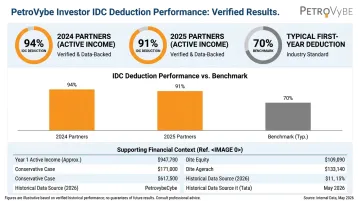
We've seen this play out directly with our own investors at PetroVybe. Partners who joined in 2024 achieved a 94% total tax deduction against active income. In 2025, that figure came in at 91%, still validated through third-party engineering review. Typical first-year IDC deductions run around 70% of invested capital against active income, with the remainder deductible over subsequent years.
One partner, an investor named Nizar, used this structure to eliminate a $30,000 tax liability entirely in a single year.
Beyond the Tax Deduction
PetroVybe structures its natural gas liquids development projects across South Texas and the Gulf Coast Basin (including a 58,000-acre Lavaca County footprint backed by a $48 million third-party engineered reserve valuation) for accredited investors seeking two things at once:
- An upfront deduction against active income in the year they invest
- Long-term passive income once wells reach production
- A targeted 10-year MOIC of 2.2x to 5.8x and target IRR of roughly 26%
This isn't a strategy for everyone. It requires accredited investor status, a minimum commitment, and a multi-year time horizon before distributions begin. It complements maxed-out retirement accounts and well-placed municipal bonds instead of replacing them.
Common Mistakes That Undermine Tax-Efficient Investing
Even well-intentioned investors sabotage their own tax strategy. Watch for these:
- Letting taxes drive every decision. Holding a poorly performing stock for years just to avoid a taxable event usually costs more than the tax you're deferring.
- Ignoring asset location entirely. Holding an identical mix of stocks and bonds across your 401(k), IRA, and taxable brokerage wastes the tax advantages each account offers.
- Overlooking active income. Spending all your energy on capital gains and dividend taxes while your salary or business income drives the actual bill means you're optimizing the wrong side of the ledger.
A genuinely tax-efficient strategy addresses both investment income and active income, not just one.
Frequently Asked Questions
What is the most tax-efficient investment?
There's no single answer: it depends on your income level, account type, and goals. Municipal bonds, index funds, Roth accounts, and IDC-eligible energy investments each serve different investor profiles.
What accounts are the most tax-efficient for investing?
401(k)s, traditional and Roth IRAs, and HSAs offer the most direct tax benefits. Taxable brokerage accounts work best for tax-efficient assets like index funds and municipal bonds.
Is tax-loss harvesting worth it?
Yes, particularly in volatile years. It offsets gains and up to $3,000 of ordinary income annually, but you must avoid wash-sale violations to keep the deduction.
How can high-income earners reduce taxes on active income through investing?
Most traditional strategies only reduce taxes on investment income. Direct oil and gas development investments, like PetroVybe's IDC-eligible projects, are among the few options that offset W-2 and business income directly.
Are municipal bonds still worth it for tax-efficient investing?
Yes, for investors in higher tax brackets, since interest is often exempt from federal (and sometimes state) tax. Compare the taxable-equivalent yield before deciding, since not all munis are created equal.
What is an IDC tax deduction in oil and gas investing?
Intangible Drilling Costs are the non-salvageable expenses of drilling a well, including labor, fuel, and site preparation, that the IRS allows investors to deduct, often in the first year, directly against active income.