
The cost shows up quietly: a higher effective rate, smaller take-home pay, and less capital left over to invest. Inflation-driven "bracket creep" makes it worse, pushing your income into higher brackets even when your real purchasing power hasn't moved.
Reducing taxable income doesn't happen by accident. It takes proactive planning. Below are 10 IRS-recognized strategies spanning retirement accounts, investments, deductions, and advanced options like energy investments.
Key Takeaways
- Above-the-line deductions and tax-deferred accounts lower your AGI directly and can unlock further tax breaks
- High earners can cut taxable income further with tax-loss harvesting and Intangible Drilling Cost (IDC) deductions
- Timing income and deductions across tax years can shift you into a lower bracket
- Layering multiple strategies together produces the biggest overall tax reduction
Understanding Taxable Income and Why It Matters
Taxable income is your gross income minus deductions. It sets your tax bracket and marginal rate—so it is the single biggest lever you control on what you actually owe.
Bracket creep happens when wage growth or inflation pushes you into a higher bracket without any real increase in purchasing power. The IRS adjusts bracket thresholds annually for inflation, but some deduction limits are fixed and not indexed—so their value erodes over time.
Most reduction strategies fall into three buckets:
- Deferring income to a lower-tax year
- Maximizing deductions through accounts and write-offs
- Offsetting gains with losses or tax credits
10 Effective Strategies to Reduce Taxable Income
The right mix depends on your income type, whether you're W-2, self-employed, or earning capital gains, and whether you itemize or take the standard deduction.
Strategy 1: Maximize Contributions to Tax-Deferred Retirement Accounts
Contributions to a traditional 401(k) or IRA reduce taxable income dollar-for-dollar. For 2026:
| Plan Type | Contribution Limit | Catch-Up (50+) |
|---|---|---|
| Traditional 401(k) deferral | $24,500 | +$8,000 (+$11,250 for ages 60-63) |
| Traditional IRA | $7,500 | +$1,100 |
| SEP IRA | Lesser of 25% comp or $72,000 | N/A |
| Solo 401(k) total | $72,000 | +$8,000 |

Self-employed individuals should look closely at a SEP IRA or solo 401(k) — both allow far higher contributions than a standard IRA.
Strategy 2: Contribute to a Health Savings Account (HSA)
HSAs offer a triple tax benefit: pretax contributions, tax-deferred growth, and tax-free qualified withdrawals. For 2026, limits are $4,400 self-only and $8,750 family coverage, plus a $1,000 catch-up at age 55+.
Think of an HSA paired with a high-deductible health plan as a stealth retirement account. Unused funds roll over indefinitely.
Strategy 3: Take Advantage of Standard vs. Itemized Deductions Strategically
Compare your itemizable expenses (mortgage interest, medical costs, state and local taxes) against the standard deduction, which is $16,100 (single), $32,200 (married filing jointly), or $24,150 (head of household) for 2026.
Charitable bunching helps here: concentrate two or three years of donations into a single year to clear the standard deduction threshold, then take the standard deduction in off years.
Strategy 4: Use Tax-Loss Harvesting
Selling underperforming investments offsets capital gains and up to $3,000 of ordinary income per year. Unused losses carry forward indefinitely.
Watch the wash-sale rule: buying back a "substantially identical" security within 30 days before or after the sale disallows the loss. Wait at least 31 days before re-entering the same position.
Strategy 5: Make Qualified Charitable Distributions (QCDs) or Donate Appreciated Assets
If you're 70½ or older, a QCD lets you send up to $111,000 directly from your IRA to charity in 2026. It satisfies your required minimum distribution without increasing your AGI.
Alternatively, donating appreciated stock held longer than a year lets you deduct fair market value while avoiding capital gains tax entirely.
Strategy 6: Defer or Accelerate Income Based on Expected Tax Bracket
If you expect a lower-income year ahead, defer bonuses, freelance invoices, or asset sales into that year. If you expect higher income, accelerate income into the current year instead.
Example: A freelancer expecting a slow Q1 might delay invoicing December work until January, shifting that income into a year where they'll land in a lower bracket.
Strategy 7: Invest in Natural Gas and Oil Development for IDC Deductions
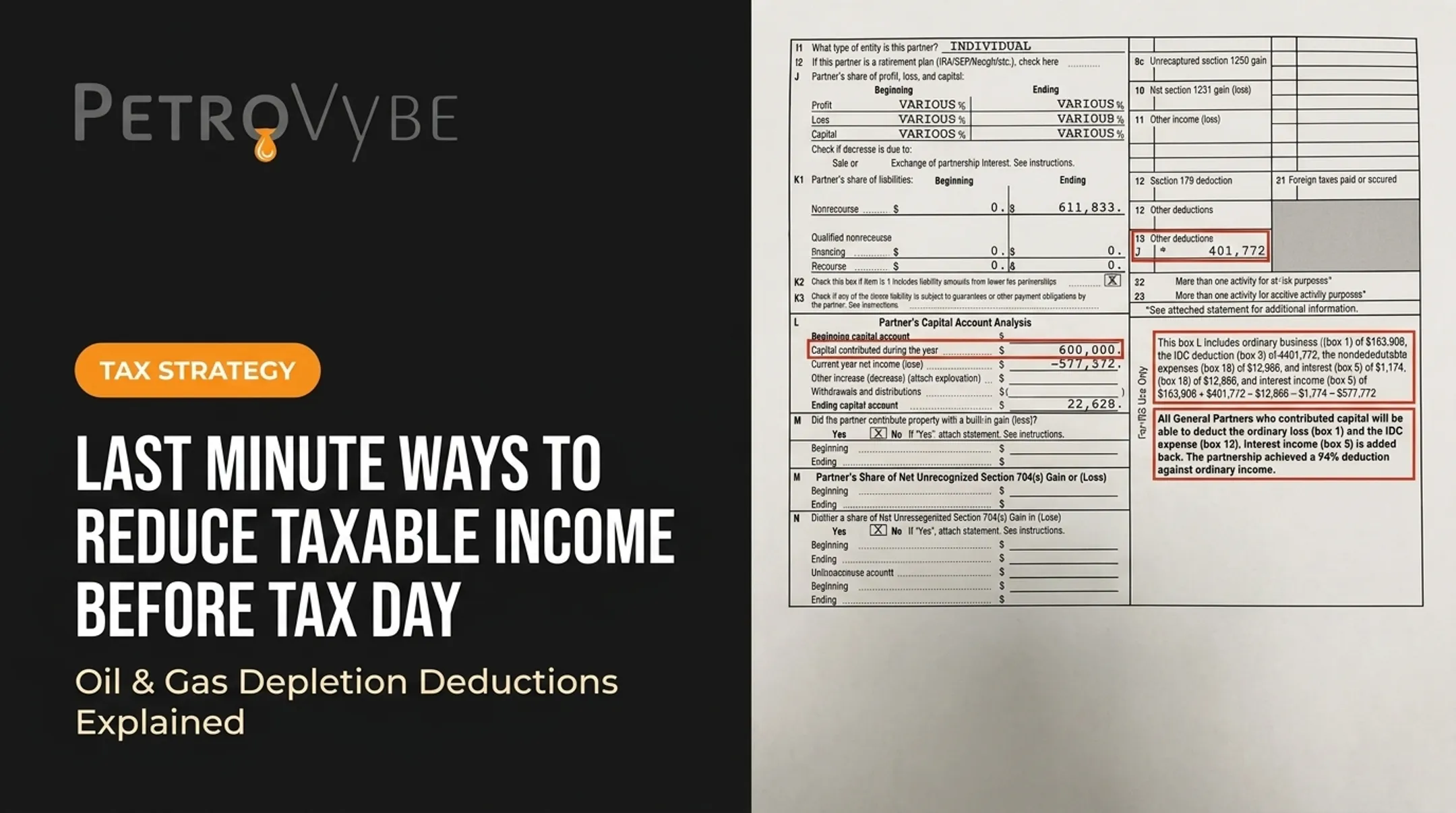
Here's one most people overlook. Section 263(c) of the tax code allows accredited investors with a working interest in oil and gas wells to deduct Intangible Drilling Costs (IDCs) — labor, fuel, site prep, and other non-salvageable expenses — against active income, including W-2 wages and capital gains.
This is unusual. Under IRC Section 469(c)(3), working interests in oil and gas are excluded from passive activity rules, so unlike most investment losses, these deductions aren't stuck offsetting only passive income.
PetroVybe, a private natural gas development company operating roughly 400 wells across 58,000 acres in Lavaca County, Texas, gives accredited investors direct access to this structure. According to company records, partners received a 94% deduction against active income in 2024 and 91% in 2025, alongside long-term passive income potential. As with any advanced strategy, investors should independently verify eligibility with their own tax advisor before committing capital.

Strategy 8: Maximize Retirement Catch-Up and Roth Conversion Timing
Once you turn 50, catch-up contributions let you push more into tax-deferred accounts. Ages 60-63 get an even bigger super catch-up under SECURE 2.0.
Separately, consider Roth conversions in low-income years. You'll pay tax now at a lower rate, then enjoy tax-free growth and withdrawals later.
Strategy 9: Claim the Qualified Business Income (QBI) Deduction
Self-employed individuals and pass-through business owners can deduct up to 20% of qualified business income. The One Big Beautiful Bill Act made this deduction permanent, removing its original 2025 sunset.
For 2026, phase-outs begin at $276,750 (single) and $553,500 (married filing jointly), with full phase-out around $351,750 and $703,500 respectively.
Strategy 10: Leverage New or Expanded Deductions from Recent Tax Legislation
Recent legislation introduced several new deductions worth checking:
- Senior deduction: $6,000 per person age 65+, phasing out above $75,000 (single) / $150,000 (joint) MAGI
- No tax on tips: up to $25,000, phasing out above $150,000 / $300,000
- No tax on overtime: up to $12,500 ($25,000 joint), same phase-out range
- Expanded SALT cap: $40,400 for 2026, phasing down above $500,000 / $1,000,000 MAGI

These thresholds aren't inflation-indexed, so eligibility can shrink over time even without a raise. Verify eligibility with a tax professional each year.
How to Choose the Right Combination of Strategies
No single strategy does all the work. The right combination depends on:
- Income type: W-2, self-employed, or investment income each unlock different deduction paths
- Filing status: thresholds shift significantly between single and joint filers
- Age: catch-up contributions and QCDs only apply past certain ages
- Risk tolerance: advanced options like IDC deductions involve real investment risk, not just tax mechanics Layering strategies compounds the benefit. Maxing out a 401(k) and HSA lowers your AGI, which can help you qualify for phase-out-sensitive deductions like QBI or the additional standard deduction for seniors. Adding an IDC-based oil and gas investment on top can reduce active income for readers with capital gains or high W-2 earnings. A CPA or financial advisor can help sequence these moves into a multi-year plan rather than a one-off filing decision.
Conclusion
Reducing your taxable income takes year-round planning. Stack deductible accounts, time income deliberately, and, if you are an accredited investor, consider advanced options like IDC deductions from natural gas development projects.
Used together, these strategies lower this year's bill and build long-term wealth while you keep more of what you earn.
Frequently Asked Questions
How do I reduce my income tax?
Contribute to tax-deferred accounts like a 401(k) or HSA, maximize deductions (standard or itemized), and time income or losses around your expected bracket. Combining several of these usually beats relying on just one.
How do I offset my taxable income?
Retirement contributions and HSA deposits reduce AGI directly, while capital losses can offset gains plus up to $3,000 of ordinary income. Charitable giving and business deductions add further offsets.
What reduces taxable income the most?
For most taxpayers, maxing retirement contributions has the biggest impact. For accredited investors with active income, IDC deductions from oil and gas investments can offset a much larger share.
How do you avoid the 22% tax bracket?
Lower your taxable income enough through deductions and pretax contributions to stay under the bracket threshold. For 2026, that's $50,400 for single filers before hitting 22%.
How do rich people reduce taxable income?
Common tools include charitable giving, tax-loss harvesting, and alternative investments with favorable tax treatment, such as oil and gas development offering IDC deductions against active income.
How does the new $6,000 tax deduction work?
Filers 65 and older can claim an extra $6,000 deduction, phasing out above $75,000 MAGI (single) or $150,000 (joint). It's effective through 2028 and isn't inflation-adjusted.