This article is general education, not investment, tax, or legal advice. Offshore drilling has quietly become one of the backbones of U.S. energy security. Federal Gulf waters alone account for roughly 13% of U.S. crude production, supplying energy at a moment when electricity demand is climbing faster than it has in decades.
Most public debate treats offshore drilling as a binary: environmental risk versus energy need. But the real story shows up in payrolls, GDP contributions, and what happens to energy prices when supply tightens. This article breaks down the practical benefits of offshore drilling, how it fits into the broader energy landscape, and what's at stake when leasing gets restricted.
Key Takeaways
- Offshore drilling supported 250,000 U.S. jobs and $30.83 billion in value added in FY2024
- Federal offshore output covers 13% of U.S. crude, reinforcing domestic energy security
- Retired platforms now function as artificial reefs, with over 600 reefed in the Gulf alone
- Safety and efficiency gains from offshore engineering also transfer to onshore development
- Accredited investors can gain similar energy-security exposure through onshore natural gas development
What Is Offshore Drilling?
Offshore drilling extracts crude oil and natural gas from reserves beneath the ocean floor, using fixed platforms, floating rigs, or subsea systems anchored to the seabed. Production is concentrated in a handful of major basins worldwide.
Common offshore basins include:
- Gulf of Mexico (Gulf of America), the largest U.S. offshore producer
- The North Sea, a long-standing supply source for European markets
- West Africa's continental shelf
- Brazil's pre-salt basins
Offshore drilling is one supply method, not a full energy strategy on its own. Alongside onshore development, it helps meet U.S. energy demand as part of a broader production mix.
Key Advantages of Offshore Drilling
Each advantage below ties to measurable outcomes: jobs, GDP, energy costs, or technological progress that ripples across the industry.
Advantage 1: Job Creation and Economic Growth
Offshore platforms require large, specialized workforces: engineers, logistics coordinators, safety inspectors, and marine support crews. These aren't small operations. A single deepwater project can employ hundreds of workers across multiple disciplines.
That employment doesn't stay contained to the rig. Offshore hubs create ripple effects onshore through:
- Increased spending at local businesses near port facilities
- Real estate demand in coastal communities
- Growth in small businesses supplying equipment, catering, and transport
According to BOEM's FY2024 economic contributions report, offshore oil and gas activity supported 250,000 jobs, generated $18.31 billion in labor income, and contributed $30.83 billion in value added to the U.S. economy. Industry spending effects alone accounted for 147,000 of those jobs.
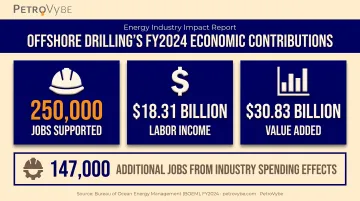
Metrics to watch: employment figures, labor income, GDP contribution, economic output value.
Coastal states like Texas and Louisiana feel this first. The effect sharpens during high energy demand or domestic supply-chain disruption, when every barrel produced at home carries added weight.
Advantage 2: Domestic Energy Security and Lower Costs
Offshore reserves reduce how much oil the U.S. needs to import. That matters more than it used to. U.S. crude and petroleum-product imports fell 39% between 2006 and 2024, and imports made up just 17% of U.S. energy supply in 2024, according to EIA data — the lowest share in nearly 40 years.
This isn't an offshore-only effect. It reflects the broader domestic production boom. But offshore output is a real contributor to that trend, not a bystander.
Why this matters for consumers:
- Greater domestic supply helps buffer against global supply shocks
- Reduced import reliance limits exposure to geopolitical disruptions
- A diversified supply base (offshore, onshore, imports) creates more price stability overall
Tied to: energy prices, trade deficit, import dependency ratio.
Those buffers matter most during global supply shocks and geopolitical instability. They also matter as AI drives electricity demand higher: data-center use is projected to jump from 176 TWh in 2023 to as much as 580 TWh by 2028.
Advantage 3: Technological Innovation and Environmental Adaptation
Offshore drilling forces engineering to keep pace with hostile environments. Deepwater pressure, remote locations, and harsh weather all demand better blowout preventers, remote-operated vehicles, and monitoring systems. Many of these advances filter down into onshore drilling standards too.
There's also an unexpected environmental upside. Retired platforms don't always get scrapped. Some become artificial reefs.
- Over 600 former Gulf platforms have been converted through the Rigs-to-Reefs program, according to BSEE
- A single eight-leg structure can house 12,000 to 14,000 fish
- A 2014 peer-reviewed study in PNAS found California platforms produced 27.4 times the fish biomass of comparable natural reefs, per unit of seafloor area
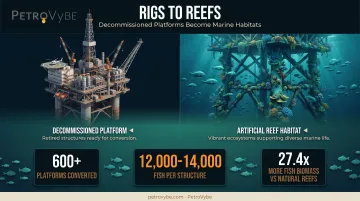
California's program hasn't converted a federal platform yet, so the Gulf remains the proven model. Still, the data shows offshore infrastructure can outlive its original purpose in productive ways.
Progress shows up in: drilling depth capability, safety incident rates, marine habitat area created.
Deepwater and Arctic work put this on full display. Extreme conditions demand the most advanced engineering available.
What Happens When Offshore Drilling Is Restricted or Ignored
Cutting back offshore leasing reshapes supply, prices, and coastal economies. The direction of those effects is clear:
- Greater reliance on foreign oil imports, reversing decades of import decline
- Higher energy prices for consumers and manufacturers during supply-tight periods
- Job losses in coastal communities and supporting industries
- Slower innovation in deepwater and safety technology as fewer projects reduce the push to solve hard engineering problems
- Reduced tax revenue for state and federal budgets that fund public infrastructure
BOEM itself admits it has limited information on the full socioeconomic effects of reduced leasing. That gap is a warning sign: policymakers are weighing major decisions without full visibility into downstream costs.
Where the Real Value Compounds: Domestic Oil and Gas Investment
Offshore drilling gets the headlines. But for accredited investors looking to participate in the same energy-security trend, much of the practical opportunity sits onshore—in natural gas development that supplies the same power system offshore oil helps stabilize.
This is where PetroVybe operates. The company gives accredited investors direct access to early-stage natural gas development in the Gulf Coast Basin, specifically its PetroVybe ONE project across 58,000 acres in Lavaca County, Texas. The project combines roughly 400 existing producing wells with 57+ planned new wells, backed by a $48 million PV-09 reserve valuation from an independent engineering firm, prepared by Lee Keeling & Associates, Tulsa, March 2026.
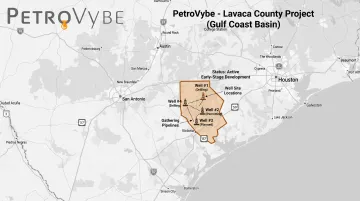
The tax structure is a significant part of the appeal:
- Partners received a 94% tax deduction against active income in 2025, driven by Intangible Drilling Cost (IDC) deductions. Prior result; not a promise of any future deduction.
- IDCs (typically a first-year deduction target of approximately 70–80% of invested capital) can offset W-2 income, business income, and capital gains—not just passive income
- The 10-year hold targets an IRR near 26% and a MOIC between roughly 2.2x and 5.8x. This treatment requires the investor to elect general partner status in the Subscription Agreement and may be limited in a given year by the excess business loss limitation under IRC §461(l).
Offshore platforms in the Gulf of Mexico and onshore wells in South Texas share the same core advantages: jobs, energy security, and long-term asset value that compounds as infrastructure matures.
Minimum participation starts at $100,000 for verified accredited investors.
Conclusion
Offshore drilling's importance shows up in concrete results: 250,000 supported jobs, billions in economic output, and a measurable drop in import dependency that strengthens the U.S. negotiating position during global disruptions. It also shows up in less obvious places, like fish thriving around decommissioned platforms in the Gulf.
These benefits compound over time. Workforce expertise deepens, safety standards mature, and infrastructure gets more efficient with each project cycle.
Offshore and onshore development aren't competitors. Together, they form the backbone of U.S. energy independence, and increasingly, the fuel supply behind the country's AI-driven electricity demand.
Frequently Asked Questions
What are the main benefits of offshore drilling?
Offshore drilling supports hundreds of thousands of U.S. jobs, strengthens domestic energy security by reducing import reliance, and helps stabilize energy costs during supply disruptions. It also drives technological innovation in deepwater engineering.
Is offshore drilling safe for the environment?
Modern offshore operations run under strict safety systems, including BSEE's Safety and Environmental Management System requirements and updated well-control rules. Programs like Rigs-to-Reefs also show how retired platforms can support marine biodiversity.
How many jobs does offshore drilling support in the U.S.?
According to BOEM, offshore oil and gas activity supported approximately 250,000 jobs and $30.83 billion in value added during FY2024, including direct, indirect, and induced economic effects.
Why is offshore drilling increasing globally?
Rising global energy demand, combined with maturing onshore reserves in some regions, is pushing investment offshore. Industry forecasts project global offshore investment approaching $250 billion in 2025.
What's the difference between offshore and onshore drilling benefits?
Offshore projects can tap larger reserves and longer production lives, but they need higher capital and specialized equipment. Onshore development—such as PetroVybe's Gulf Coast Basin projects—usually has lower entry costs and gives accredited investors more direct, tax-advantaged access to early-stage production.
Can individuals invest in oil and gas development like offshore projects?
Direct partnership access is far more common onshore than in large offshore programs. Accredited investors can join onshore natural gas projects such as PetroVybe's Lavaca County offering, with tax-advantaged passive income. Participation begins at one unit of $100,000, with add-on subscriptions from $25,000.
Informational requests only. PetroVybe projects are offered solely to verified accredited investors. Submitting this form does not create an investment or advisory relationship.