This article covers what passive investing actually is, how it works, its genuine advantages and real limitations, and how it compares to active strategies. For high-income earners and accredited investors, the full picture is more nuanced than "just buy an index fund."
This article is general education, not investment, tax, or legal advice.
Key Takeaways
- Passive investing tracks a market index rather than attempting to beat it
- Primary advantages: lower fees, tax efficiency, simplicity, and broad diversification
- Main drawbacks: no downside protection and a structural ceiling on returns
- Best suited for long-term, hands-off investors focused on steady wealth accumulation
- For accredited investors, direct energy partnerships like PetroVybe may offer a different tax and return profile than index funds
What Is Passive Investing?
Passive investing is a long-term strategy built on buying and holding a diversified portfolio that mirrors a specific market index — the S&P 500, Russell 2000, or a bond benchmark. The goal is broad market exposure, not picking individual winners or timing market movements.
The underlying philosophy is straightforward: markets are largely efficient over time, and consistently beating them after fees and taxes is exceptionally difficult. Passive investors accept that — and capture broad market gains at minimal cost instead.
A Quick Clarification on Terms
"Passive investing" and "passive income" are often confused but mean different things:
- Passive investing = an investment management approach (buy-and-hold index tracking)
- Passive income = earnings requiring little ongoing effort (dividends, distributions, royalties)
Some passive investments do generate passive income. But the terms aren't interchangeable, and conflating them can lead investors to misunderstand what they're actually buying.
How Index Investing Started
Vanguard launched the First Index Investment Trust on August 31, 1976 — now the Vanguard 500 Index Fund — as the first index fund available to individual investors. The first U.S.-listed ETF arrived nearly two decades later when State Street launched the SPDR S&P 500 ETF Trust in January 1993.
As of May 2026, ICI reported $21.821 trillion in U.S. index mutual funds and ETFs, compared to $18.745 trillion in active products. Index strategies now represent roughly 53.8% of the combined total — a structural shift that reflects just how broadly the passive approach has been adopted.
How Passive Investing Works
The Three Main Vehicles
| Vehicle | How It Trades | Minimum Investment |
|---|---|---|
| Index mutual funds | Once daily at NAV | Often $1,000–$3,000 |
| ETFs | Intraday like stocks | No minimum (price of one share) |
| Bond index funds | Once daily at NAV | Varies by fund |
Each tracks a different benchmark, but the core mechanic is identical: the fund holds securities in proportion to their weight in the target index.
Automatic Rebalancing
When an index adds or removes a company, the fund adjusts its holdings to match. Investors don't make those decisions — the fund does it automatically.
That said, passive investing is not entirely hands-off. Investors still need to:
- Choose which index or indexes to track
- Determine asset allocation across equities and bonds
- Schedule periodic rebalancing as their target risk profile shifts over time
The strategy narrows decision-making — but doesn't eliminate it entirely.
The Pros of Passive Investing
Lower Costs
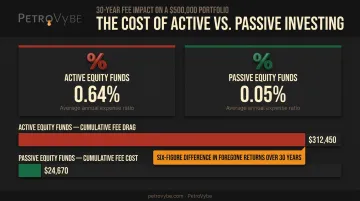
The fee gap between active and passive funds is substantial and well-documented. According to ICI's 2024 asset-weighted averages:
- Active equity mutual funds: 0.64% average expense ratio
- Passive equity mutual funds: 0.05% average expense ratio
That 0.59-percentage-point gap compounds significantly over decades. On a $500,000 portfolio held for 30 years, the difference between 0.64% and 0.05% in annual fees runs well into six figures of foregone returns.
Tax Efficiency
Passive funds trade infrequently. Less trading means fewer capital gains distributions to shareholders each year — which matters most for investors in high tax brackets. A buy-and-hold strategy defers tax events rather than triggering them annually, keeping more capital working inside the fund over time.
Emotional Discipline
Rules-based investing removes the temptation to react emotionally. Panic-selling during a downturn or chasing returns during a rally destroys long-term performance. A set-and-forget passive strategy protects investors from their own worst instincts — and that behavioral edge is harder to quantify than fees, but just as real.
Instant Diversification
A single S&P 500 index fund provides exposure to 500 large-cap U.S. companies across every major sector. This breadth of holdings reduces company-specific and sector-specific risk compared to holding a handful of individual stocks.
Long-Term Performance Advantage
That diversification also translates into a durable performance edge over time. The data against active managers is stark. The SPIVA U.S. Scorecard Year-End 2025 found that among all domestic equity funds:
- 90.43% underperformed their benchmark index over 10 years
- 93.15% underperformed over 15 years
For large-cap funds specifically, 85.59% underperformed over 10 years and 89.93% over 15 years. Wharton research notes that successful active managers have roughly a 10% chance of outperforming three years in a row.
Active management can work — but the odds are steep, and the costs make a difficult task harder. For most investors, the passive approach wins by attrition.
The Cons of Passive Investing
No Ability to Outperform
Passive funds are engineered to match their benchmark. By design, they won't beat it — and after operating costs, they'll return marginally less. That's an acceptable trade-off for many investors. For those seeking above-market returns, it's a hard ceiling.
Zero Flexibility During Downturns
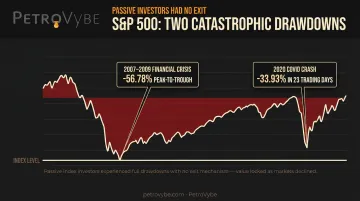
Passive managers cannot rotate out of declining sectors, move into defensive assets, or reduce exposure when risks escalate. Investors ride the index down just as they ride it up.
Historical context matters here. S&P data documents that the S&P 500 fell 56.78% peak-to-trough during the 2007–2009 financial crisis and 33.93% during the 2020 COVID crash — in 23 trading days. Passive investors absorbed those declines in full, with no mechanism to reduce exposure.
Concentration Risk
Broad diversification doesn't eliminate concentration risk within the index itself. As of May 29, 2026, the top 10 constituents of the S&P 500 represented 36.4% of the index, with the largest single holding at 7.5%. Capitalization weighting means the biggest companies command increasing index weight — a concentration risk that's easy to overlook.
Limited Tax Optimization for High Earners
Passive funds are tax-efficient relative to frequent trading — but they provide no mechanism for reducing your tax bill on active income.
A passive index fund investor earning $400,000 in W-2 income has no way to reduce that ordinary income tax liability through their investment. The fund generates no deductions against active earnings — only capital gains deferral.
Accredited investors have access to structures that work differently. Direct oil and gas development partnerships, for example, generate Intangible Drilling Cost (IDC) deductions that apply against W-2 income and capital gains — not just passive income. The contrast is significant:
- Index funds: capital gains deferral only; no deduction against active income
- IDC partnerships: a first-year deduction target of approximately 70–80% of invested capital, applied against ordinary income, including W-2 earnings
That's a structurally different tax outcome — one passive index investing cannot replicate.
Passive Investing vs. Active Investing
The Core Trade-Off
| Passive | Active | |
|---|---|---|
| Goal | Match the benchmark | Beat the benchmark |
| Average equity mutual fund fee (2024) | 0.05% | 0.64% |
| Average equity ETF fee (2024) | 0.14% | 0.70% |
| 15-year outperformance rate | N/A (it is the benchmark) | ~6.85% of domestic funds |
| Flexibility during downturns | None | Varies by manager |
Active managers charge significantly more and, in aggregate, deliver less after fees and taxes over long time horizons. The fee drag compounds over decades, and even skilled active managers rarely maintain an edge long enough to justify the cost.
The Hybrid Approach
That data doesn't make the choice binary. Many experienced investors use passive strategies for core holdings (broad equity and bond index funds) while allocating a portion to active or alternative strategies where specialized expertise or unique market access creates genuine edge.
This hybrid model captures the cost and consistency benefits of passive investing while leaving room for targeted positions where the passive approach structurally falls short:
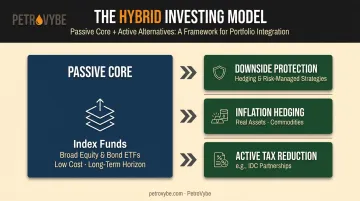
- Downside protection during market drawdowns
- Inflation hedging through real assets or commodities exposure
- Active tax reduction strategies unavailable in index funds
Who Should Consider Passive Investing?
Ideal Candidates
- New investors building foundational wealth
- Those with 10+ year time horizons who want simplicity
- Investors comfortable with market-rate returns at low cost
- People who value hands-off portfolio management
Less Suited For
Passive index investing may fall short for:
- High-income W-2 earners who need aggressive tax mitigation beyond basic capital gains deferral
- Accredited investors with $100,000+ in liquidity seeking income streams tied to tangible, real-world assets rather than market indices
- Investors wanting uncorrelated returns — when the market drops, index funds drop with it
For accredited investors in that second category, direct oil and gas development partnerships offer a structurally different option. PetroVybe structures its partnerships so that IDC deductions — targeting approximately 70–80% of invested capital in a new drilling project — apply directly against W-2 income and capital gains, not just passive income. This treatment requires the investor to elect general partner status in the Subscription Agreement and may be limited in a given year by the excess business loss limitation under IRC §461(l).
Partners received a 94% tax deduction against active income in 2025 — a prior-year result and not a promise of any future deduction, an outcome no index fund structure can replicate.
Combined with quarterly distributions from tangible energy production, estimated to begin Q1 2027, and a modeled 10-year net exit MOIC ranging from approximately 2.2x (conservative) to 5.8x (optimistic), with a 4.2x base case, PetroVybe operates on a different return model — one built around asset ownership and tax efficiency rather than market exposure.
PetroVybe's minimum is $100,000, with add-on subscriptions from $25,000, and participation requires verification of accredited status by a qualified third party — this is not a retail product. For the right investor profile, it can complement a passive index portfolio by addressing the tax and income gaps index funds leave unresolved.
Frequently Asked Questions
What is the best passive investment?
It depends on your goals and tax situation. S&P 500 index ETFs are widely considered the most accessible and cost-effective option for most investors. Accredited investors may also consider REITs or direct energy development partnerships for passive income distributions combined with distinct tax advantages not available through public funds.
How much money do I need to invest to make $3,000 a month?
The required capital depends on your investment's expected yield. A 4% annual return requires roughly $900,000 in invested assets to generate $3,000 per month in income. Higher-yielding or tax-advantaged investments may reduce the capital threshold, though typically with different risk and liquidity profiles.
How do I make $1,000 per month passively?
Common approaches include dividend index funds, REITs, bond funds, and direct investment partnerships. The capital required varies significantly — from roughly $300,000 at a 4% yield to less if the investment vehicle carries higher yields or tax deductions that reduce your net tax on distributions.
What is the 70/20/10 investment strategy?
The 70/20/10 framework typically allocates 70% to core long-term investments, 20% to growth-oriented positions, and 10% to higher-risk or speculative opportunities. No major financial institution has established this as a universal standard — treat it as a general starting framework, not a rule, and adjust based on your own risk tolerance and goals.
Is passive investing better than active investing?
For most retail investors, passive investing wins on cost and long-term consistency. Active investing may hold advantages in niche markets, downside protection scenarios, or when investors access genuinely differentiated expertise or deal flow unavailable through public markets.
What are the main risks of passive investing?
Three primary risks: full exposure to market drawdowns with no protection mechanism, concentration risk as an index becomes heavily weighted in a few large companies, and limited ability to tax-optimize beyond basic capital gains deferral. Investors with high active income or specific tax objectives should assess whether passive investing alone meets their tax and income objectives.
Informational requests only. PetroVybe projects are offered solely to verified accredited investors. Submitting a contact form does not create an investment or advisory relationship.
Investments in private oil and gas partnerships such as PetroVybe are available exclusively to accredited investors under SEC Regulation D 506(c). All projections are forward-looking and subject to material risks including commodity price volatility and drilling outcomes. PetroVybe is not a registered investment adviser, broker-dealer, or tax or legal advisor. This is not an offer to sell — any offer is made only through the confidential Private Placement Memorandum. Consult a qualified financial and legal advisor before making any investment decision.