
Here's the twist: the IRS doesn't recognize "LLC" as a tax classification at all. Your LLC's tax treatment depends entirely on elections you make, which means you have more control over your tax outcome than most business owners realize.
This guide breaks down default LLC taxation, how to calculate taxable income, self-employment tax mechanics, and strategies to reduce what you owe, including advanced options like oil and gas investments that high-income earners use to offset active income.
Key Takeaways
- LLCs don't pay federal income tax by default; profits pass through to members' personal returns
- Calculate taxable income as gross revenue minus allowable business deductions
- Members typically owe self-employment tax (15.3%) on their share of profits
- Filing Form 8832 or 2553 lets LLCs elect S corp or C corp taxation instead
- Retirement plans, standard deductions, and IDC investments can lower the tax you owe on profits
What Is LLC Taxable Income?
LLC taxable income is your net profit after subtracting allowable business expenses from gross revenue. It's not the same as revenue, and confusing the two is one of the most common mistakes new business owners make.
The IRS taxes LLCs based on how they're classified, not because "LLC" is a distinct tax category. Depending on the elections you make, your LLC could be taxed as:
- A disregarded entity (single-member default)
- A partnership (multi-member default)
- An S corporation (by election)
- A C corporation (by election)
Quick example: Say your LLC brings in $150,000 in gross revenue. After $60,000 in deductible expenses (supplies, rent, contractor payments), your taxable income is $90,000. Federal income tax and self-employment tax apply to that $90,000—not the $150,000.

How Are LLCs Taxed by Default?
By default, the IRS does not tax an LLC as a separate corporation. Treatment depends on how many members the LLC has—and owners can elect a different classification when the default does not fit.
Single-Member LLCs
A single-member LLC is a "disregarded entity" by default. That means the IRS ignores the LLC structure for tax purposes and treats you like a sole proprietor.
You report income and expenses on Schedule C, attached to your personal Form 1040. All net profit is subject to self-employment tax unless you've filed an election to change your classification.
Multi-Member LLCs
Multi-member LLCs default to partnership taxation. The LLC files Form 1065 (an informational return, not a tax payment) and issues each member a Schedule K-1 showing their share of profit or loss.
Each member reports their K-1 income on their personal return, taxed according to the allocation percentages in the operating agreement. Those percentages can differ from ownership if the agreement allows special allocations.
Electing Corporate Taxation
LLCs are not locked into default treatment. Owners can file Form 8832 to elect C corp taxation or Form 2553 to elect S corp status.
S corp election is popular because it can reduce self-employment tax. Owners pay themselves a "reasonable salary" subject to payroll tax, then take remaining profit as distributions that are not subject to SE tax.
One catch: once you make a classification election, you're locked in for 60 months under Treas. Reg. §301.7701-3(c)(1)(iv) before you can change again.

How Is LLC Taxable Income Calculated?
LLC taxable income starts with a straightforward calculation: gross receipts minus cost of goods sold and operating expenses equals net profit.
Common allowable deductions include:
- Rent and utilities
- Office supplies and software
- Marketing and advertising costs
- Business travel
- Wages paid to employees
- Professional services (legal, accounting)
Self-Employment Tax Breakdown
Once you know your net profit, you calculate self-employment tax separately on Schedule SE. For 2025-2026, the rates break down as:
| Element | 2025 | 2026 |
|---|---|---|
| Social Security wage base | $176,100 | $184,500 |
| OASDI rate (self-employed) | 12.4% | 12.4% |
| Medicare rate (self-employed) | 2.9% | 2.9% |
| Combined SE tax rate | 15.3% | 15.3% |
High earners should also watch for the Additional Medicare Tax of 0.9%, which kicks in above $200,000 (single) or $250,000 (married filing jointly), per IRS Tax Topic 560.
Phantom Income: A Real Trap
Taxable income is not the same as cash in your account. Multi-member LLCs can create phantom income when the operating agreement allocates profit to you even though the LLC distributed no cash.
That often happens when the business reinvests earnings into growth. Plan cash reserves accordingly, or you could owe tax on money you never received.

Strategies to Reduce LLC Taxable Income
Retirement Contributions and the QBI Deduction
Beyond routine business expenses, LLC owners can lower taxable income through:
- SEP-IRA: Contribute up to 25% of net self-employment earnings, capped at $72,000 for 2026
- Solo 401(k): Combine employee deferrals ($24,500 in 2026) with employer profit-sharing contributions
- QBI deduction: Up to 20% of qualified business income, subject to phase-out limits starting at $197,300 (single) and $394,600 (MFJ) for 2025
Advanced Strategy: Oil and Gas Investment Deductions
For accredited investors carrying a heavy active-income tax burden, direct investment in oil and gas development offers a planning tool most pass-through losses can't match.
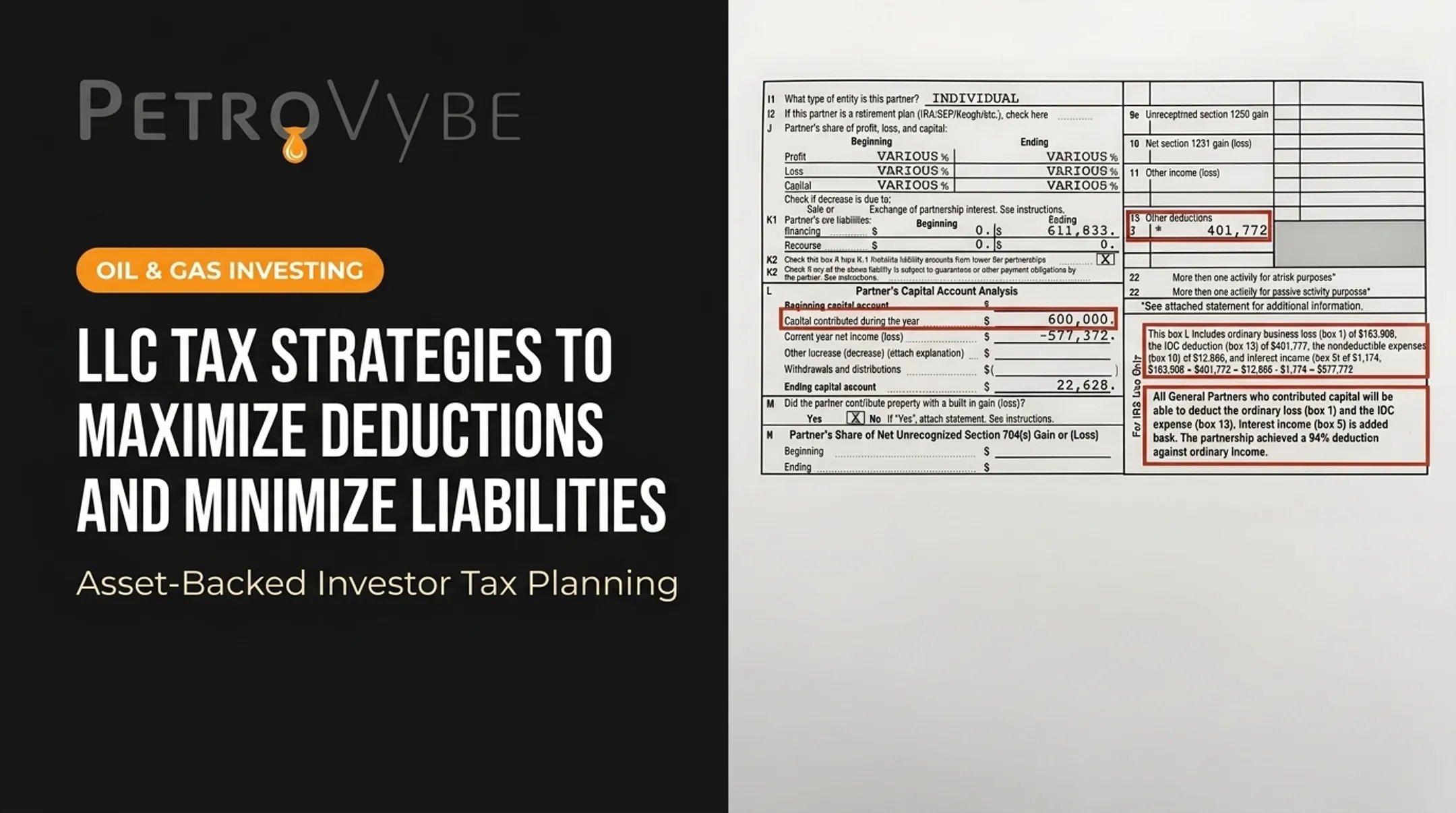
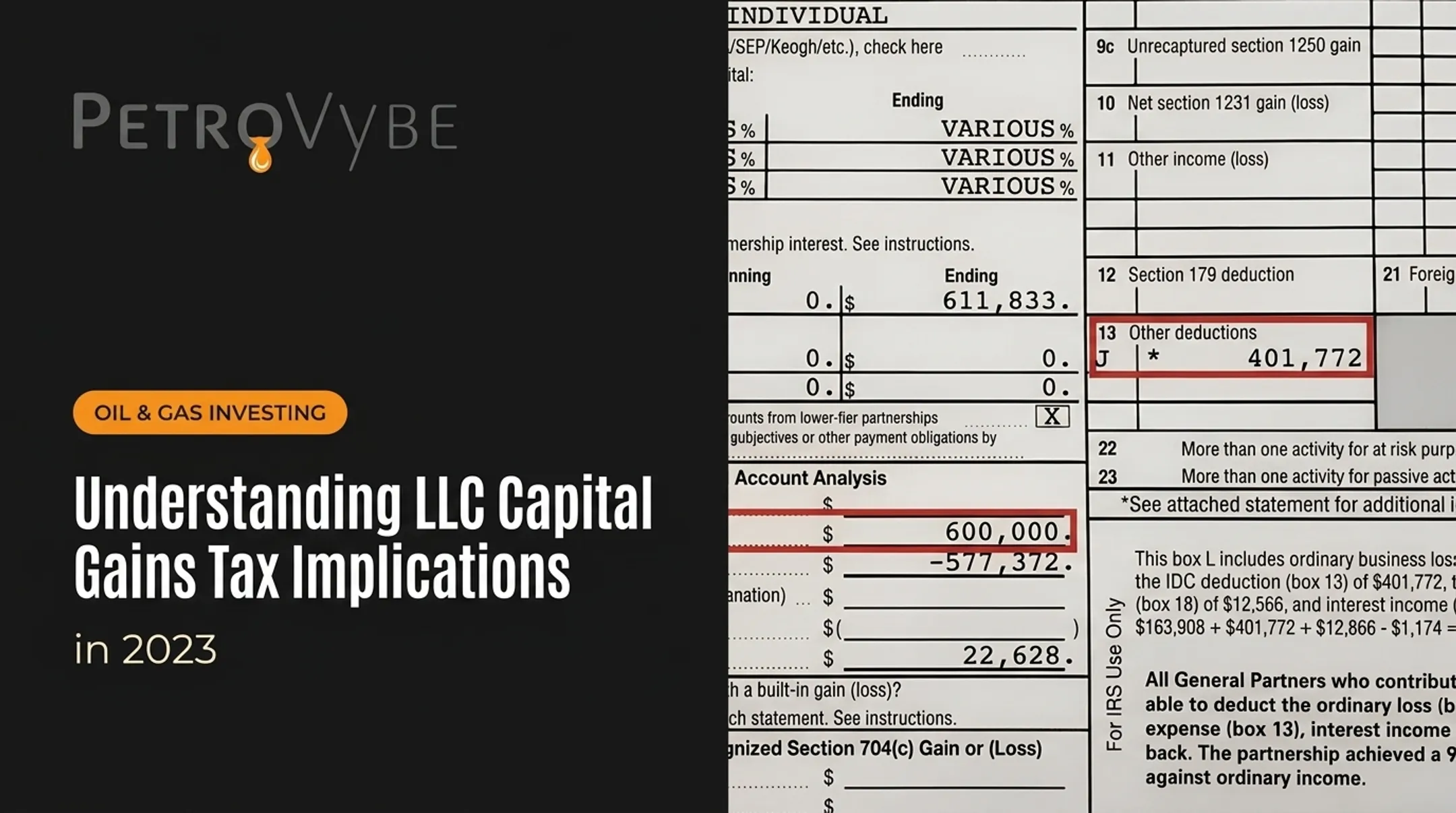
Intangible Drilling Cost (IDC) deductions typically represent 60-80% of invested capital in a new drilling project. They can offset active income, including W-2 wages and capital gains—not just passive income.
This matters because most pass-through business losses are trapped by passive activity rules under §469, only usable against other passive income. Working interests in oil and gas properties are specifically exempted from those passive activity limitations under §469(c)(3), which is why this strategy works differently.
Real-world example: PetroVybe, a Texas-based natural gas development company, reported partners receiving a 94% tax deduction against active income in 2025 and 91% in 2024 through IDC and depletion allowances on its development projects.
A $100,000 investment could generate $60,000–$80,000 in first-year IDC deductions alone, taken either immediately or spread over five years.

This isn't for everyone. Participation generally requires:
- Accredited investor status (net worth over $1 million excluding primary residence, or income above $200,000 individually / $300,000 jointly)
- Minimum investment around $100,000
- Comfort with a multi-year hold before distributions begin
Always consult a CPA before pursuing this strategy to confirm it fits your tax situation and risk tolerance.
LLC vs. S Corp vs. C Corp Tax Treatment
How your entity is taxed shapes self-employment tax, double taxation risk, and admin load. Here’s the side-by-side:
| Factor | LLC (default) | S Corp | C Corp |
|---|---|---|---|
| Self-employment tax | On full profit | Only on salary | N/A (payroll tax on wages) |
| Double taxation | No | No | Yes |
| Administrative burden | Low | Moderate (payroll required) | High |
C corps pay a flat 21% corporate tax rate, then shareholders pay individual tax again on dividends. The effective combined rate can approach 40.8%. LLCs and S corps avoid this through pass-through treatment.

As your LLC scales and profits grow, an S corp election often starts making sense. That shift usually pays off once self-employment tax savings outweigh the added payroll administration.
Common LLC Tax Filing Requirements
Your filing obligations depend on your tax classification:
- Schedule C — single-member LLCs (disregarded entity)
- Form 1065 + K-1 — multi-member LLCs (partnership)
- Form 1120-S — LLCs electing S corp status
- Form 1120 — LLCs electing C corp status
Most LLC members also owe quarterly estimated taxes if they expect to owe $1,000 or more for the year.
State-level obligations vary by where your LLC operates:
- Franchise taxes
- Annual report fees
- State income tax filings
Frequently Asked Questions
How much is an LLC taxed on income?
There's no single LLC tax rate. Income passes through to members and gets taxed at their individual federal tax bracket, plus self-employment tax (15.3%) where applicable.
Will I be taxed twice with an LLC?
Default LLC taxation avoids double taxation entirely. Electing C corp status, however, triggers taxation at both the corporate level (21%) and again when profits are distributed to you personally.
How can I lower taxable income with an LLC?
Stack standard deductions, retirement contributions (SEP-IRA or Solo 401k), and the QBI deduction. Accredited investors can also use oil and gas IDC deductions from direct development projects to offset active income, including W2 wages and capital gains.
What should my LLC be taxed as?
It depends on your income, growth plans, and whether S corp self-employment tax savings outweigh the extra payroll and admin costs. Model both paths before you elect.
Do I need to pay estimated taxes as an LLC member?
Yes, if you expect to owe $1,000 or more for the year after subtracting withholding and credits, you're required to make quarterly estimated payments.
What happens if my LLC has a loss?
Losses generally pass through to your personal return, but they're subject to basis limitations and passive activity rules, meaning you can't always deduct the full loss immediately.