
Two investors can hold the identical portfolio — same stocks, same bonds, same allocation — and end up with meaningfully different wealth after 20 years. The difference isn't what they own. It's where they hold it.
This is asset location, and it's one of the few genuinely "free lunch" strategies left in personal finance. Vanguard's research puts the annual after-tax return boost at roughly 0.05% to 0.30%, depending on your tax bracket, account balances, and time horizon — modest-sounding numbers that compound into real money over decades source.
This article covers the three account types, the core principles for placing assets correctly, and a strategy most asset-location guides skip entirely: direct alternative investments like oil and gas development that offer deductions unavailable through any Roth or 401(k).
Key Takeaways
- Asset location means choosing which account type holds which investment to minimize tax drag — not what you own, but where you own it
- High-return, tax-inefficient assets belong in tax-advantaged accounts; tax-efficient assets belong in taxable accounts
- Direct investments with upfront active-income deductions, such as oil and gas development, complement traditional account-based location strategies
- Your personal tax bracket and account mix determine the right approach; there's no universal template
What Is Asset Location and Why It Matters
Asset allocation is what you own: your split between stocks, bonds, real estate, and cash. Asset location is where you own it: which of those assets sit in your taxable brokerage account versus your IRA versus your Roth.
Two investors with identical 70/30 stock-bond allocations can have very different after-tax outcomes based purely on placement decisions.
Understanding the Three Account Types
Every dollar you invest lives in one of three tax environments:
- Taxable brokerage accounts — No contribution limits or withdrawal restrictions. Interest, dividends, and realized gains are taxed annually; capital losses are deductible (wash-sale rules apply).
- Tax-deferred accounts (Traditional IRA/401(k)) — Contributions often lower taxable income now; withdrawals are taxed as ordinary income later. RMDs apply in retirement.
- Tax-exempt accounts (Roth IRA/401(k), HSA) — After-tax contributions; qualified withdrawals are tax-free. Roth IRAs have no RMDs during the owner's lifetime.
Few investors optimize placement across these buckets. Most max out contributions, choose a generic target-date fund, and never decide which holdings belong where—leaving after-tax returns on the table.
Core Principles for Placing Assets Tax-Efficiently
Principle 1: High-growth assets belong in tax-protected accounts. A stock expected to triple over 20 years shelters far more future tax liability in a Roth than a bond earning modest fixed income. Compounding tax-free growth on your highest-return assets is where the real value sits.
Principle 2: Match tax efficiency to account type. Put the least tax-efficient holdings where the tax hit is deferred or eliminated, and leave efficient holdings in taxable accounts.
| Asset Type | Best Account |
|---|---|
| Taxable bonds, REITs, active funds | Tax-deferred |
| Index funds, municipal bonds | Taxable |
| High-growth equities | Roth/tax-exempt |

Principle 3: Keep volatile assets in taxable accounts. Losses in a taxable account are usable — you can harvest them to offset gains. Losses inside an IRA simply vanish; there's no tax benefit to a loss you can't deduct.
Principle 4: Watch your RMD exposure. Once you reach age 73, the IRS forces withdrawals from tax-deferred accounts based on the IRS Uniform Lifetime Table. Missing an RMD triggers a 25% excise tax on the shortfall (reduced to 10% if corrected within two years).
Large tax-deferred balances can push retirees into higher brackets involuntarily. That risk is a strong reason to shift some growth assets into Roth space earlier.
Over a 10-year horizon, a portfolio with even a 0.25% average after-tax uplift on a $1 million balance can compound into six figures of additional wealth. Location—not a different set of investments—drives that gap.

Matching Specific Asset Classes to the Right Accounts
Once the principles are clear, the placement gets fairly mechanical:
- Municipal bonds and tax-managed index funds → Taxable accounts. Munis are already federally tax-exempt, so wasting Roth space on them is inefficient.
- Taxable bonds, high-yield debt, REITs → Tax-deferred accounts. Ordinary-income treatment makes these the worst fit for taxable exposure.
- High-growth or actively managed equity strategies → Roth/tax-exempt accounts, where future gains escape tax entirely.
Fund Structure Matters Too
Tax efficiency also depends on the vehicle, even within the same asset class:
- ETFs generally beat mutual funds on tax efficiency because in-kind creation/redemption avoids fund-level taxable events, according to State Street.
- Index funds trade less frequently than active funds, generating fewer taxable distributions.
- Separately managed accounts (SMAs) allow lot-level tax-loss harvesting since you own the underlying securities directly, which is useful for larger taxable balances.
Beyond Stocks and Bonds: Alternative Assets and Upfront Tax Deductions
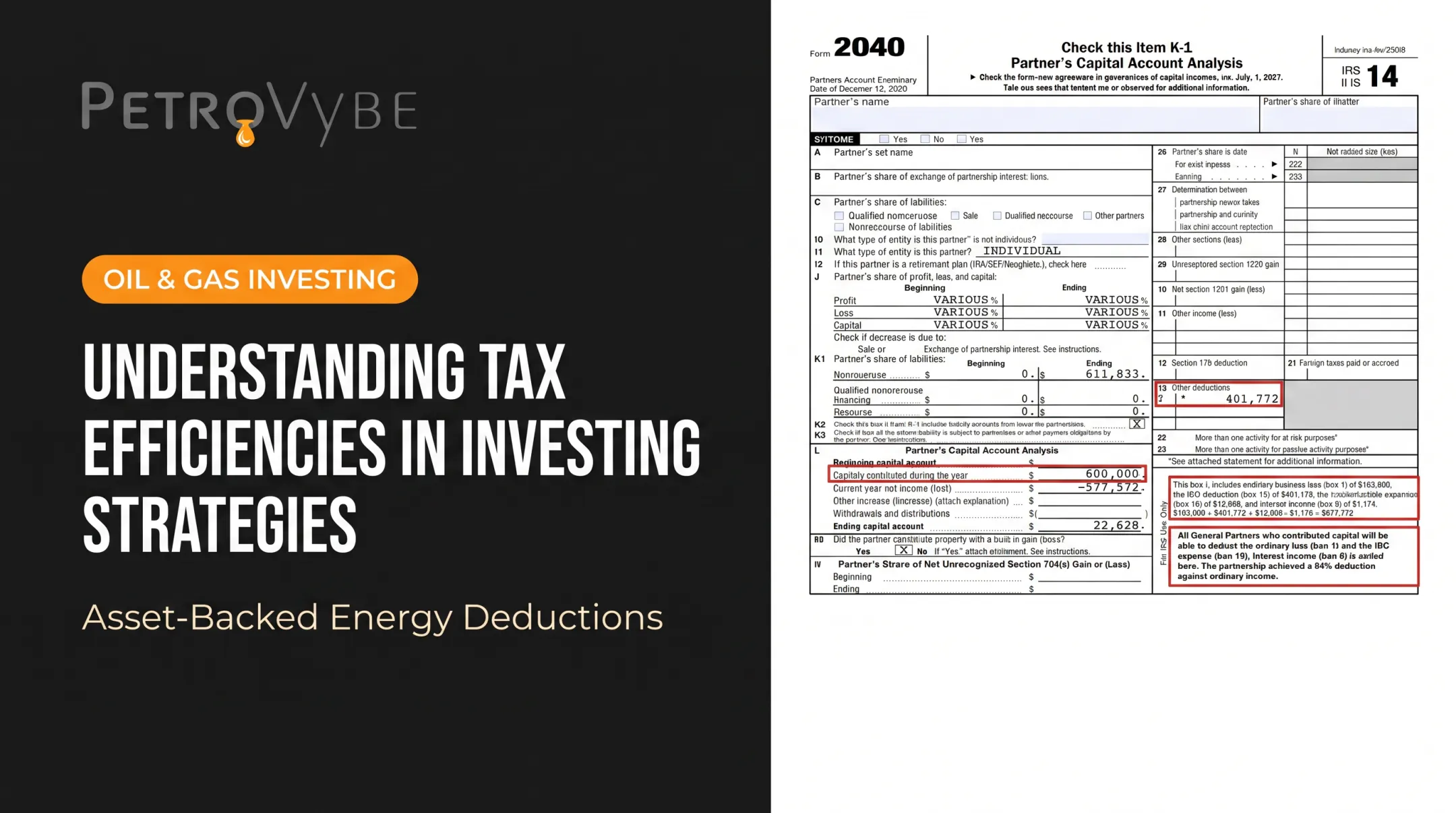
Traditional asset-location frameworks stop at stocks and bonds. They don't address direct alternative investments with fundamentally different tax mechanics, a gap for high-income earners who've already maxed out their tax-advantaged accounts. Oil and gas development investments offer something Roth IRAs and 401(k)s can't: an upfront deduction that offsets active income. Here's the mechanism. Intangible Drilling Cost (IDC) deductions under IRC Section 263(c) let investors deduct a large share of a drilling investment immediately. Unlike passive real estate losses (trapped behind passive-activity-loss rules), a working-interest exception under Section 469(c)(3)(A) lets oil and gas working interests offset W-2 income, capital gains, and other active earnings directly. That makes this effectively a fourth portfolio "location"—outside taxable, tax-deferred, and tax-exempt buckets—with its own tax treatment. PetroVybe, a private natural gas development company in South Texas's Gulf Coast Basin, puts this structure into practice. Its 2024 and 2025 partners received 91% and 94% deductions against active income, respectively, through combined IDC and depletion allowances. On a $100,000 investment, the IDC component alone typically represents 60–80% of invested capital as a deductible expense, taken in year one or spread across five years. Beyond the tax mechanics, PetroVybe builds projects for long-term production. Partners are projected to receive monthly passive distributions peaking above $10,000/month during peak production, with a targeted 2.2x–5.8x MOIC and roughly 26% IRR over a 10-year hold. These are forecasts, not guarantees, and the company's materials frame them that way. This is a narrow strategy. It requires:

- Accredited investor status: net worth over $1 million (excluding primary residence), or income above $200,000 individually / $300,000 jointly
- $100,000+ in liquidity you won't need for years
- A high current tax burden worth offsetting (not a fit for low brackets) For the right investor profile (a high-W-2 earner or business owner already maxing out Roth and 401(k) contributions and looking to diversify beyond stocks, bonds, and real estate), it's a genuine complement to account-based asset location, not a replacement for it.
Common Asset Location Mistakes to Avoid
Even solid asset-location plans fail when these common errors creep in:
- Applying a generic placement checklist. A "bonds in tax-deferred" rule ignores your actual bracket, account sizes, and time horizon. What's optimal at a 24% bracket may not be at 37%.
- Ignoring tax-loss harvesting opportunities. Moving all volatile assets into IRAs to "protect" them forfeits harvestable losses that could offset other gains.
- Over-optimizing small accounts. If your taxable account holds $15,000, the dollar impact of perfect asset location is negligible. Focus optimization effort where balances are large enough to matter.
Frequently Asked Questions
What is the most tax-efficient way to invest?
Pair account-based asset location (tax-inefficient assets in tax-deferred accounts, growth assets in Roth) with complementary strategies. High-income earners can also use energy development deductions to shelter active income.
How do I invest in assets to avoid capital gains tax?
Hold assets longer than one year to qualify for long-term rates, harvest losses to offset gains, and consider donating appreciated shares directly to charity. At death, heirs receive a step-up in basis to fair market value under IRC Section 1014.
What's the difference between asset allocation and asset location?
Asset allocation is what you own: your stock, bond, and cash mix. Asset location is where you hold those assets across taxable, tax-deferred, and tax-exempt accounts to minimize taxes.
Should I put bonds in taxable or tax-deferred accounts?
Generally tax-deferred, since bond interest is taxed at ordinary rates. In very low-yield environments, some advisors prefer holding bonds in taxable accounts instead; it depends on your bracket and the current yield curve.
Can alternative investments like oil and gas help with tax efficiency?
Yes. Intangible Drilling Cost deductions can offset active income, including W-2 earnings and capital gains. That advantage is not available with passive real estate losses or retirement accounts, and it suits accredited investors with high current tax liabilities.