This article is general education, not investment, tax, or legal advice. The energy trade looks different in 2026 than it did five years ago. Inflation keeps eating into fixed-income returns, and electricity demand is climbing at a pace utilities haven't seen since the early 2000s. Fracking, once a controversial sideline conversation, is now a mainstream portfolio question.
Investors have two real paths here. You can buy public fracking-related stocks and ETFs, trading liquidity for diluted, indirect exposure. Or you can put capital directly into private natural gas development projects, trading liquidity for direct ownership and meaningful tax advantages.
This article walks through how fracking investment actually works, the ways to get exposure, the tax benefits unique to direct development, the risks worth understanding, and how to evaluate a specific opportunity.
Key Takeaways
- Shale underpins U.S. oil and gas output—and direct development delivers IDC tax advantages public stocks cannot match.
- Public stocks/ETFs are liquid but indirect; private partnerships are illiquid but offer direct ownership and IDC deductions.
- IDC deductions, MOIC/IRR targets, and operator track record are the three things to vet before committing capital.
- AI-driven electricity demand is a real tailwind; regulatory and commodity-price risk still apply.
What Is Fracking and Why Investors Are Paying Attention
Hydraulic fracturing injects water, sand, and chemicals at high pressure into tight rock formations, releasing oil and gas trapped inside. Paired with horizontal drilling, it's the technology that turned shale basins like the Permian and Eagle Ford into the backbone of U.S. energy production.
Lower-48 onshore tight-oil output rose from 0.8 million barrels per day in 2010 to 8.9 million barrels per day in 2024, supplying 81% of Lower-48 onshore crude, according to EIA data.
Why now? Two forces are converging:
- Inflation protection: hard assets tied to commodity production tend to hold value when the dollar weakens
- AI electricity demand: data centers are pushing U.S. electricity use up sharply, and natural gas is a core part of the supply response
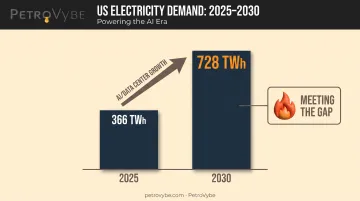
S&P Global projects U.S. data-center electricity demand growing from 366 TWh in 2025 to 728 TWh in 2030, nearly doubling in five years. That kind of load growth doesn't get met by grid upgrades alone. It needs new gas supply.
Ways to Invest in Fracking: Comparing Your Options
Most investors access fracking through public equities or private working interests. The right path depends on how you weigh liquidity, tax treatment, and how directly you want exposure to the well.
Public Market Exposure: Stocks and ETFs
Buying shares in major exploration-and-production (E&P) companies or oilfield services firms is the easiest on-ramp. Sector ETFs bundle multiple producers into a single trade, offering diversification without picking individual winners.
The tradeoffs include:
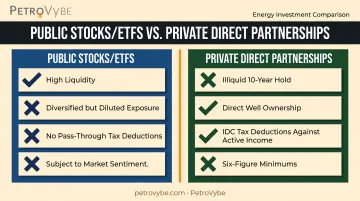
- Daily price swings tied to broad market sentiment, not just well economics
- Exposure diluted across many business lines, regions, and commodities
- No pass-through tax treatment: stock ownership does not allocate the producer's drilling deductions to you
ETFs also carry fees, bid-ask spreads, and can trade above or below net asset value, per SEC investor guidance. You're buying a slice of a company's overall performance, not a specific well.
Private Direct Development Partnerships
Accredited investors have another option: buying directly into a natural gas development project. Instead of a diluted equity stake in a public company, you own a working interest at the well, where value is actually created.
PetroVybe is one example of this model. The company focuses on Natural Gas Liquids development across a 58,000-acre position in South Texas and the Gulf Coast Basin, combining roughly 400 acquired producing wells with 57+ planned new wells.
What sets direct partnerships apart:
- Qualifying Intangible Drilling Costs (IDCs) can offset active income, which stock ownership never provides
- Capital sits in specific wells and reserves, not a diversified corporate balance sheet
- Operator track record and third-party reserve reports become central underwriting inputs. This treatment requires the investor to elect general partner status in the Subscription Agreement and may be limited in a given year by the excess business loss limitation under IRC §461(l).
On the PetroVybe project, reserves carry a $48 million PV-09 valuation from a licensed third-party engineering firm, prepared by Lee Keeling & Associates, Tulsa, March 2026, plus a clean 2025 audit from Weaver. The Chief Geophysicist's documented 75.2% career hit rate on profitable well selection sits well above the sub-40% industry peer average. Disclaimer: these results were achieved at prior companies.
The catch is illiquidity. These are typically 10-year holds requiring six-figure minimums, not something you exit on a bad Tuesday.
Tax Advantages That Make Direct Fracking Investment Unique
This is where direct development separates itself from anything public markets offer.
How IDC deductions work: Intangible Drilling Costs cover the non-salvageable expenses of bringing a well online:
- Wages, fuel, and drilling contractor costs
- Surveying and site preparation
- Everything except tangible equipment with salvage value
Federal law under IRC 263(c) lets qualifying producers expense these costs rather than capitalizing them over time.
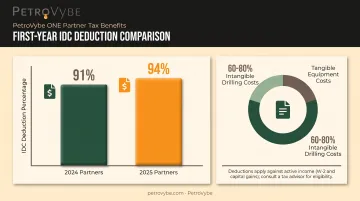
The IDC component of a well typically represents a first-year deduction target of approximately 70–80% of invested capital of total invested capital. That's the deduction pool investors work with. This treatment requires the investor to elect general partner status in the Subscription Agreement and may be limited in a given year by the excess business loss limitation under IRC §461(l).
PetroVybe reported first-year deductions of for 2025 partners and 94%** for 2025 partners**, applied against active income: W-2 wages and capital gains, not just passive income. Prior result; not a promise of any future deduction.
Unlike a passive real estate loss that only offsets other passive income, a properly structured direct interest can generate a nonpassive loss under the Section 469 working-interest exception. That loss can reduce your ordinary income directly.
What public stockholders get instead: nothing comparable. Owning shares in an E&P company means the company claims its own deductions on its own books. None of that flows through to you as a shareholder.
Eligibility depends on your income situation, entity structure, and accredited status. Talk to a tax professional before assuming any deduction percentage applies to you.
Is Fracking Growing or Declining? Industry Outlook
Short answer: growing, and the growth story is shifting.
Traditional oil demand used to be the main driver of shale drilling. That's changing. As of December 2025, the Permian still anchors U.S. shale output:
- 6.0 million bbl/d of crude — 44% of U.S. oil production
- 22.2 Bcf/d of dry natural gas — 19% of U.S. marketed gas production
Rig activity has stayed firm. Baker Hughes counted 588 active U.S. rigs in August 2026, up 50 year-over-year even with a slight weekly dip.
Steady drilling is only half the story. The stronger tailwind now is electricity demand, not oil alone:
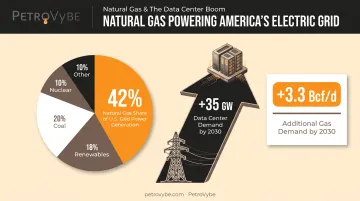
- Natural gas already supplies close to 42% of U.S. grid-power generation
- Data-center demand could add 35 gigawatts by 2030 — equivalent to roughly 40 million new homes on the grid
- That could translate to an additional 3.3 Bcf/d of gas demand by 2030, with some estimates running as high as 6–10 Bcf/d
Regulatory headwinds still exist. New York banned high-volume hydraulic fracturing statewide in 2015, and Vermont has similar restrictions.
Those limits are state-level, not national. Shale is deeply embedded in Texas, New Mexico, and North Dakota economies, so a broad federal shutdown remains unlikely near term. For investors watching the gas-for-power shift, that keeps development focused where acreage, midstream, and grid demand already intersect—especially across major U.S. producing basins.
Risks Every Fracking Investor Should Understand
No energy investment is risk-free. Three categories matter most.
Commodity price volatility. Well economics live and die by price. The Dallas Fed's 2025 survey found producers needed an average of $65/bbl WTI just to profitably drill a new well, with regional breakevens ranging $61-$70/bbl. Natural gas is even choppier. Henry Hub volatility hit 102% on a 30-day basis in early February 2025.
Environmental and regulatory risk. Permitting delays, EPA methane rules, and state-level restrictions can all slow projects or raise compliance costs. Operators with active permits, compliance systems, and basin-level regulatory experience absorb less of that drag than newer entrants.
Capital intensity. Drilling and completing wells requires significant upfront spend before any revenue arrives. This makes operator vetting non-negotiable:
- Audited financials and clear capital accounts
- Geological expertise backed by historical success rates
- Documented results across prior projects, not marketing decks
How to Evaluate a Fracking Investment Opportunity
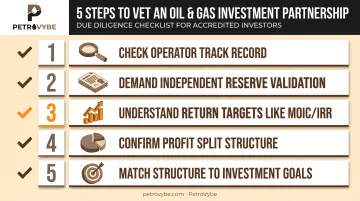
Before writing a check, run through this checklist.
- Check the operator's track record. Ask for historical well success rates with numbers you can verify. PetroVybe's Chief Geophysicist, for example, cites a 48-year career and a 75.2% hit rate.
- Demand independent reserve validation. Look for a PV-09 or PV-10 report from a licensed third-party engineering firm, not an internal estimate.
- Understand the return targets. PetroVybe discloses a 10-year modeled net exit MOIC of roughly 2.2x to 5.8x and a target IRR near 26%, framed explicitly as forecasts, not guarantees.
- Confirm the profit split. An 80/20 structure favoring investors, as PetroVybe uses, tells you how upside gets divided once the project performs.
- Match structure to your goals. If you need liquidity next year, public markets fit better. If you're building tax-advantaged legacy wealth over a decade, direct partnerships make more sense.
Don't skip the paperwork. Review the private-placement memorandum, subscription agreement, and financial statements line by line, or have a tax attorney do it for you.
Frequently Asked Questions
Is investing in fracking a good idea?
It can be, if you can handle commodity and operational risk and do not need daily liquidity. Investors who want tax efficiency and direct ownership often favor private partnerships; those who prioritize easy entry and exit usually stick with public stocks.
Is fracking growing or declining?
Fracking activity is growing, with rig counts up year-over-year and Permian output still expanding. The newer driver is AI-related electricity demand, not just traditional oil consumption.
What's the difference between investing in fracking stocks versus private development projects?
Stocks and ETFs offer liquidity and diversification but no direct tax benefit. Private partnerships offer direct ownership, IDC deductions against active income, and typically require a multi-year commitment. This treatment requires the investor to elect general partner status in the Subscription Agreement and may be limited in a given year by the excess business loss limitation under IRC §461(l).
How much capital is needed to invest in fracking?
Public stocks and ETFs require minimal capital, sometimes just the price of one share. Private accredited-investor partnerships, like PetroVybe. Participation begins at one unit of $100,000, with add-on subscriptions from $25,000.
What tax benefits are available to fracking investors?
Direct development partnerships can offer IDC deductions against active income, including W-2 wages and capital gains. Public stockholders receive no comparable pass-through deduction. This treatment requires the investor to elect general partner status in the Subscription Agreement and may be limited in a given year by the excess business loss limitation under IRC §461(l).
Who can invest in private fracking development projects?
Only accredited investors may participate—generally $1 million+ net worth excluding primary residence, or income above $200,000 individually ($300,000 jointly). A CPA, attorney, or licensed advisor typically verifies accredited status.
Informational requests only. PetroVybe projects are offered solely to verified accredited investors. Submitting this form does not create an investment or advisory relationship.