Introduction
Scroll through any pitch deck for a hedge fund, private placement, or oil and gas development program, and you'll likely see "qualified investor" and "accredited investor" used as if they mean the same thing. They don't.
This mix-up isn't just a semantic quibble. Misreading these terms can disqualify you from a Reg D 506(c) offering, or cause an issuer to miscalculate who's actually eligible to invest.
Private placements demand exact compliance, so getting the terminology wrong is a costly mistake for either side.
This article breaks down the SEC's formal accredited investor standard and the looser "qualified investor" terminology, which usually means something different depending on where you live.
It also explains how each classification affects your access to opportunities like private natural gas development programs.
Key Takeaways
- Accredited investor is a formal SEC term under Regulation D, based on income, net worth, or licensing
- "Qualified investor" isn't an official U.S. term—it's shorthand for MiFID II clients abroad or "qualified purchasers" domestically
- Qualified purchasers need $5M+ in investments; accredited investors need roughly $1M net worth or $200k/$300k income
- Most private placements, including PetroVybe's oil and gas programs, use the more accessible accredited investor standard
Qualified Investor vs Accredited Investor: Quick Comparison
| Category | Qualified Investor/Purchaser | Accredited Investor |
|---|---|---|
| Governing Regulation | MiFID II (EU) for professional clients; loosely used in the U.S. for "qualified purchaser" under the Investment Company Act of 1940 | Regulation D, Rule 501 of the Securities Act of 1933 |
| Minimum Threshold | $5M+ in investments (individual); $25M+ if investing discretionarily for others | $1M net worth (excluding primary residence), or $200k/$300k income |
| Fund Access | Section 3(c)(7) funds (no investor-count cap under the Investment Company Act, though other rules may apply) | 3(c)(1) funds (capped at 100–250 investors) and most Reg D placements |
| Verification | Issuer confirms holdings and supporting documentation | Self-certification (506(b)) or mandatory third-party verification (506(c)) |
A qualified purchaser needs five times the investable assets required for accredited investor status, which is exactly why most private placements skip the higher bar entirely. For PetroVybe's oil and gas partnerships, this distinction matters directly: the offering is structured for accredited investors under Regulation D, not the steeper $5M+ threshold required of qualified purchasers.
What Is a Qualified Investor?
Here's where the confusion starts: "qualified investor" carries two entirely different meanings depending on jurisdiction.
Outside the U.S., particularly in the EU, it's a formal category under MiFID II (the Markets in Financial Instruments Directive). Inside the U.S., it's informal shorthand for "qualified purchaser" under the Investment Company Act of 1940, a term with real teeth but no relationship to MiFID II at all.
The U.S. qualified purchaser standard requires one of the following:
- A natural person owning $5 million or more in investments, including assets held jointly with a spouse
- A person or entity investing $25 million or more on a discretionary basis for other qualified purchasers
- A family-owned company holding $5 million or more in investments (provided it wasn't formed solely to buy into a specific fund)
- A trust where every settlor and the decision-maker are themselves qualified purchasers
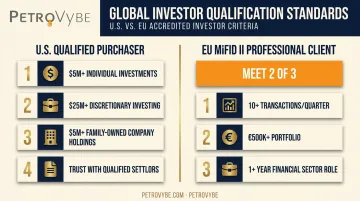
MiFID II's elective professional-client test works differently. A client must meet at least two of these three criteria:
- Executed an average of 10 significant transactions per quarter over the past year
- Holds a financial-instrument portfolio (including cash) exceeding €500,000
- Worked in the financial sector for at least one year in a role requiring relevant expertise
Under MiFID II's Annex II criteria, firms must also assess the client's actual expertise before granting professional status, and the client must acknowledge in writing that they're giving up certain protections.
Use Cases of Qualified Purchasers
Qualified purchaser status matters primarily for one thing: accessing Section 3(c)(7) funds, vehicles designed to sidestep the ownership restrictions imposed on 3(c)(1) funds.
You'll rarely see this requirement in smaller private placements. It's reserved for:
- Large institutional-grade hedge funds
- Fund-of-funds structures
- Private equity vehicles targeting sophisticated, deep-pocketed capital
The pool of investors who clear this bar is genuinely small. For comparison, the SEC estimates that 24.3 million U.S. households (18.5%) qualify as accredited investors based on 2022 Federal Reserve data, according to SEC staff analysis of Survey of Consumer Finances data. No comparable public count exists for qualified purchasers, but given the $5M investment floor, that pool is a fraction of the accredited universe.
What Is an Accredited Investor?
This is the term that actually governs most private placements you'll encounter, including oil and gas development partnerships.
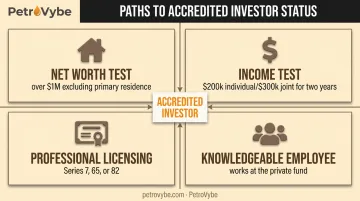
Under SEC Rule 501 (Regulation D), an individual qualifies through any of these paths:
- Net worth test: Over $1 million, excluding the value of your primary residence
- Income test: Over $200,000 individually (or $300,000 jointly) in each of the past two years, with reasonable expectation of the same this year
- Professional licensing: Holding a Series 7, 65, or 82 license in good standing
- Knowledgeable employee status: Working directly for the private fund in a role involving its investment activities
Entities can qualify too. Trusts, LLCs, corporations, or family offices qualify if they hold over $5 million in assets, or if every equity owner is individually accredited.
Why does this matter practically? Accreditation opens the door to Reg D 506(b) and 506(c) private placements, exempt from full SEC registration, covering everything from venture capital to direct oil and gas development programs.
The verification difference is real:
| Rule | Solicitation | Verification Method |
|---|---|---|
| 506(b) | Not permitted | Self-certification |
| 506(c) | Permitted | Mandatory third-party verification |
PetroVybe ONE, for example, operates exclusively under Rule 506(c). That means investors must produce a formal accreditation letter from a CPA, tax attorney, or licensed financial advisor before they can participate, since general solicitation removes the option of simple self-attestation.
Use Cases of Accredited Investors
Accredited status shows up constantly across private markets:
- Hedge funds and venture capital funds
- Real estate syndications
- Private oil and gas development partnerships offering tax-advantaged structures like intangible drilling cost (IDC) deductions
The income test is what widens the door for so many people. Many high-earning W-2 professionals and business owners qualify through income alone, without ever hitting the $1 million net worth mark, let alone the $5 million qualified purchaser threshold.
That's a meaningfully larger population than the qualified purchaser pool, and it's why accredited status remains the practical gateway for most private capital-raising.
Qualified Investor vs Accredited Investor: Which Status Matters for Your Investment Goals?
Your decision really comes down to three factors:
- Fund type: Is it a 3(c)(1) fund (accredited investors, capped ownership) or a 3(c)(7) fund (qualified purchasers only)?
- Minimum investment size: Smaller raises rarely require qualified purchaser status
- Solicitation method: General solicitation under 506(c) triggers mandatory verification requirements
For most private placements raising under $10 million through a 3(c)(1) structure, accredited investor status is sufficient. Qualified purchaser status only becomes relevant for large institutional-style funds using the 3(c)(7) exemption.
Most direct participation programs in natural resources, including PetroVybe's natural gas development opportunities across South Texas and the Gulf Coast Basin, are structured specifically for accredited investors. This balances SEC compliance with a broader, more realistic investor pool.
Here's a practical example: A W-2 earner making $250,000 a year meets the accredited investor income test easily, no $1M net worth required.
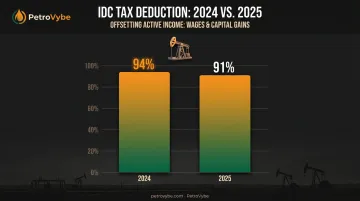
That single qualification opens the door to PetroVybe's oil and gas development partnerships. In 2024 and 2025, partners received 94% and 91% tax deductions, respectively, against active income like wages and capital gains through intangible drilling cost deductions.
That's a meaningfully different outcome than chasing a $5 million qualified purchaser threshold for a fund they don't actually need.
If you meet the accredited investor income or net worth test, you may already qualify for opportunities like PetroVybe ONE. Review the partnership criteria to confirm your eligibility before scheduling a discovery call.
Conclusion
Accredited investor is the well-defined, more accessible U.S. standard governing most private placements. Qualified investor, by contrast, is either an EU regulatory designation or informal shorthand for the much higher qualified purchaser bar.
Knowing which status you actually hold determines which private funds, real estate syndications, or oil and gas development programs—like PetroVybe's natural gas partnerships—you can pursue. Get it right upfront, and you save yourself from chasing opportunities you were never eligible for in the first place.
Frequently Asked Questions
Who is considered a qualified investor?
Outside the U.S., it typically refers to MiFID II professional clients based on portfolio size or financial experience. In the U.S., it's informal shorthand for a "qualified purchaser" with $5 million or more in investments.
What is considered a qualified investment?
A qualified investment generally means holdings like stocks, bonds, funds, or investment real estate that count toward the asset thresholds for qualified purchaser or accredited investor status. Your primary residence doesn't count.
Is a qualified investor the same as an accredited investor?
No. Accredited investor is an SEC-defined term with lower thresholds (roughly $1M net worth or $200k/$300k income). Qualified investor/purchaser status requires substantially higher investable assets, generally $5 million or more.
Can I become an accredited investor without $1 million in net worth?
Yes. The income test ($200,000 individually or $300,000 jointly for two years) qualifies you without meeting the net worth threshold. Holding a Series 7, 65, or 82 license also qualifies you.
How is accredited investor status verified for private placements?
Under Rule 506(b), issuers can accept self-certification. Under Rule 506(c), issuers must obtain mandatory third-party verification, typically a letter from a CPA, tax attorney, or licensed financial advisor.
What happens if I invest in a private placement without meeting accredited investor requirements?
The issuer risks losing its Regulation D exemption for that sale, and you may gain rescission rights under securities law. This is why compliant issuers, including PetroVybe, verify accredited status directly with partners before accepting capital.