
Introduction
Cross $626,350 in taxable income as a single filer in 2025, or $751,600 married filing jointly, and you're in the top 37% federal bracket — the same threshold outlined in the IRS's 2025 inflation adjustments.
Average physician starting salaries now sit at $403,000, according to Medscape's 2024 Physician Compensation Report, with specialties like orthopedic surgery averaging $576,000. Plenty of attendings land in the top bracket within a few years of finishing training.
A six-figure paycheck sounds like financial freedom. In practice, federal tax, self-employment tax, state tax, and phased-out deductions can quietly claim close to half of it before a dollar reaches investable savings.
Here's the part most physicians miss: that burden isn't fixed by income alone. It's driven by entity choices and missed deductions, compounded by a lack of proactive planning.
This article breaks down how that burden builds, what drives it, and three practical strategy categories, whether you're a W2 employee, a 1099 contractor, or a practice owner.
Key Takeaways
- Physician taxes compound across brackets, self-employment tax, SALT caps, and phase-outs
- New attendings often lose Roth eligibility and QBI deductions in a single bracket jump
- Strategies split into three buckets: upfront decisions, ongoing management, and investment context
- W2-only physicians have fewer levers but still benefit from retirement stacking and alternative assets
- Certain natural gas investments deduct against active income, unlike typical real estate
How Tax Burden Builds Up for Physicians
Tax burden rarely shows up as one visible expense. It accumulates through payroll withholding for W2 physicians, self-employment tax accrual for 1099 earners, and quarterly estimated payments for anyone with locum or contract income. None of these feel dramatic in the moment. They add up in the background.
Bracket Creep Happens in Sudden Cliffs
As income climbs from residency to attending pay, physicians don't just pay a bit more tax. They cross thresholds that eliminate entire benefits:
- Direct Roth IRA eligibility phases out between $150,000–$165,000 MAGI for single filers, and $236,000–$246,000 for married couples filing jointly (2025 figures)
- QBI deduction for self-employed physicians (classified as a specified service trade or business) phases out entirely above $247,300 single / $494,600 MFJ
- Additional Medicare Tax of 0.9% applies to wages above $200,000 single / $250,000 MFJ, a threshold many physicians cross in their first attending year
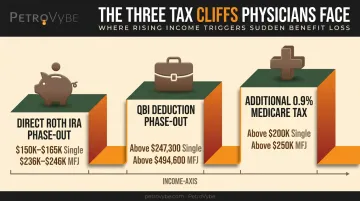
These aren't smooth increases. They're step-changes that catch physicians off guard, especially in the first year or two after residency.
Much of this cost stays invisible until tax filing season, when underwithholding, missed quarterly payments, or unclaimed deductions surface all at once. It's a common shock for physicians juggling 1099 locum shifts alongside W2 hospital work.
Key Tax Burden Drivers for Physicians
The single biggest driver is compensation structure. W2 employees have limited deduction options: unreimbursed expenses and home office deductions generally aren't available to them. 1099 earners and practice owners, on the other hand, can access business deductions, retirement plan design, and entity elections that pure employees can't touch.
Self-employment tax compounds this gap. It totals 15.3% (12.4% for Social Security and 2.9% for Medicare), applied to 92.35% of net self-employment earnings, on top of ordinary income tax.
Other drivers worth flagging:
- Career stage: new attendings lose Roth eligibility and QBI benefits abruptly; veteran practice owners face entity restructuring and succession questions
- Early structural choices: entity election, retirement plan design, and investment allocation matter more than day-to-day spending
- State of residence: the SALT deduction cap ranges from $10,000 to $40,000 depending on current law, and multi-state locum work adds nonresident filing complexity
The strategies below carry different weight depending on whether you're a W2 employee, a 1099 contractor, or a practice owner. Read on for what applies to you.
Tax-Reduction Strategies for Physicians
Effective tax reduction works through a set of levers that activate at different points. Some strategies are decisions made once, upfront. Others require ongoing management throughout the year. A third category depends on the investment context you build around your income.
Strategies That Reduce Taxes by Changing Decisions
These are structural choices made before or around the time income is earned, not adjustments made after the fact.
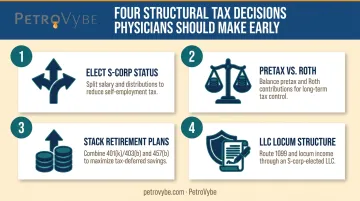
- Elect S-corp status if self-employed. Split income between a "reasonable salary" and distributions to reduce self-employment tax exposure on the distribution portion. The IRS judges "reasonable" using factors like training, duties, and comparable pay.
- Choose pretax vs. Roth contributions deliberately. The right choice depends on your current bracket versus a realistic projection of your retirement-year tax rate, not just the assumption that Roth is always better.
- Stack employer retirement plans early. A 401(k)/403(b) allows $23,500 in employee deferrals for 2025 (plus a $7,500 catch-up at 50+), and a governmental 457(b) adds a separate limit. Physicians with access to both can significantly boost deductible contributions.
- Structure 1099 or locum income through an LLC electing S-corp taxation rather than reporting as a sole proprietor. This one decision often has the largest single impact on self-employment tax for locum physicians.
Strategies That Reduce Taxes by Changing How Taxes Are Managed
Unlike the decisions above, these are ongoing habits repeated every year, and they improve consistency and control over time.
- Make timely quarterly estimated payments. Skipping this triggers underpayment penalties for 1099 and locum physicians. Safe harbor requires paying the lesser of 90% of current-year tax or 100% (110% for high earners) of last year's tax.
- Max out HSA contributions and backdoor Roth conversions annually. 2025 HSA limits are $4,300 self-only and $8,550 family. Backdoor Roths work well for high earners, but watch the pro-rata rule if you hold existing pretax IRA balances, since it can make part of the conversion taxable.
- Harvest tax losses in taxable brokerage accounts. This offsets capital gains and up to $3,000 of ordinary income annually. Avoid repurchasing the same or a substantially identical security within 30 days, which triggers the wash-sale rule and disallows the loss.
- Bunch charitable contributions through a donor-advised fund in high-income years. Funneling several years of giving into one high-earning year can push you over the itemization threshold.
Strategies That Reduce Taxes by Changing the Context Around Taxes
For high-earning W2 physicians especially, the paycheck itself has limited flexibility. The real remaining lever is the investment context surrounding it.
Real estate strategies exist, but access is narrow. Real Estate Professional Status requires one spouse to spend more than 750 hours and more than half of all personal service time in real property trades.
Short-term rental strategies can also convert losses into active offsets, but only with genuine material participation. Most full-time physicians simply don't clear that bar.
Natural gas and oil development programs work differently. Under IRC Section 263(c), investors can elect to expense qualifying Intangible Drilling Costs (IDCs). Because working interests held without limited liability aren't classified as passive activities, these deductions can offset active W2 and 1099 income directly, not just passive income.
This is the mechanism behind PetroVybe's structure. Investors hold units in a limited partnership (PetroVybe Partners LP) and receive a Schedule K-1 reporting their share of IDC deductions. That deduction can apply against active earnings in the year it's incurred, or spread over five years.
Based on PetroVybe's internal reporting, partners in the 2024 tax year saw deductions around 94% of invested capital against active income, with 2025 partnerships tracking near 91%. That's meaningfully above the 60–80% range typical of new-drilling IDC programs generally.
A few things worth checking before committing capital to any development program:
- Does the sponsor hold an active operator's license (in Texas, verifiable through the Texas Railroad Commission)?
- Is there an independent audit and third-party reserve engineering report?
- Are reviews verifiable through a platform like Invest Clearly, sourced from actual accredited investors?
The IRS's annual "Dirty Dozen" list flags abusive shelters: often inflated appraisals or syndicated conservation easements with no real underlying asset. Legitimate development programs look different, built on third-party engineered reserves, regulatory licensing, and audited financials that anyone can independently check.
PetroVybe requires accredited investor status and a $100,000 minimum. It discloses its RRC operator license, its 2025 Weaver audit, and a $48 million third-party PV-09 reserve valuation for exactly this reason.
Conclusion
Reducing physician tax burden comes down to identifying which lever actually applies to your situation: personal decisions, practice structure, or broader financial context. A W2 hospitalist and a practice-owning surgeon are working with entirely different toolkits.
Tax planning isn't a one-time project, either. Bracket thresholds shift, contribution limits rise, and eligibility rules change as your income grows and tax law evolves. What worked in your PGY years won't necessarily work five years into attending life, particularly once new income streams enter the picture, including tax-advantaged investments outside traditional retirement accounts.
Frequently Asked Questions
How to minimize taxes as a physician?
Maximize retirement contributions across every plan you're eligible for, choose the right entity structure if you're self-employed, and layer in tax-advantaged tools like HSAs, backdoor Roths, and qualifying alternative investments where they fit your income type.
What can a doctor write off on taxes?
Self-employed and 1099 physicians can typically deduct CME that maintains existing skills, licensing fees, malpractice insurance, and other ordinary business expenses. W2 physicians generally can't deduct unreimbursed employee expenses or claim a home office.
Is an S-Corp election worth it for physician practice owners?
It can meaningfully reduce self-employment tax by splitting income into salary and distributions, but the benefit depends on your income level, a defensible "reasonable salary," and the added payroll and administrative costs.
What is a backdoor Roth IRA and why do physicians use it?
It's a two-step process: a nondeductible traditional IRA contribution followed by a Roth conversion, used by high earners above direct Roth income limits. Watch the pro-rata rule if you hold existing pretax IRA balances; it can make part of the conversion taxable.
Can W2 physicians use alternative investments like oil and gas or real estate to reduce their tax bill?
Real estate losses are usually limited to offsetting passive income unless you qualify as a real estate professional. Certain natural gas development investments, such as PetroVybe's IDC-deduction structured projects, can offset active W2 income directly.
How often should physicians revisit their tax strategy?
At minimum, once a year, ideally before year-end when there's still time to act. Revisit immediately after any major life or career change, like a new job, marriage, or a jump into practice ownership.