The Permian Basin alone produced 6.6 million barrels per day in 2025, accounting for 48% of total U.S. crude oil production. That's nearly half the country's output from one region in West Texas and southeastern New Mexico.
For 2025-2026, Texas oil companies offer two distinct paths: publicly traded stocks with liquidity and dividends, or private development deals with direct tax advantages. There's also a newer angle worth watching — natural gas producers positioning themselves to fuel the electricity demand spike coming from AI data centers.
TL;DR
- Public E&P names like ConocoPhillips, EOG, Diamondback, and Oxy offer liquid stock exposure to Permian and Gulf Coast assets
- PetroVybe gives accredited investors direct partnership-unit access with large upfront tax deductions
- Weigh acreage quality, balance sheet strength, tax efficiency, and management track record
- Private gas development can deliver IDC tax advantages public equities typically cannot
Overview of Texas Oil & Gas Investment Landscape
Texas anchors American energy production. The Permian Basin, Eagle Ford Shale, and Gulf Coast formations make it the single largest producing state in the country by a wide margin.
U.S. crude oil production averaged 13.2 million barrels per day in 2024, up 270,000 b/d from the prior year, according to the EIA. Much of that growth traces to Texas operators drilling more efficient wells at lower breakeven costs.
Power demand is shifting in parallel. ERCOT projected large flexible load, driven heavily by data centers and AI infrastructure, would hit 54 billion kWh in 2025, nearly 60% above 2024 levels. Natural gas producers are increasingly viewed as the backbone fuel for that growth.
Investors are putting capital to work across 2025–2026 through public equities and private development partnerships.
Top Texas Oil Companies to Invest In
Each profile below is filtered on five things: acreage quality, cost structure, tax efficiency, balance sheet strength, and growth trajectory.
PetroVybe
PetroVybe is a private American oil and gas development company focused on Natural Gas Liquids production across South Texas and the Gulf Coast Basin. It operates under a Texas Railroad Commission operator's license through its PetroVybe OpCo LLC entity.
What sets it apart is the leadership bench. Results below were achieved at prior companies and are not indicative of PetroVybe results:
- Blaine Yeary (President & COO): scaled a $5 billion asset from zero to 35,000 BOEPD over eight years
- Michael Stamatedes (Chief Geophysicist): documented 75.2% success rate selecting profitable well locations over 48 years, vs. an industry peer average below 40%
- Peter A. Snell (CEO): led a 5x year-over-year EBITDAX turnaround at a prior development company
PetroVybe's current position includes roughly 400 acquired wells and 57-plus planned new wells across a 58,000-acre position in Lavaca County, part of the broader Gulf Coast Basin. The project carries a $48 million proved-reserves valuation (PV-09), verified by an independent, licensed third-party engineering firm.
| Metric | Details |
|---|---|
| Investment Type | Direct partnership position in natural gas development (not publicly traded stock) |
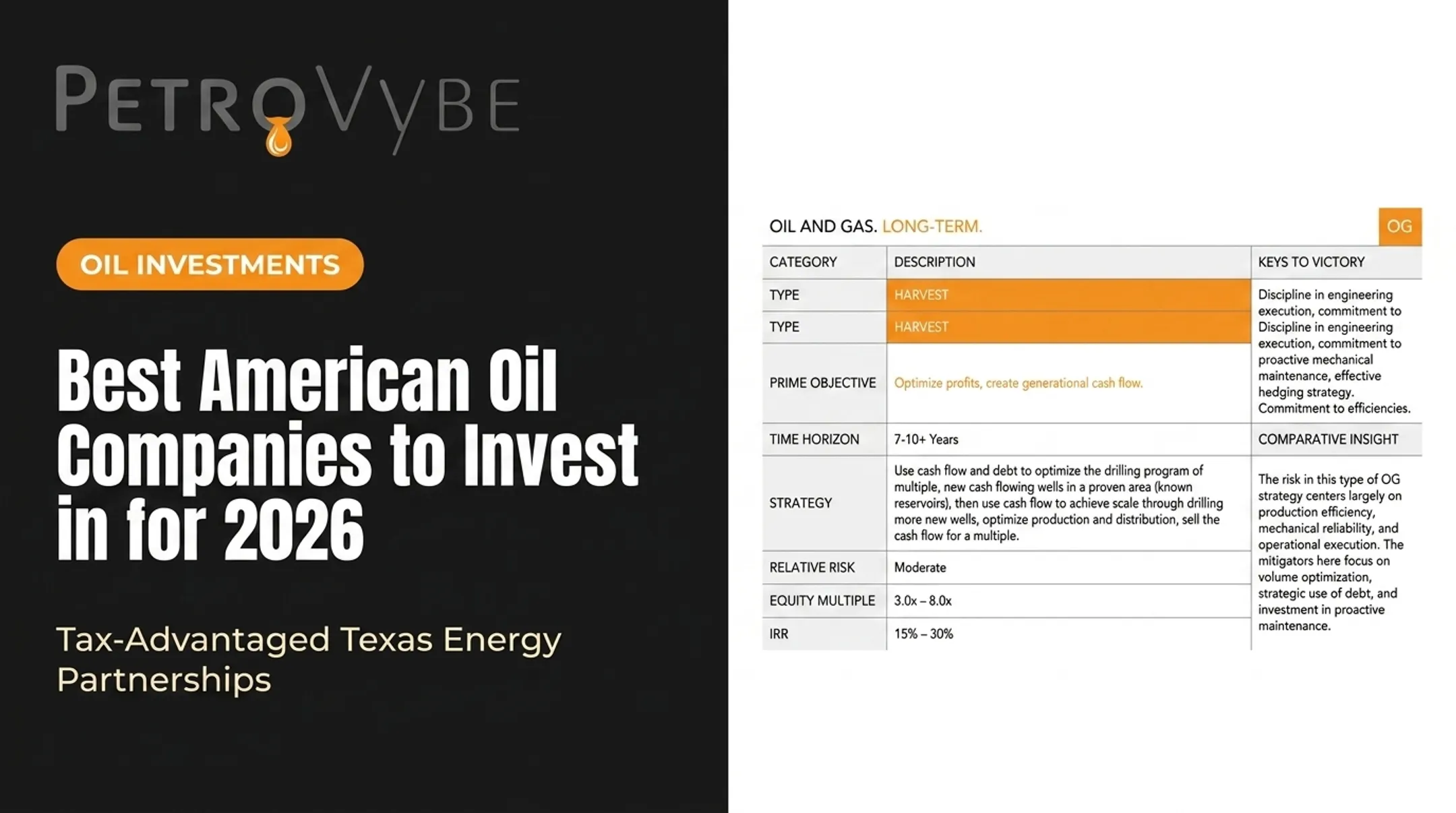
| Target Returns | 10-year target MOIC of ~2.2x–5.8x and target IRR of ~26% |
| Tax Treatment | Up to 100% total deduction with ~70% first-year deduction against active income via IDC |

This isn't a stock you buy on your phone during lunch. It's a direct partnership position, so accredited investors get entry-point exposure to gas development rather than secondhand exposure through a share price.
ConocoPhillips
ConocoPhillips is the Houston-headquartered heavyweight, holding one of the largest Tier 1 acreage positions in the Permian's Delaware sub-basin: roughly 792,000 unconventional net acres, according to the company's 2024 Annual Report.
The company returned $9.1 billion to shareholders in 2024, split between $5.5 billion in dividends/variable cash returns and $3.6 billion in buybacks. That's a serious capital-return machine.
| Metric | Details |
|---|---|
| Stock Ticker | NYSE: COP |
| Key Region | Permian Basin (Delaware sub-basin), Eagle Ford, Bakken |
| Investor Appeal | Dividend growth targets, share buybacks, low-cost production |
EOG Resources
EOG runs a high-margin, technology-first drilling operation spanning the Permian and Eagle Ford. In the Eagle Ford alone, EOG holds approximately 535,000 net acres and completed 160 net wells in 2024.
The company raised its regular dividend 7% for 2024 results and committed $6.2 billion to its 2025 capital plan. EOG has built a reputation for disciplined spending — it doesn't chase production growth at the expense of returns.
| Metric | Details |
|---|---|
| Stock Ticker | NYSE: EOG |
| Key Region | Permian Basin, Eagle Ford (Texas-focused) |
| Investor Appeal | Decades-long dividend growth history, disciplined capital allocation |
Diamondback Energy
Diamondback is Midland, Texas born-and-bred, a pure-play Permian operator with no distractions elsewhere. It develops the Midland and Delaware Basins, targeting the Spraberry and Wolfcamp formations.
Q2 2024 production hit 276.1 MBO/d of oil, or 474.7 MBOE/d total. For investors who want concentrated Permian exposure without diversification diluting the story, Diamondback is about as pure as it gets.
| Metric | Details |
|---|---|
| Stock Ticker | NASDAQ: FANG |
| Key Region | Midland Basin & Delaware Basin, West Texas |
| Investor Appeal | Pure Permian exposure, strong production growth profile |
Occidental Petroleum
Occidental holds roughly 10% of total Permian oil production as of 2024, per its 10-K filing. But what makes Occidental different is the second act it's building alongside oil production: carbon capture.
The company's STRATOS direct-air-capture facility in Ector County is designed to capture up to 500,000 tonnes of CO2 annually. Occidental's subsidiary, 1PointFive, also secured up to $500 million in Department of Energy funding for a South Texas DAC hub.
| Metric | Details |
|---|---|
| Stock Ticker | NYSE: OXY |
| Key Region | Permian Basin, Gulf Coast |
| Investor Appeal | Oil and gas cash flow plus emerging low-carbon technology upside |

How We Chose the Best Texas Oil Companies
Investors make the same mistakes over and over. Chasing dividend yield without checking the balance sheet. Ignoring breakeven costs until oil prices dip. Assuming reserve estimates are gospel without third-party verification.
We screened companies against five criteria:
- Acreage quality: Tier 1 Permian, Eagle Ford, or Gulf Coast positions with proven productivity
- Financial resilience: balance sheet strength that survives commodity downturns, not just boom-year optimism
- Third-party validation: independent engineering reports on reserves, not just internal projections
- Management track record: teams that have actually scaled assets before, with verifiable numbers
- Tax efficiency: whether you're buying stock or a direct working interest, tax treatment shapes your real return

Public companies win on liquidity. Private developers like PetroVybe offer stronger tax structure and direct asset ownership. The right fit depends on whether you prioritize exit flexibility or tax-advantaged ownership.
Conclusion
There's no single "best" Texas oil investment for 2025-2026. It comes down to what you need: liquidity and dividends from public markets, or long-term tax-advantaged returns from private development.
Before committing capital anywhere, dig into three things:
- Management team's actual track record
- Quality of the underlying acreage
- How the investment gets taxed
Those three factors will tell you more than any headline production number.
If you're an accredited investor exploring natural gas development beyond the stock market, PetroVybe's South Texas and Gulf Coast Basin projects are worth a closer look, particularly given the tax treatment and the team's operating history in scaling similar assets.
Frequently Asked Questions
Which Texas oil companies should I invest in?
Top public options include ConocoPhillips, EOG Resources, and Diamondback Energy for stock exposure. Accredited investors seeking direct, tax-advantaged positions might also consider private developers like PetroVybe.
What is the difference between investing in oil stocks and private oil and gas development?
Stocks offer liquidity and market-priced returns you can exit anytime. Private development investments give you a direct working interest, meaningful tax deductions, and a longer hold period, often a decade.
Are Texas oil and gas investments tax-advantaged?
Direct working-interest owners can claim Intangible Drilling Cost (IDC) deductions against active income, per IRS guidance. Public stock investors, by contrast, get standard capital gains treatment on any sale.
Is now a good time to invest in Texas oil and gas?
Production trends remain strong, and rising AI/data-center electricity demand is creating new tailwinds for natural gas specifically. Timing still depends on your risk tolerance and investment horizon.
Who can invest in private oil and gas development companies like PetroVybe?
These opportunities are generally limited to accredited investors. That means a net worth over $1 million (excluding primary residence) or income over $200,000 individually ($300,000 jointly) in the past two years.
What risks should I consider before investing in oil and gas?
Commodity price volatility can swing returns significantly, and geopolitical events add unpredictability. Private development investments also carry illiquidity risk since you can't easily exit before the hold period ends.