

Here's the problem. "Investing in an LP" means wildly different things depending on the vehicle. A publicly traded master limited partnership (MLP) trades like a stock, with daily liquidity and no accreditation requirement. A private placement energy development program can require $100,000 or more, lock your capital up for a decade, and demand accredited investor status before you see a single offering document.
This guide walks through the exact steps to invest, what you need before you commit capital, the variables that actually drive returns, and the mistakes that trip up first-time LP investors.
Key Takeaways
- General Partners manage operations and carry liability; Limited Partners invest passively
- LP vehicles range from liquid public MLPs to illiquid private placements
- Most LPs use pass-through taxation, reporting income via Schedule K-1s
- Returns depend on GP track record, fee structure, and asset tax treatment
- Private LP deals require accredited status, six-figure minimums, and multi-year patience
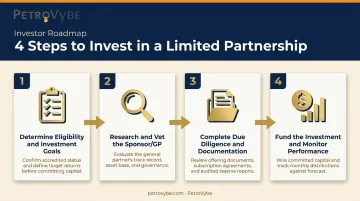
How to Invest in Limited Partnerships: Step-by-Step
Every LP investment follows a similar sequence, whether you're buying units on an exchange or committing capital to a private energy program.
Step 1: Determine Your Eligibility and Investment Goals
First, figure out which door you're walking through. Publicly traded MLPs are open to anyone with a brokerage account.
Private placement LPs generally require accredited investor status under SEC Rule 501: net worth above $1 million excluding your primary residence, or income above $200,000 individually ($300,000 jointly) for the past two years.
Next, clarify your objective. Are you after passive income, a deduction against active W-2 income, long-term appreciation, or portfolio diversification? Your answer determines which LP type actually fits.
Step 2: Research and Vet the Sponsor/General Partner
The GP makes or breaks the investment. Evaluate:
- Prior fund performance and years of operational history
- Independent third-party engineering or valuation reports backing asset claims
- The Limited Partnership Agreement (LPA) or private placement memorandum (PPM), specifically fee structure, profit-sharing waterfall, and exit terms
Don't skip the PPM. It's a contract, not marketing material.
Step 3: Complete Due Diligence and Documentation
Gather your subscription agreement, proof of accreditation, and funding source details required by the sponsor's compliance team. Then consult a tax advisor to model your expected K-1 impact — including IDC deductions for oil and gas LPs, basis changes, and how the investment fits your broader tax strategy.
Step 4: Fund the Investment and Monitor Ongoing Performance
Choose your funding method: direct capital, a self-directed IRA, or rollover proceeds. Confirm minimum thresholds first. Once funded, track:
- Annual distributions and capital account statements
- K-1 filings (these often arrive later than a standard 1099)
- Reinvestment versus cash-out decisions at liquidity events
What You Need Before Investing in a Limited Partnership
Preparation on eligibility, capital, and paperwork directly determines which LP opportunities you can access and how smoothly your investment closes.
Investor Eligibility and Accreditation
Most private placement LPs require accredited investor verification, and reputable sponsors don't just take your word for it. PetroVybe, for example, requires prospective investors in its PetroVybe ONE program to confirm accreditation through a qualified third party (a CPA, tax attorney, or licensed financial advisor) verified through Accredited Investor Partners before any capital moves.
Capital and Liquidity Planning
Private LPs typically require $50,000 to $100,000+ minimums, with multi-year hold periods before any exit or redemption. PetroVybe ONE, as one example, sets a $100,000 minimum and a 10-year target hold, with first distributions expected roughly 2-3 years after funding as development ramps up.
Documentation and Advisory Team
Core paperwork includes:
- Subscription agreement
- Private placement memorandum (PPM)
- W-9 or tax ID documentation
Engage a CPA familiar with pass-through taxation, depletion, and intangible drilling cost (IDC) deductions if you're looking at energy-focused LPs. Skipping this step risks a deduction that won't survive an audit.
Key Factors That Affect Your LP Investment Returns
Two LP offerings can look nearly identical on paper and still produce very different outcomes. These four variables explain why.
General Partner Track Record and Alignment
GP experience and skin-in-the-game directly influence execution risk. For U.S. private equity funds formed between 1986 and 2012, Cambridge Associates found roughly a 1,400-basis-point spread between top- and bottom-quartile fund returns. Smaller funds showed even wider dispersion.
That's a historical pattern, not a guarantee, but it underscores why sponsor selection matters more than the asset class itself.
Fee Structure and Profit-Sharing Waterfall
Beyond sponsor quality, management fees and carried interest eat directly into your net return. Preqin's private-capital terms study found 82% of recent funds used a 20% carry rate. PetroVybe ONE structures its compound capital model around an 80/20 split favoring investors, which is more generous than the 70/30 or 60/40 splits common in many private equity waterfalls.
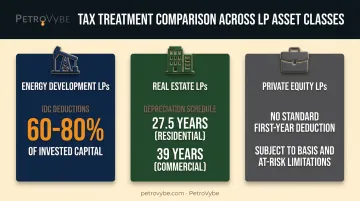
Underlying Asset Class and Tax Treatment
Fees aside, asset type determines both cash flow timing and available deductions:
- Energy development LPs: IDC deductions can represent 60-80% of invested capital, since most drilling costs qualify as intangible under IRC Section 263(c)
- Real estate LPs: Depreciation runs over 27.5 years (residential) or 39 years (commercial), so first-year deductions are far smaller and depend heavily on land allocation
- Private equity LPs: No standard first-year deduction exists; losses remain subject to basis and at-risk limitations
Liquidity Terms and Hold Period
Liquidity terms complete the picture: public MLPs trade daily, though some units trade thinly. Private development LPs commonly run 5-10 year hold periods. PetroVybe ONE, for instance, targets a 10-year window with monthly passive distributions projected to peak above $10,000 during the production phase — a very different liquidity profile than a stock you can sell tomorrow.
When Limited Partnerships Make Sense — and Mistakes to Avoid
When It Makes Sense
LPs tend to fit two investor profiles best:
- High-income W-2 earners or those with capital gains seeking above-the-line deductions, such as IDC deductions available through certain energy development LPs
- Investors with a multi-year horizon looking to diversify beyond stocks, bonds, and REITs
Common Mistakes to Avoid
- Skipping GP due diligence: signing before fully understanding the fee and waterfall structure
- Underestimating illiquidity when committing capital that may be locked up for years
- Placing LP interests in retirement accounts that trigger Unrelated Business Taxable Income (UBTI); Form 990-T is generally required once gross unrelated business income hits $1,000
- Not planning for K-1 delays: these forms often arrive well after January, pushing back personal filing timelines
Alternatives to Direct Limited Partnership Investing
Other structures may fit your liquidity needs, eligibility, or tax goals better than a direct private LP:
- Publicly Traded MLPs: Best for investors who want daily liquidity through a brokerage account and don't meet accreditation thresholds. As of mid-2026, the Alerian MLP Index yielded 6.6%, with a trailing 10-year standard deviation near 30%, a real volatility trade-off for that liquidity and lower deduction potential.
- REITs and Real Estate Funds: Best for investors wanting real estate exposure with simpler 1099-style reporting instead of a K-1. Trade-off: less direct tax-shelter benefit compared to energy development LPs offering IDC deductions.
- Private Direct Participation Programs: Best for accredited investors prioritizing maximum first-year deductions and long-term MOIC/IRR targets. PetroVybe's natural gas development partnerships, for example, forecast a 10-year MOIC of roughly 2.2-5.8x with a targeted 26% IRR, backed by third-party engineered reserves. Trade-off: higher illiquidity and full dependence on sponsor execution.
| Structure | Liquidity | Minimum | Tax Reporting |
|---|---|---|---|
| Public MLP | Daily | Cost of 1 unit | Schedule K-1 |
| REIT | Daily | Cost of 1 share | Form 1099-DIV |
| Private Development LP | 5-10 years | $50K-$100K+ | Schedule K-1 |
Frequently Asked Questions
Can you invest in a limited partnership?
Yes. Publicly traded MLPs are open to any investor with a brokerage account, while private placement LPs typically require accredited investor status and higher minimum capital.
Are MLPs still a good investment?
MLPs can offer attractive yields and tax-advantaged distributions, but they carry energy-sector concentration, interest rate sensitivity, and K-1 tax complexity worth weighing carefully.
What are the tax implications of owning an MLP?
Income and losses pass through via Schedule K-1, distributions often count as return of capital that reduces your cost basis, and IRA holders should watch for potential UBTI exposure.
What happens when I sell an MLP in an IRA?
The IRA generally defers gains, but recapture of prior depreciation or depletion deductions and any UBTI can still create a tax liability. Consult a specialist before selling.
How much money do you need to invest in a limited partnership?
Publicly traded MLPs cost as little as one unit's share price. Private placement LPs, such as direct oil and gas development partnerships, typically require $100,000 or more per unit, depending on the sponsor's terms.
What is a Schedule K-1 and why does it matter for LP investors?
A K-1 is the tax form reporting your share of partnership income, deductions, and credits. It often arrives later than a standard 1099, which can affect your personal filing timeline.