

Introduction
Private markets have swelled past $14.76 trillion in assets under management, according to Preqin's 2024 fundraising data, and more individual investors want a piece of it.
For decades, private equity felt off-limits. Minimums stretched into the millions, information stayed locked behind institutional relationships, and the average investor had no clear entry point.
That's changing. This guide breaks down what private market opportunities actually look like today, from equity funds to direct asset partnerships. It also covers how much capital you need and how to evaluate a deal before you wire a single dollar.
Key Takeaways
- Private equity now spans co-investments, secondaries, private credit, and energy assets
- Accreditation and capital minimums remain gatekeepers, with entry points now starting near $100,000 at many sponsors
- Track record and third-party validation predict trustworthy opportunities better than marketing materials
- Natural gas development tied to AI power demand creates tax-advantaged entry points unmatched in traditional equity deals
What Is Private Equity Investing? Understanding the Landscape
Private equity means capital deployed into companies or assets that aren't listed on a public stock exchange. A general partner (GP) manages the fund and makes investment decisions. Limited partners (LPs) supply the capital and collect returns, minus fees and carried interest.
The Three Core Strategies
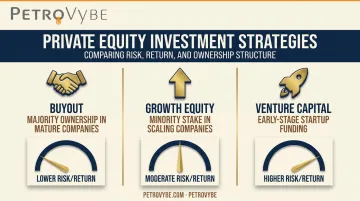
Most private equity opportunities fall into one of three buckets:
- Buyout: acquiring majority ownership in mature, established private companies
- Growth equity: minority investment in companies past the startup phase but not yet public
- Venture capital: early-stage funding for high-growth startups, with higher risk and higher potential upside
Why Companies Are Staying Private Longer
Businesses no longer rush to IPO the way they once did. The median age of a company at IPO was just 8 years in the 1980s. By 2024, that number had climbed to 14 years, according to research from the University of Florida's IPO database.
That means more value creation now happens while a company is still private, and public markets alone no longer capture it.
How Individual Investors Get In
Two main doors have opened for accredited investors:
- Co-investing alongside a GP directly into a specific deal, often at reduced fees
- Secondary market transactions, buying or selling existing LP stakes before a fund's natural exit
The definition has also broadened. "Private equity" today can mean private credit, farmland, real estate, or energy and natural resource development, not just company buyouts. PetroVybe fits squarely into this expanded category, giving accredited investors direct partnership units in Texas oil and gas development projects rather than a traditional buyout fund structure.
Top Private Equity Investment Opportunities to Consider Right Now
Current opportunity is shaped by rates and manager size. In a higher-rate environment, capital is pickier, and where it flows matters more than ever.
Sector Specialists Are Gaining an Edge
Smaller, sector-focused managers with real operational expertise have outperformed large generalist funds in certain vintages and size bands. Preqin's own research shows the pattern is mixed rather than universal — specialists led generalists in 2016-2019 vintages, but generalists came out ahead in funds above $2.5 billion.
Manager expertise in a specific niche drives outperformance more than fund size alone.
AI and Growth-Stage Tech: A Reset Creates Opportunity
Venture and growth-stage technology, particularly AI-adjacent companies, looks attractive again after the valuation reset of recent years. Entry prices are lower. Just remember the horizon: these are typically 10-15 year investment cycles, not quick flips.
Secondaries: Buying at a Discount
Secondary transactions have become one of the fastest-growing corners of private markets. LPs seeking liquidity are selling fund stakes, often below net asset value, creating entry points for buyers with patience and capital ready to deploy.
Energy and Natural Gas Development: The AI Infrastructure Play
Data centers are becoming massive electricity consumers. McKinsey projects U.S. data-center power demand rising from 178 terawatt-hours in 2024 to 606 terawatt-hours by 2030, jumping from 4.3% to 11.7% of total U.S. electricity demand. Natural gas is set to supply a large share of that growth.
This is where PetroVybe fits in. As a private Texas-based natural gas development company, PetroVybe gives accredited investors direct, early-stage access to development assets across a 58,000-acre footprint in Lavaca County and the broader Gulf Coast Basin.
The portfolio spans roughly 400 producing wells and 57-plus planned new wells, positioned to help fuel AI-driven electricity demand across South Texas.
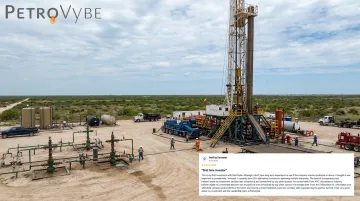
Tax treatment sets this apart from traditional equity or venture deals. Intangible Drilling Cost (IDC) deductions in oil and gas development can offset active income, including W-2 earnings and capital gains, not just passive gains. That's a structural advantage most private equity or venture allocations simply don't offer.
How Much Capital Do You Need to Invest?
Most private equity opportunities require accredited investor status under SEC rules. You qualify by meeting one of these thresholds:
- Net worth over $1 million, excluding your primary residence (individually or jointly)
- Income over $200,000 individually or $300,000 jointly in each of the past two years, with the same expected this year
- Certain professional licenses, such as Series 7, 65, or 82
Minimums vary widely by structure:
| Access Type | Typical Minimum |
|---|---|
| Traditional PE fund commitments | $250,000+ |
| Tender-offer / registered access funds | $25,000-$100,000 |
| Direct sponsor deals (such as PetroVybe) | $100,000 per unit |
Don't chase a number just because it's available. Size your commitment around your financial goals, how much illiquidity you can tolerate, and a target allocation to alternatives, commonly cited in the 5-20% range of an overall portfolio.
What to Look for When Evaluating a Private Equity Opportunity
Marketing decks all sound impressive, but track records don't lie. Cambridge Associates has documented annualized return dispersion of over 1,000 basis points between top- and bottom-quartile PE funds in a given vintage year. That gap is why sponsor selection matters more than the asset class label.
Demand third-party validation. Audited financials and independent engineering or reserve reports reduce the guesswork. PetroVybe, for example, has an independently determined proved reserves valuation (PV-09) of $48 million, assessed by a licensed third-party engineering firm, alongside a clean 2025 audit.
Look past the resume, and check the numbers. Team bios are easy to write; verifiable outcomes are harder to fake. PetroVybe's Chief Geophysicist, for instance, has a documented 75.2% well-success rate over a 48-year career, compared to an industry peer average below 40%. That's the kind of "supportable number" every sponsor should be able to produce.
Before committing capital, confirm credibility independently:
- Check independent platforms like InvestClearly for verified investor reviews
- Confirm accreditation verification processes are third-party, not self-reported
- Review fee structures and whether the GP has real capital at risk alongside you
- Ask for exit strategy clarity in writing, not just verbally
Risks to Understand Before You Invest
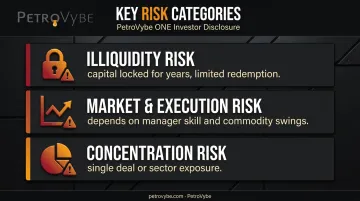
Private equity isn't a place to park money you might need soon. Weigh these primary risks before committing capital:
- Illiquidity risk: capital is typically locked up for multiple years with no early redemption option (PetroVybe units carry a 10-year hold), and even interval funds cap repurchases at 5-25% of assets
- Market and execution risk: returns depend heavily on manager skill; energy-focused investments carry added exposure to commodity price swings
- Concentration risk: a single deal, manager, or sector can sink an otherwise sound portfolio strategy
Treat private equity as a long-term allocation. Diversify across managers, vintage years, and sectors rather than betting everything on one opportunity, no matter how compelling the pitch looks.
Frequently Asked Questions
How much do I need to invest in private investment opportunities to reach my financial goals?
Accreditation requires $1 million net worth (excluding your home) or $200,000+ in annual income. Fund minimums range from $25,000 to $250,000+, with PetroVybe's oil and gas partnership units starting at $100,000. The right amount depends on your target allocation to alternatives.
What are the best private investment opportunities right now?
Current standouts include secondaries trading at discounts to NAV, sector-specialist managers with deep operational expertise, and emerging energy plays like natural gas development tied to AI-driven electricity demand.
What is the difference between private equity and venture capital?
Private equity typically targets mature, established private companies through buyouts or growth investments. Venture capital focuses on early-stage startups with high growth potential but higher failure rates.
Is private equity investing safe for beginners?
Private equity carries higher risk and illiquidity than public markets. Accreditation requirements exist for a reason, so newer investors should prioritize sponsors with verified track records and third-party validation.
How long is money typically locked up in a private equity investment?
Traditional PE commitments often lock up capital for 10 years or longer. Some structures, like PetroVybe's, target distributions starting in year 2-3 with a defined 10-year hold period.
Can private equity investments offer tax benefits?
Certain structures do. Oil and gas development, for example, allows Intangible Drilling Cost deductions that offset active income, including W-2 earnings, unlike most traditional equity or venture deals.