

For investors evaluating energy, real estate, or any asset-heavy opportunity, this distinction isn't academic. It directly determines your income stability, upside potential, and net after-tax returns.
This article breaks down both structures, compares their tax treatment, and offers a practical framework for deciding which fits your situation.
Key Takeaways
- Equity = ownership stake with upside tied to performance; royalty = contracted payment for asset use with no ownership
- Equity carries higher risk and higher compounding potential — royalties offer predictable income with capped upside
- Royalty income is taxed as ordinary income under IRS Publication 525; long-term equity gains may qualify for lower capital gains rates
- In oil and gas, royalty interest and working interest (equity) carry sharply different risk, reward, and tax exposure
- Choosing between the two comes down to your income goals, tax situation, and appetite for risk
Equity vs. Royalty: Quick Comparison
Here's how equity and royalty structures compare across the dimensions investors typically weigh first:
| Dimension | Equity | Royalty |
|---|---|---|
| Ownership | Percentage stake in company or asset | No ownership — contractual payment right only |
| Payment Structure | Variable (dividends, distributions, capital gains) | Fixed percentage of revenue or units sold |
| Risk & Reward | Full participation in upside and downside | Stable income with capped upside |
| Governance | Common shareholders typically vote; preferred and LP units vary | No governance role |
| Tax Treatment | Capital gains (if held >1 year) or ordinary income via pass-through | Ordinary income in year received |
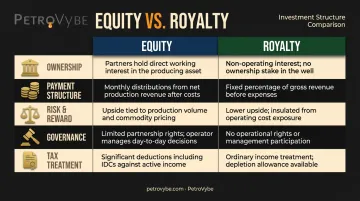
The governance column warrants a note. According to SEC Investor.gov, common stockholders normally vote, but preferred stockholders usually don't — and LLC/LP governance rights follow the operating agreement, not a universal rule.
What Is Equity?
Equity is an ownership interest in a company or asset. Depending on the structure, that interest may be represented by common shares, preferred shares, LLC membership units, or limited partnership interests — each carrying different rights and priorities.
The CFA Institute characterizes equity as a residual claim, meaning equity holders stand behind creditors in the payment hierarchy. More risk, but also more upside when the asset performs.
How Equity Returns Work
Equity holders profit through three mechanisms:
- Distributions or dividends — proportional share of profits paid out periodically
- Capital appreciation — growth in the underlying asset's value over time
- Exit proceeds — payment upon a sale, merger, or liquidation event
Partnership income items pass through to partners retaining their original character — meaning a capital gain at the partnership level flows to partners as a capital gain, not ordinary income. Cash distributions within a partner's outside basis generally recognize no taxable gain.
Forms of Equity Relevant to Investors
- Common stock — voting rights, residual claim, fully exposed to downside
- Preferred stock — priority in dividends and liquidation, usually no voting rights
- LLC/LP membership units — rights defined by the operating agreement; economics and governance vary
- Working interest (oil and gas) — operating mineral interest burdened with development and operating costs, as defined by the IRS Oil and Gas Audit Technique Guide
Use Cases for Equity
Equity dominates in venture-backed startups, private equity buyouts, real estate partnerships, and direct oil and gas development. In the O&G context, working interest holders fund drilling operations but access a larger share of production revenue — plus tax deductions unavailable to royalty holders.
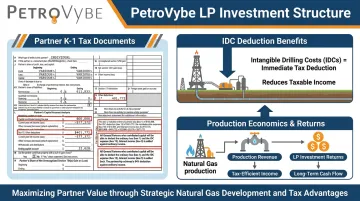
For high-income investors, the IDC deduction is where direct equity in energy development separates from most other asset classes. PetroVybe, a Texas-based natural gas development company, illustrates this through its LP structure: partners receive K-1 tax documents, share in production economics, and access Intangible Drilling Cost (IDC) deductions that offset active income — including W2 wages and capital gains.
In 2024 and 2025, PetroVybe partners achieved tax deductions of 91% and 94% of invested capital, respectively.
What Is Royalty?
A royalty is a contractual payment made to the legal owner of an asset in exchange for the right to use or profit from it — without transferring ownership. The royalty holder receives income; the operator bears the costs and retains control.
Common Royalty Structures
Royalty terms vary by industry and contract:
- Flat fee per unit — common in publishing and software licensing
- Percentage of gross or net revenue — standard in mineral rights and pharmaceutical patents
- Tiered rates tied to volume milestones — used in technology licensing when production scales
Terms are typically set at contract inception and cannot be renegotiated until expiration. The royalty holder has no governance role and no operational burden.
Of all these structures, the oil and gas royalty is the most consequential for asset-level investors — and the most commonly misunderstood.
The Oil and Gas Royalty Explained
In O&G, a royalty interest is the mineral rights owner's retained share of production revenue — generally free of drilling and operating costs. The IRS Oil and Gas Audit Technique Guide confirms that landowner royalties are "free and clear of drilling or operating expenses."
Production taxes, ad valorem taxes, and certain post-production costs may still apply, depending on the lease terms and state law.
This is the critical O&G distinction:
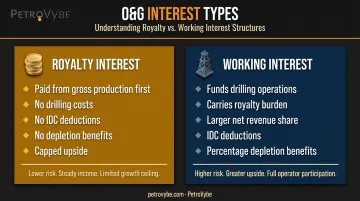
- Royalty interest holder — gets paid from gross production first, bears no drilling costs, accesses no drilling deductions
- Working interest holder — funds operations, carries the royalty burden, but claims the remaining production revenue and tax benefits
Use Cases for Royalty
Industries where royalties are the standard income model:
- Music and publishing — ASCAP and BMI calculate performance royalties using weighted formulas and license fee pools; no single universal per-play rate exists
- Pharmaceuticals and technology — patent licensing agreements with royalty provisions negotiated by contract (USPTO confirms no universal industry rate exists)
- Oil and gas mineral rights — landowners receive a share of production revenue from operators drilling on their land, without bearing any operational costs
That last point draws the sharpest contrast with equity: royalty holders generate income from an asset they never have to operate, but they also have no claim to the upside if that asset's value grows — or to the tax deductions that flow to the operator.
Key Differences in Tax Treatment and Investment Returns
Tax treatment is where the equity vs. royalty decision becomes financially significant — especially for high-income investors.
Tax Treatment of Royalties
Per IRS Publication 525, royalties from copyrights, patents, and oil, gas, and mineral properties are taxable as ordinary income in the year received. They're typically reported on Schedule E unless the royalty activity constitutes an active trade or business.
This means royalty income sits on top of your existing income and is taxed at your marginal rate. For 2026, that rate reaches 37% for single filers with taxable income above $640,600, per IRS tax inflation adjustments. Royalty recipients generally cannot offset that income with deductions the way a working interest holder can.
Tax Treatment of Equity
Equity returns have more flexibility:
- Long-term capital gains — equity held over one year qualifies for reduced capital gains rates upon sale
- Pass-through income — partnership items retain their character; capital gains pass as capital gains, ordinary income as ordinary income
- IDC deductions (O&G working interest) — taxpayers may elect to expense qualifying Intangible Drilling Costs under 26 CFR 1.612-4 in the year incurred
The IDC provision is the key differentiator. Unlike real estate passive loss rules — which restrict deductions to passive income — the oil and gas IDC deduction operates under a separate statutory framework. For qualifying working interests, these deductions can offset active income including W2 wages and capital gains, not just passive income.

Important qualification from IRS Publication 925: the passive-loss exception for working interests applies only when the interest is held directly or through an entity that does not limit liability. A limited-liability entity does not automatically receive this exception.
The specific structure and how the interest is held matters. Investors should confirm the treatment with a qualified tax advisor before committing capital.
Return Potential: Equity vs. Royalty
Return comparisons between equity and royalty structures depend heavily on asset performance — which is precisely the point. The structural difference tells the story:
- Royalties deliver contractually defined income regardless of how the underlying asset performs — predictable, but fixed at the contracted rate
- Equity participates fully in appreciation; when an asset dramatically outperforms, equity holders capture that upside while royalty holders receive only their percentage
- Compounding works differently — equity positions can reinvest distributions into expanded production or new assets, while royalty income is extracted without participation in asset growth
For investors weighing these structures, the IDC deduction available through qualifying equity positions adds a third dimension beyond yield: the ability to reduce active income taxes in year one while retaining full upside participation over the hold period.
How to Choose Between Equity and Royalty
The decision comes down to four investor-specific variables: income goals, risk tolerance, time horizon, and tax situation.
Decision Framework
Choose royalty if you:
- Prioritize stable, predictable income over growth
- Want zero exposure to operational costs or performance risk
- Have no need for ownership upside or governance input
- Are indifferent to tax efficiency on investment income
Choose equity if you:
- Seek long-term wealth compounding and asset appreciation
- Are comfortable with performance-linked, variable returns
- Want access to tax-advantaged structures (particularly in oil and gas)
- Have a long time horizon and can tolerate early-stage illiquidity
The High-Income W2 Case
For investors carrying a heavy income tax burden, direct equity participation in a pass-through entity can be substantially more valuable than royalty income — not just for the upside potential, but for the immediate tax relief.
Royalty income simply adds to taxable income at your marginal rate. Equity participation in a qualifying oil and gas working interest, by contrast, can generate deductions against that same active income.
A $100,000 investment in a development program with strong IDC characteristics can produce a $60,000–$80,000 first-year deduction — which translates to real cash savings at a 37% marginal rate.
The Oil and Gas Distinction
In oil and gas, the royalty vs. equity decision carries distinct legal and financial consequences that don't apply in most other asset classes:
- Royalty interest holders receive payment off the top of gross production — but miss out on IDC deductions, depletion allowances, and the larger net revenue share
- Working interest holders fund drilling, carry the royalty burden, and bear operational risk — but access a larger revenue share, IDC deductions, and percentage depletion benefits that can significantly reduce taxable income
Neither structure is universally superior. The right choice depends on whether an investor needs the deduction, can tolerate operational exposure, and has the time horizon to benefit from equity-style compounding.
Conclusion
There is no universal winner between equity and royalty. The right structure depends on what you're actually trying to optimize:
- Income timing — predictable cash flow now vs. compounding growth over time
- Risk profile — fixed royalty receipts vs. equity upside tied to asset performance
- Tax position — royalty income taxed at ordinary rates vs. equity structures with deduction potential
- Control preference — passive receipt with no say vs. active participation in asset decisions
A royalty strips the relationship down: income in, no costs out, no say in what happens next. Equity adds complexity — but that complexity is where the upside lives, especially when the tax treatment is favorable and the underlying asset is high quality.
Knowing the structure is just the starting point. What actually determines the outcome is asset quality, operator track record, and deal terms — three variables that matter far more than the structure label. Get those right, and either approach can work. Get them wrong, and neither will.
Frequently Asked Questions
What is the difference between ownership and royalty?
Ownership (equity) means holding a stake in a company or asset with rights to profits, appreciation, and — depending on the structure — governance. A royalty is a contractual payment for the use of an asset, with no ownership stake, no control rights, and no participation in asset appreciation beyond the contracted rate.
What does a 5% royalty mean?
A 5% royalty means the asset owner receives 5% of the revenue generated from use of their asset — the exact base (gross revenue, net revenue, or units) depends on the contract terms. In oil and gas, a 5% royalty interest would entitle the mineral rights owner to 5% of production revenue from any well drilled on their land.
Is royalty income taxed differently than equity returns?
Yes. Royalty income is generally taxed as ordinary income at the recipient's marginal rate, while long-term equity gains — held more than one year — may qualify for lower capital gains rates. Certain equity structures, like qualifying working interests in oil and gas, can also generate deductions that offset active income; royalty income cannot.
What is a royalty interest in oil and gas?
A royalty interest is the mineral rights owner's right to receive a percentage of production revenue without bearing any drilling or operating costs. It's distinct from a working interest (equity), where the holder funds operations but claims a larger revenue share, plus tax deductions like IDC and depletion allowances.
Can an investor hold both equity and royalty interest in the same asset?
Yes. In oil and gas, an investor can hold a working interest while also receiving an overriding royalty interest (ORRI) carved out of the lessee's working interest. This requires a more complex agreement and is most common in resource-based industries where interests can be separately assigned.
Which is better for long-term wealth building: equity or royalty?
Equity generally offers stronger long-term compounding because it participates fully in asset appreciation and — in the right structures — accesses meaningful tax advantages. Royalties provide more consistent income but cap your upside at the contracted rate. For investors with a long time horizon and a high tax burden, equity in a well-structured deal tends to outperform on a net after-tax basis.
Disclosure: PetroVybe and its team members are not licensed financial advisors, and nothing on this website constitutes financial or investment advice or a recommendation to buy, sell, or hold any investment. PetroVybe and its team members are not tax advisors, accountants, or tax strategists, and nothing on this website constitutes tax advice or a tax strategy. PetroVybe and its team members are not attorneys, and nothing on this website constitutes legal advice. All content is provided for general informational purposes only. You should consult your own independent financial advisor, tax professional, and legal counsel before making any decision.