
Here's the problem: most marketing materials mention IDC without explaining how the deduction is actually calculated, who legally qualifies, or where its limits kick in. This article breaks down what IDCs are, why the deduction exists, how it flows from drilling invoice to tax return, and the eligibility rules that determine how much you can actually deduct.
TL;DR
- IDCs cover non-salvageable costs (labor, fuel, chemicals, site prep) and often make up the bulk of a project's capital
- Independent producers and direct investors can expense up to 100% of IDCs in year one; integrated companies are capped at 70%
- Only working interest owners qualify; royalty owners bear no drilling cost or operational risk
- IDC deductions can offset active income, including W-2 wages and capital gains, unlike most passive real estate write-offs
- IRAs and other tax-exempt accounts can't use this deduction, since there's no tax liability to offset
What Are Intangible Drilling Costs?
Intangible Drilling Costs are the non-salvageable expenses required to prepare and drill a well: labor, fuel, chemicals, drilling mud, and site clearing. They're distinct from the physical equipment left in the ground. There's nothing to resell if the well disappoints. The money is simply spent, so the tax code lets investors deduct it immediately rather than capitalize it.
This immediate deduction lets investors recover a large share of at-risk drilling capital in year one, rather than spreading the write-off across a well's 10, 15, or even 20-year producing life.
Typical IDC categories include:
- Wages and labor for drilling crews
- Drilling fluids, mud, and chemicals
- Site preparation, grading, and access road construction
- Fracturing and completion services
- Geological survey and mapping work
IDC vs. Tangible Drilling Costs (TDC)
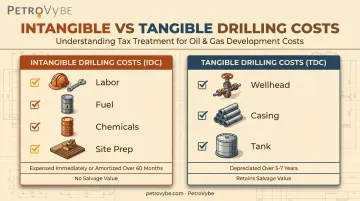
| IDC | TDC | |
|---|---|---|
| Covers | Labor, fuel, chemicals, site prep | Wellheads, casing, tanks, physical equipment |
| Tax treatment | Expensed immediately (or amortized over 60 months) | Depreciated over 5-7 years under IRS asset classes |
| Salvage value | None | Retains value even if the well underperforms |
The split matters because IDC, not TDC, drives the outsized first-year deduction most investors are chasing. Congress has treated this expense category as immediately deductible since 1913, and the IPAA's technical brief on intangible drilling costs confirms the deduction's long history as a tool to pull capital into high-risk exploration.
Why the IDC Deduction Matters for Oil & Gas Investors
Congress didn't create this deduction as a favor to drillers. It exists because domestic oil and gas exploration is genuinely risky, and lawmakers wanted capital flowing into it anyway.
The origin: IDC expensing has sat in the tax code since 1913, built to offset the reality that a meaningful share of wells drilled never produce commercially. Without an incentive to expense costs right away, fewer investors would take that risk on.
Here's what oil and gas investing actually demands:
- Large upfront capital outlays before any production begins
- Months of drilling and completion work with no revenue
- Zero guarantee the well ever produces a barrel
The IDC deduction addresses that mismatch directly. It doesn't lower your risk of a dry hole, but it does lower your after-tax cost of taking the risk in the first place.
Without the deduction, investors would have to capitalize drilling costs and amortize them over the well's productive life - often a decade or more. That would slow down the tax benefit considerably and hurt near-term cash flow, which is exactly why nearly every independent producer and direct working interest investor elects immediate expensing over amortization.
PetroVybe's own numbers show how this plays out for partners:
| Year | IDC Deduction Against Active Income |
|---|---|
| 2024 | 94% |
| 2025 | 91% |
Both results sit well above the range investors typically model for IDC as a share of invested capital.
What makes this especially relevant for high earners: PetroVybe structures its natural gas development partnerships so the IDC deduction applies against active income, including W-2 wages and capital gains. That's a meaningful distinction, since most real estate deductions get stuck in passive income only, unless you qualify as a real estate professional.
How the IDC Deduction Works (Conceptual Flow)
At a high level, the process runs like this: the operator classifies costs incurred during drilling and completion as IDC or TDC. The working interest owner then elects to expense the IDCs immediately or amortize them over 60 months.
The inputs are straightforward. The well operator issues invoices and cost allocations, split into IDC and TDC categories, typically documented through a K-1 or cost statement to each working interest partner. From there, the investor reports the IDC amount as a deduction on their personal or business return for the year the cost was incurred.
Two things control how much you deduct and when: your election type (expense 100% now, or amortize ratably over 60 months under IRC Section 59(e)) and your corporate structure (integrated producers face a different cap than independent producers and direct investors).
The result: taxable income for that year drops, often substantially, while producing wells continue generating monthly revenue on a completely separate timeline from the deduction itself.
Step 1: Well Costs Are Allocated
The operator breaks down all well costs into IDC and TDC categories per Treasury Regulation 1.612-4, then documents the split for each working interest holder. This allocation is the foundation everything downstream depends on.
Step 2: The Investor Makes a Deduction Election
The working interest owner chooses to expense 100% of IDCs in year one, or elect the 60-month amortization schedule. The right call depends on your current tax bracket, expected future income, and whether the benefit is more useful now or spread out.
Step 3: The Deduction Is Claimed on the Tax Return
Investors report the IDC amount on the applicable return for the year costs were paid or incurred. Partnership investors typically see this on Schedule K-1, box 13, with a supporting statement identifying the expenditure type and amount.

Who Qualifies & Key Factors Affecting the IDC Deduction
Not every oil and gas position qualifies, and not every dollar invested gets the same tax treatment. Here's what determines eligibility and deduction size:
- Working interest ownership is required. Royalty interest holders don't qualify, since they never bear drilling cost or operational liability.
- Wells must sit onshore or offshore within the United States. Costs tied to foreign wells don't qualify for the deduction.
- Passive activity rules can limit usability for some limited partners. Per IRS Publication 925, working interests without limited liability count as nonpassive, letting many direct holders offset active income without material participation.
- Corporate structure changes the math. Under IRC Section 291(b), integrated oil companies lose 30% of the immediate deduction, recovered over 60 months; independent producers and direct investors face no such reduction.
Where the Confusion Usually Starts
A handful of misconceptions come up constantly with this deduction, and getting them wrong can produce an unpleasant surprise at tax time:
- "IDC applies to any oil and gas investment." It doesn't: IRA-held positions and royalty-only interests fail to qualify, since IRAs are already tax-exempt and royalty owners carry no drilling cost exposure.
- "The well has to actually produce." Not true. IDCs remain deductible in the year incurred even on a dry hole for investors who elected current expensing.
- "Full expensing always beats amortization." Both are elective choices. Investors in a lower bracket now, or expecting higher income later, often benefit more from spreading the deduction over 5 years.
- "There's no ceiling on the benefit." IDCs become an Alternative Minimum Tax preference item once they exceed 65% of net income from oil and gas properties, reducing the deduction's real-world value for some investors.
Conclusion
The IDC deduction lets qualifying working interest investors write off the large majority of well costs, often 90% or more in year one. That deduction applies directly against income that's normally hard to shelter: W-2 wages, capital gains, active business profit.
That's a different economics story than most tax-advantaged investments offer, particularly for high earners who've exhausted conventional ways to reduce their tax bill.
But the benefit only materializes if the eligibility checks actually pass: working interest status, a domestic well, and an election that fits your real tax situation. Skipping that homework is how investors end up disappointed come filing season.
That same discipline shapes how PetroVybe structures its natural gas partnerships. In South Texas, accredited investors capture the IDC deduction against active income while the underlying wells build toward long-term passive distributions in the years that follow.
Frequently Asked Questions
What is an IDC deduction?
The IDC deduction is a tax write-off for non-salvageable drilling costs (labor, fuel, chemicals, and site prep) that can be fully or partially deducted in the year those costs are incurred.
Can I deduct 100% of intangible drilling costs in the first year?
Independent producers and direct investors can generally elect to expense 100% of qualifying IDCs immediately. Integrated oil companies are capped at 70% in year one, with the remaining 30% amortized over 60 months.
Are IDC deductions available against W-2 income or only passive income?
Qualifying working interest owners can typically apply IDC deductions against active income, including W-2 wages and capital gains. This differs from most passive-only tax shelters, such as standard real estate deductions.
What's the difference between IDCs and tangible drilling costs (TDC)?
IDCs cover non-salvageable costs like labor and site prep, deducted immediately. TDCs cover physical equipment - wellheads, casing, tanks - depreciated over 5 to 7 years instead.
Can I use IDC deductions if I invest through a self-directed IRA?
No. IRAs are already tax-exempt vehicles, so the IDC deduction has nothing to offset inside the account. Capturing this benefit requires investing directly, outside a retirement account.
What happens to the IDC deduction if the well turns out to be a dry hole?
IDCs on a dry hole remain fully deductible in the year incurred for investors who elected current expensing. The tax code doesn't condition this benefit on the well actually producing.