
This article is general education, not investment, tax, or legal advice. Private funds don't just appear on the market and start taking checks. Most rely on Regulation D, a Securities Act exemption that lets sponsors raise capital from accredited investors without registering the offering with the SEC. That includes private natural gas development funds like PetroVybe, which structures its PetroVybe ONE offering under one of Reg D's two most-used private placement rules.
Choosing between Rule 506(b) and Rule 506(c) shapes everything: how a sponsor can market the deal, who's allowed to invest, and how much compliance paperwork sits behind the scenes. Get it wrong, and a sponsor risks blowing the exemption entirely.
This guide breaks down both rules so investors and sponsors know exactly what governs a private placement before capital changes hands.
TL;DR
- 506(b) bars general solicitation but allows self-certification and up to 35 non-accredited investors
- 506(c) permits public advertising but requires verified accredited status from every investor
- Both: unlimited capital raises; Form D filing within 15 days of first sale
- Choose 506(b) if your network can fill the raise; 506(c) if you need to market publicly
506(b) vs 506(c): Quick Comparison
| Factor | Rule 506(b) | Rule 506(c) |
|---|---|---|
| General solicitation | Prohibited | Permitted |
| Investor verification | Self-certification | Reasonable steps to verify required |
| Non-accredited investors | Up to 35 allowed | Not permitted |
| Pre-existing relationship | Required | Not required |
| Compliance burden | Lower, minimal documentation | Higher, ongoing verification records |

Neither exemption sets a maximum offering amount, unlike smaller Reg D paths such as Rule 504. Choose 506(b) when you can rely on existing relationships and want lighter verification; choose 506(c) when you need general solicitation and can document accredited status.
What Is Rule 506(b)?
Rule 506(b) has been the workhorse private placement exemption since Regulation D was adopted in 1982. It lets sponsors raise unlimited capital from accredited investors without public advertising, relying instead on relationships built before the offering opens.
Why sponsors like it:
- Self-certification of accredited status through subscription documents
- No mandatory verification file to maintain
- Lower legal and administrative overhead
There's a catch, though. Self-certification alone isn't always enough. The SEC's 2025 guidance on assessing accredited investors makes clear that a checkbox alone doesn't satisfy the "reasonable belief" standard unless the issuer has other supporting knowledge.
The 35 Non-Accredited Investor Allowance
506(b) permits up to 35 non-accredited investors alongside unlimited accredited ones. Each must have enough financial sophistication to evaluate the deal. Including even one non-accredited investor triggers a heavier disclosure package, comparable to a Regulation A offering. Most sponsors avoid that complexity and stick to accredited-only raises.
Use Cases of 506(b)
506(b) fits sponsors with a built-in investor base: family offices, referral networks, or a curated list of high-net-worth relationships developed over years.
SEC statistics show 30,315 Rule 506(b) offerings in 2025 compared to just 3,989 Rule 506(c) offerings. Roughly 88% of combined 506(b)/506(c) deals used 506(b), according to SEC Regulation D offering statistics. By dollars raised, 506(b) accounted for about 94% of the combined total.

A private energy development fund working exclusively through direct introductions, warm referrals, and existing partner relationships is a textbook 506(b) candidate. No public website pitch. No cold outreach. Just a network built one relationship at a time.
What Is Rule 506(c)?
Rule 506(c) is the newer option, created under the 2012 JOBS Act and effective since September 2013. It flips the trade-off: sponsors can advertise publicly, but every single investor must be accredited and verified.
The core benefit: reaching investors beyond an existing network through webinars, digital platforms, or public-facing marketing content.
Four SEC Verification Methods
There's no single required way to verify accredited status under 506(c). The SEC recognizes four non-exclusive safe harbors:
- Income review — W-2s, 1099s, K-1s, or Form 1040 documentation
- Net worth review — bank/brokerage statements and a credit report dated within three months
- Third-party confirmation — written verification from a broker-dealer, registered investment adviser, attorney, or CPA
- Prior verification — a written representation good for five years if the issuer previously verified the same investor

The 2025 Verification Update
A March 2025 SEC no-action response to Latham & Watkins eased this burden. The SEC's interpretive response concurred that minimum investment thresholds of $200,000 for individuals and $1,000,000 for entities, combined with written representations, can count as reasonable verification.
This is fact-specific guidance, not a blanket rule. It doesn't carry the force of a regulation. Still, it lowers the historical verification burden that pushed many sponsors away from 506(c) in the first place.
When 506(c) Fits
506(c) suits sponsors scaling past a personal network, including those who:
- Raise capital on online platforms
- Publish investment materials publicly
- Run structured outreach campaigns
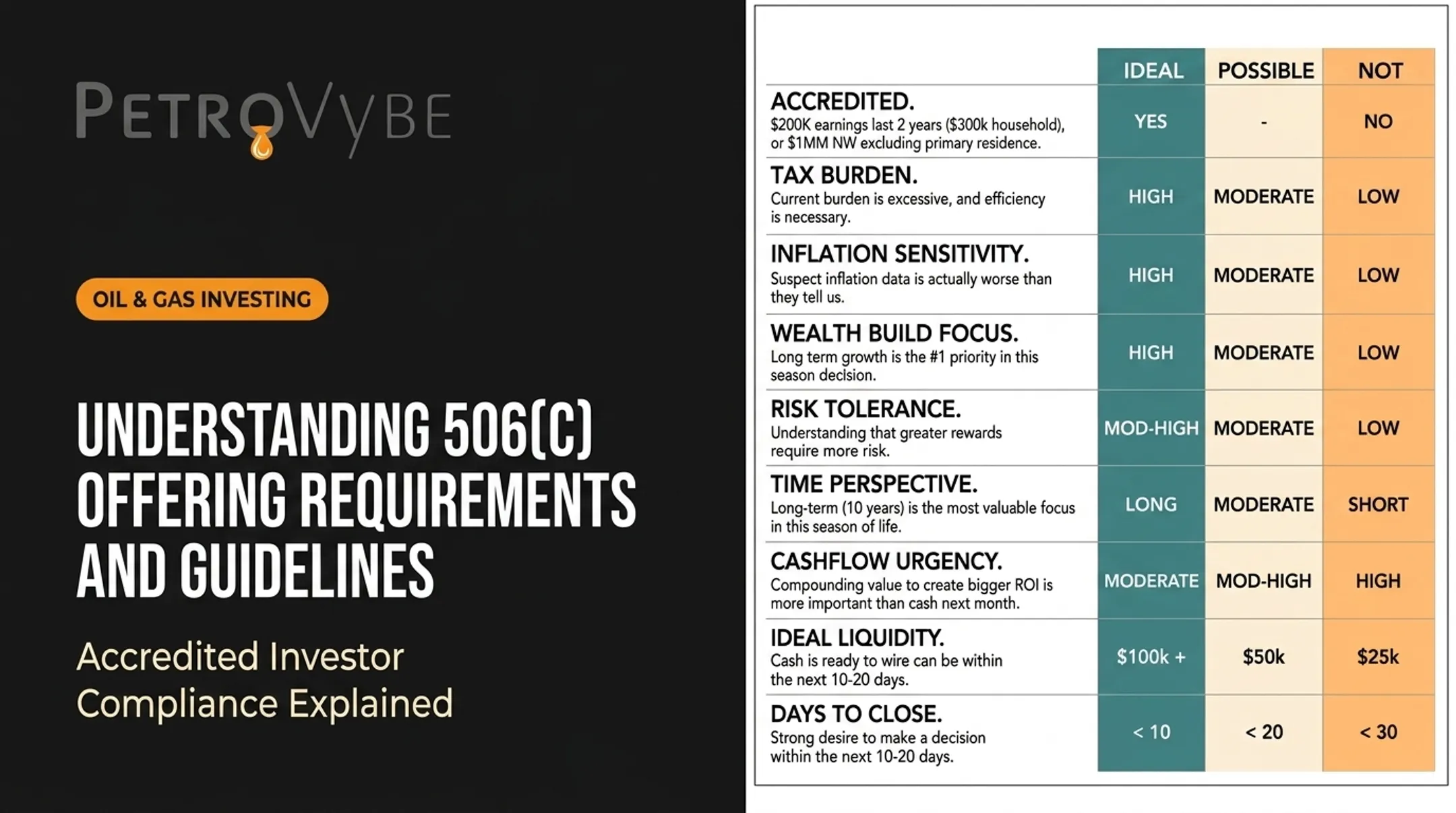
PetroVybe structures its PetroVybe ONE offering under Rule 506(c), requiring qualified third-party verification (CPA, tax attorney, or licensed financial adviser) from every investor before capital is accepted. The company markets through its website, an investor deck, and digital content, the kind of public-facing presence that fits the 506(c) framework rather than the relationship-only 506(b) path.
506(b) vs 506(c): Which Fits Your Raise?
Three questions decide it:
- Does your existing network cover the raise? If yes, 506(b) keeps things simple.
- Do you need to reach new accredited investors through marketing? If yes, 506(c) is likely necessary.
- Will any non-accredited investors participate? Only 506(b) allows this.
Choose 506(b) for relationship-based raises with a known investor base. Choose 506(c) if you're scaling publicly or through digital platforms.
One warning: switching exemptions mid-offering carries integration risk. The SEC generally requires a 30-day gap between closing one offering and opening another under a different exemption, and if the first offering used general solicitation, additional conditions apply, per SEC integration guidance. Lock in the exemption before marketing begins.

Why This Matters for Accredited Investors Evaluating Private Placements
Whether a fund uses 506(b) or 506(c), the exemption only sets how the offering is marketed and who can invest. It does not replace your diligence.
A legitimate private placement should still come with a Private Placement Memorandum (PPM) that discloses risk factors, use of proceeds, and fund structure. That document spells out what happens to your capital.
Private natural gas development offerings are often structured under Reg D and, when done properly, should include:
- Third-party engineering validation of reserve estimates
- Independent financial audit review
- Clear risk disclosures covering commodity pricing, drilling operations, and reserve uncertainty
Before committing capital to any 506(b) or 506(c) placement, investors should verify:
- Sponsor track record and prior project performance
- Operator licensing for energy funds (confirm with the state regulator)
- Independent reviews from verified sources
- The full PPM, Limited Partnership Agreement, and Subscription Agreement — ideally with financial and legal counsel
Conclusion
Neither exemption wins by default. Choose 506(b) when you raise from existing relationships and do not need public marketing. Choose 506(c) when you want broader reach through general solicitation and can handle accredited-investor verification.
Get the structure right and both sides stay protected. Sponsors avoid exemption breaches that can unwind an offering. Investors get the disclosure they need to judge a deal on its merits—whether a real estate fund, a venture vehicle, or an oil and gas development partnership built around long-term production assets.
Frequently Asked Questions
What is the difference between Rule 506(b) and 506(c)?
506(b) prohibits public advertising but allows self-certified accredited status and up to 35 non-accredited investors. 506(c) permits public marketing but requires verified proof of accredited status from every participant.
What are the requirements for a Rule 506 private placement?
Both rules allow unlimited capital raises and require filing Form D within 15 days of the first sale. Sponsors must also handle state Blue Sky notice filings and confirm no "bad actor" disqualifying events apply.
Who is eligible to participate in a Rule 506(c) private placement?
Only verified accredited investors. There's no non-accredited investor exception under 506(c), unlike 506(b)'s 35-investor allowance.
What are the investor limits for Rule 506 offerings?
Both rules allow unlimited accredited investors. Only 506(b) additionally permits up to 35 non-accredited investors with sufficient financial sophistication.
What are the disqualifying events under Rule 506(d)?
"Bad actor" disqualifications include certain criminal convictions, regulatory cease-and-desist orders, SEC disciplinary actions, and SRO suspensions. Disqualification periods generally run 5-10 years depending on the event.
What are the key differences between Regulation D Rules 504 and 506?
Rule 504 caps raises at $10 million over 12 months and generally restricts general solicitation. Rule 506 has no dollar cap but focuses on accredited investors and carries stricter verification or relationship requirements.
Informational requests only. PetroVybe projects are offered solely to verified accredited investors. Submitting this form does not create an investment or advisory relationship.