
This article is general education, not investment, tax, or legal advice. If you've heard that bonus depreciation is phasing down to 20% in 2026, you heard old news. That was the Tax Cuts and Jobs Act (TCJA) schedule, and it's dead. Under the One Big Beautiful Bill Act (OBBBA), 100% bonus depreciation is now permanent for qualifying property acquired and placed in service after January 19, 2025 (Section 70301).
That makes 2026 the first full calendar year operating under this restored rule, not the first year of a 20% write-off.
Plenty of business owners and investors are still planning around outdated numbers. This article breaks down who qualifies, how the math works, when recapture kicks in, and how a parallel deduction, Intangible Drilling Costs in oil and gas development, gives investors another lever entirely.
Key Takeaways
- 100% bonus depreciation is permanent for property acquired and placed in service after January 19, 2025
- Qualifying property covers assets with recovery periods of 20 years or less
- Qualified Production Property (QPP) under Section 168(n) gets a separate 100% write-off
- Recapture tax applies if you sell or repurpose bonus-depreciated property early
- Oil and gas working interests offer IDC deductions that can offset active W-2 and capital gains income. This treatment requires the investor to elect general partner status in the Subscription Agreement and may be limited in a given year by the excess business loss limitation under IRC §461(l).
What Is 100% Bonus Depreciation and Why 2026 Changes Everything
Bonus depreciation lets you deduct the full cost of qualifying business property in the year you place it in service, instead of spreading that deduction across five, seven, or more years through standard MACRS depreciation. Buy a $500,000 piece of equipment, and instead of writing off a fraction annually, you take the whole thing at once.
That wasn't always the deal. The TCJA phase-down schedule looked like this:
| Year Placed in Service | Bonus Depreciation Rate |
|---|---|
| 2018-2022 | 100% |
| 2023 | 80% |
| 2024 | 60% |
| 2025 (legacy property) | 40% |
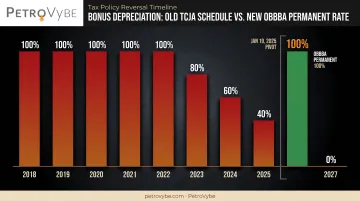
That trajectory was heading toward 0% by 2027. Then OBBBA, signed into law on July 4, 2025, reset the clock. IRS Notice 2026-11 confirms 100% bonus depreciation now applies permanently to qualifying property acquired and placed in service after January 19, 2025.
Why This Matters for 2026 Specifically
Without OBBBA, 2026 acquisitions would have landed at roughly 20%. Instead, they sit at 100%. That's a massive difference in first-year cash flow for anyone planning capital purchases.
One catch worth flagging: the binding contract rule. Acquisition is tied to when a written, enforceable agreement was signed—not when the asset is delivered or placed in service.
If you signed a purchase contract before January 20, 2025, that asset may still fall under the old 40% legacy rate even if it lands in service in 2026. IRS Notice 2026-11 makes clear that enforceability, contingencies, and cancellation terms all factor into that determination.
What Property Qualifies for 100% Bonus Depreciation
Not everything gets the 100% treatment. Per IRS Publication 946, qualifying property generally includes:
- Tangible assets with MACRS recovery periods of 20 years or less
- Machinery, equipment, and vehicles used in business
- Computer software
- Water utility property
- Qualified improvement property (generally 15-year property)
The New Qualified Production Property Category
Section 168(n) creates Qualified Production Property (QPP): nonresidential real property that is an integral part of manufacturing, chemical production, agricultural production, or refining.
To qualify, the property must meet strict windows:
- Construction begins after January 19, 2025, and before January 1, 2029
- Property is placed in service after July 4, 2025, and before January 1, 2031
QPP specifically excludes office space, administrative areas, parking, and finished-product storage. A factory floor might qualify; the attached corporate office won't.
One more requirement across the board: property generally must be purchased from an unrelated party, and both acquired and placed in service after the January 19, 2025 cutoff, to hit 100%.
For operators and investors, that often means business machinery, vehicles, software, and certain production-related improvements can still qualify under the standard MACRS rules above—while only a narrow slice of nonresidential real property qualifies as QPP. Always confirm recovery period, acquisition date, and placed-in-service date before modeling the deduction.
A Practical Example: How 100% Bonus Depreciation Works
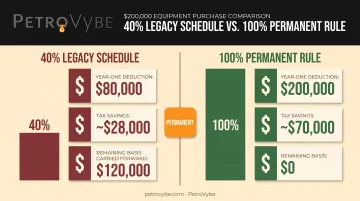
Say a business spends $200,000 on qualifying manufacturing equipment in 2026.
Under the old 40% legacy schedule (if the acquisition had been locked in via pre-2025 contract):
- Year-one deduction: $80,000
- Year-one tax savings at a 35% rate: about $28,000
- Remaining $120,000 depreciated over later years under standard MACRS
Under the permanent 100% rule:
- Year-one deduction: $200,000
- Year-one tax savings at a 35% rate: about $70,000
- Remaining basis: $0
The full cost comes off in year one instead of over 5–7 years. Under the 40% schedule, the rest of the tax benefit would have been spread across future years.
Why does this matter for cash flow? You get the tax benefit now, when capital can fund growth, rather than waiting years for the full write-off.
For pass-through owners and active investors, material participation rules matter: this deduction can offset ordinary income, not only passive income. That changes how it stacks up against other deduction strategies.
Does Bonus Depreciation Get Recaptured?
Yes, and this is where people get caught off guard. If you sell bonus-depreciated property, or convert it to non-qualifying use, before you fully recover its basis, some or all of that deduction can be clawed back.
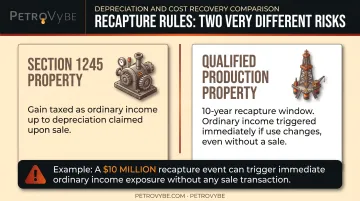
For Section 1245 property (typical equipment and other personal property), IRS Publication 544 treats gain as ordinary income up to the depreciation you claimed. Sell above the depreciated basis, and that slice is taxed at ordinary rates—not the lower capital gains rate.
QPP has its own, stricter rule. A 10-year recapture window applies. If Qualified Production Property stops being used in a qualified production activity within that period, the bonus depreciation you claimed is generally pulled back as ordinary income right away—even if you never sell the asset.
Notice 2026-16 walks through a factory change-in-use example that generates $10 million of ordinary income in the year the use changed.
Before making a large capital acquisition, model your recapture exposure. A tax advisor can walk through:
- How long you plan to hold the asset
- Whether use might change (leasing it out, repurposing space)
- What recapture would cost if you exit early
Beyond Equipment: How Oil & Gas Investments Use Similar Tax Advantages
Equipment purchases aren't the only route to accelerated deductions. Natural gas and oil development investments offer a parallel but distinct mechanism: Intangible Drilling Cost (IDC) deductions. IDCs cover non-salvageable drilling costs such as labor, chemicals, and site preparation. They typically represent a first-year deduction target of approximately 70–80% of invested capital of total invested capital in a new-drilling project, and up to 100% of qualifying IDCs can be deductible. In practice, investors often see:
- Roughly 70% deductible in year one
- Total deductible benefits that can reach up to 100% over the full deduction period The bigger distinction from standard bonus depreciation: IDC deductions on oil and gas working interests aren't limited to passive income. They can offset active income, including W-2 wages and capital gains. PetroVybe, a private Texas-based natural gas development company, gives accredited investors direct access to this structure through development positions in South Texas and the Gulf Coast Basin. Partners received 94% tax deductions against active income in 2025, through a mix of IDC and depletion allowances. Prior result; not a promise of any future deduction. Project backing includes:
- Third-party engineering validation, including a $48 million PV-09 reserves valuation. Prepared by Lee Keeling & Associates, Tulsa, March 2026.
- A ~58,000-acre Lavaca County footprint
- Roughly 400 acquired wells plus 57+ planned new wells Understanding both bonus depreciation and IDC strategies gives high-income earners a fuller year-end tax toolkit—especially if equipment purchases are already maxed out and active income still needs an offset. This treatment requires the investor to elect general partner status in the Subscription Agreement and may be limited in a given year by the excess business loss limitation under IRC §461(l).

Steps to Take Before Year-End 2026
Use the window before year-end 2026 to confirm what still qualifies for 100% bonus depreciation—and what to do with income those deductions won’t fully offset.
- Audit your capital expenditure plans. Identify equipment, software, or QPP-eligible construction that qualifies for full expensing, and check acquisition dates against the January 19, 2025 cutoff.
- Check your contracts, not just delivery dates. A binding contract signed before January 20, 2025 can lock you into legacy rates regardless of when the asset arrives.
- Work with a CPA or tax strategist. Model multiyear impact if NOLs, passive activity limits, or recapture risk apply to your situation.
- Evaluate alternative asset classes. If W-2 earnings or capital gains remain after equipment deductions, model direct oil and gas development (IDC and depletion) if you are an accredited investor with $100,000+ in liquidity. This treatment requires the investor to elect general partner status in the Subscription Agreement and may be limited in a given year by the excess business loss limitation under IRC §461(l).
Frequently Asked Questions
What qualifies for 100% bonus depreciation?
Qualifying property includes tangible assets with 20-year or shorter recovery periods, such as equipment, machinery, and software, acquired and placed in service after January 19, 2025. The new QPP category adds certain production-related real property too.
Is there any recapture on bonus depreciation?
Yes. If you sell the property or its qualifying use ends early, part of the deduction can convert back into taxable ordinary income. QPP carries a specific 10-year recapture window.
What’s an example of 100% bonus depreciation in practice?
A $200,000 equipment purchase is fully deducted in year one instead of spread across 5–7 years under MACRS. You get the entire write-off up front rather than a fraction each year.
What happened to bonus depreciation for 2026?
Under OBBBA, 100% bonus depreciation is permanent for property acquired after January 19, 2025. That means 2026 stays at 100%, not the 20% rate previously scheduled under the TCJA phase-down.
How does bonus depreciation differ from Section 179 expensing?
Section 179 has annual caps, now $2.5 million (indexed to roughly $2.56 million for 2026), while bonus depreciation has no dollar cap. That makes bonus depreciation more valuable for larger capital investments.
How can investors get similar tax deductions without buying equipment?
Oil and gas development working interests offer IDC deductions that can offset active income, providing accredited investors a comparable upfront tax advantage outside of equipment purchases. This treatment requires the investor to elect general partner status in the Subscription Agreement and may be limited in a given year by the excess business loss limitation under IRC §461(l).
This article is for informational purposes and doesn't constitute tax advice. Consult a qualified tax professional before making decisions based on bonus depreciation or investment strategies discussed here.
Informational requests only. PetroVybe projects are offered solely to verified accredited investors. Submitting this form does not create an investment or advisory relationship.