

Most retirement savers don't realize how lopsided their tax exposure has become. The bulk of American retirement wealth sits inside IRAs and employer plans like 401(k)s - accounts that mix pretax and Roth dollars but skew heavily toward pretax contributions built up over decades of paycheck deferrals. Every dollar in a traditional 401(k) or IRA carries a future tax bill attached, whether you want it that year or not.
This article breaks down the three traditional tax "buckets" behind a solid tax diversification strategy, how to apply them at each life stage, and a fourth, often-overlooked bucket - direct investment in natural gas development - that can accelerate tax efficiency for high-income earners in the exact year they need it.
Key Takeaways
- Spreading savings across taxable, tax-deferred, and tax-free accounts lowers lifetime taxes and RMD pressure
- RMDs currently start at age 73, rising to 75 for those turning 73 after 2032
- Roth conversions work best in low-income years; energy investment deductions work best in high-income years
- IDC deductions from natural gas development can offset active income, including W-2 wages, in the same year
- Revisit your tax bucket mix annually as income, balances, and tax law shift
What Is Tax Diversification?
Tax diversification means spreading your savings across accounts with different tax treatments (taxable, tax-deferred, and tax-free) rather than concentrating everything in one type. The goal is control: how much taxable income do you want to generate in any given year, especially once you're living off these assets?
Financial advisors sometimes call this the "tax diversification triangle." Picture three account types stacked together, each available to draw from depending on what a given year calls for:
- Taxable accounts - flexible, no distribution rules, useful for early or unplanned withdrawals
- Tax-deferred accounts - built from pretax dollars, taxed on the way out
- Tax-free accounts - funded after tax, grow and distribute tax-free when qualified
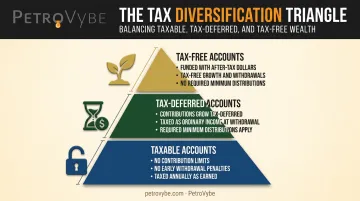
Right now, the mix leans heavily toward one corner of that triangle. IRAs and employer-sponsored defined contribution plans hold roughly two-thirds of the nation's $47.6 trillion in retirement assets, according to Investment Company Institute data. That figure blends pretax and Roth balances, but it shows how much retirement wealth sits inside accounts with built-in withdrawal rules.
Tax diversification differs from asset diversification: the stock, bond, and cash mix inside your portfolio. It's about the tax wrapper around the investment, not the investment itself. You could hold an identical S&P 500 index fund in a taxable brokerage account, a traditional IRA, and a Roth IRA - same asset, three different tax outcomes.
The Three Tax Treatment Buckets Explained
Taxable Accounts
Funded with after-tax dollars, taxable accounts include brokerage accounts, savings accounts, and CDs. Interest, dividends, and realized capital gains are taxed the year they're received, whether or not you touch the money.
The trade-off is flexibility. Taxable accounts offer:
- No RMDs, ever
- Avoid early-withdrawal penalties before age 59½
- Tax-loss harvesting opportunities to offset gains elsewhere
That flexibility makes them a useful bridge for money you might need before traditional retirement age, or during early retirement years before Social Security or pension income begins.
Tax-Deferred Accounts
Traditional 401(k)s, 403(b)s, and IRAs are funded with pretax contributions that lower taxable income the year you contribute. Growth compounds without an annual tax drag, but withdrawals later are taxed as ordinary income.
The catch: the IRS eventually requires you to take money out. Required minimum distributions currently begin at age 73. Under SECURE 2.0, that age rises to 75 for anyone turning 73 after December 31, 2032. Miss an RMD, and the IRS levies a 25% excise tax on the shortfall, reduced to 10% if you correct it quickly.
Tax-Free Accounts
Roth IRAs, Roth 401(k)s, HSAs, and municipal bonds make up the tax-free bucket. Except for HSAs, these accounts are funded with after-tax dollars, but qualified withdrawals, including growth, come out tax-free. Roth accounts also carry no lifetime RMDs for the original owner.
Eligibility is the limiting factor here. Roth IRA contributions phase out at higher incomes (for 2026, between $153,000 and $168,000 for single filers). That's why many high earners use a "backdoor" conversion: contributing to a nondeductible traditional IRA, then converting it to a Roth, to get money into this bucket despite the income cap.
Why Tax Diversification Matters for Retirement Longevity
Having all three buckets available means you get to choose, year by year, which account to draw from. That choice carries real financial weight.
Managing Tax Brackets and Medicare Surcharges
Pull too much from tax-deferred accounts in a single year, and you risk a higher bracket or Medicare's Income-Related Monthly Adjustment Amount (IRMAA). For 2026, retirees with 2024 income above $109,000 (single) or $218,000 (joint) pay elevated Medicare premiums, with surcharges reaching $689.90 a month for Part B alone at the highest tier.
A retiree with only tax-deferred savings has no way around this - every withdrawal counts as taxable income. Someone with a mix of buckets can pull from taxable or Roth accounts in a high-expense year instead, keeping reported income (and IRMAA exposure) lower.
Flexibility for Life's Curveballs
Unplanned expenses don't wait for a convenient tax year. A new roof, a medical bill, or a grandchild's tuition can appear without warning, and taxable and tax-free accounts carry no distribution requirements. That means you can tap them without disturbing a carefully sequenced withdrawal plan.
Easing the Burden on Heirs
That flexibility extends beyond your own lifetime to your heirs, too. Since 2020, most non-spouse beneficiaries who inherit an IRA or 401(k) must empty the account within 10 years of the original owner's death. If that inherited account is entirely tax-deferred, heirs face a decade of forced taxable withdrawals stacked on their own income. A mix of Roth and taxable assets passed down gives beneficiaries more control over when, and how much, tax they owe.
Building a Tax-Diversified Strategy by Life Stage
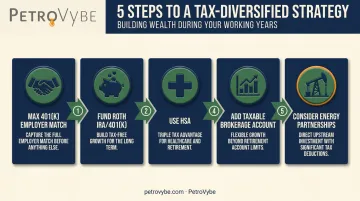
During Your Working Years
Start with the employer match - it's free money. From there, prioritize based on eligibility:
- Max the 401(k) match first - never leave employer money on the table
- Fund a Roth IRA or Roth 401(k) if income-eligible, to start building tax-free assets early
- Use an HSA if enrolled in a high-deductible health plan - contributions are deductible, growth is tax-free, and qualified withdrawals are tax-free
- Add a taxable brokerage account once tax-advantaged space is maxed, for extra flexibility
- Consider direct energy partnerships if accredited - oil and gas development investments can offer upfront intangible drilling cost (IDC) deductions against active income, adding a non-traditional layer to your tax mix
Before Retirement
The years just before retirement - often lower-income years if you've cut back on work - are prime time for Roth conversions. Converting traditional IRA dollars while in a lower bracket shrinks the balance subject to future RMDs and locks in today's tax rate on that money.
If you hold significant employer stock in a 401(k), look into net unrealized appreciation (NUA) rules. Distributing the stock in-kind, rather than rolling it into an IRA, means paying ordinary income tax only on the original cost basis, while the appreciation qualifies for long-term capital gains treatment when sold.
During Retirement
Once income needs kick in, sequencing matters. A common approach: draw from taxable accounts first, tax-deferred accounts next, and tax-free accounts last, adjusting annually to stay under a target bracket.
For charitably inclined retirees over age 70½, qualified charitable distributions (QCDs) offer another lever. A QCD sent directly from an IRA to a qualified charity counts toward your RMD but isn't included in taxable income - up to a projected $111,000 per person in 2026, based on current inflation-indexed IRS limits.
The Overlooked Fourth Bucket: Tax Deductions Through Direct Natural Gas Development
The three traditional buckets share one trait: their tax benefits build slowly, over years or decades. A fourth option works differently, and it's available right now, in the same tax year you need it.
Accredited investors can participate directly in oil and natural gas development projects. They can then elect to deduct Intangible Drilling Costs (IDCs) - the wages, fuel, and supplies that go into drilling a well - against active income.
Unlike most retirement account benefits, this deduction isn't limited to passive income. Under IRC Section 263(c), a working interest held directly, without limited liability, is treated as nonpassive, meaning the resulting deduction can offset W-2 wages and capital gains in the same year the investment is made.
That's a different mechanism than a Roth conversion or a 401(k) contribution. Those unfold over decades. A direct IDC investment creates an immediate, investor-controlled deduction event, one you can time deliberately.
PetroVybe, a private Texas-based natural gas development company, illustrates this at scale. Partners in PetroVybe's 2024 development program received a documented 94% tax deduction against active income; 2025 partners received 91%. A $100,000 investment, for example, could generate a deduction well into six figures of qualifying costs, reported to partners via K-1.

When Timing Makes the Difference
This fourth bucket works as the active-income counterpart to a Roth conversion. Roth conversions perform best in low-income years. IDC-based deductions perform best in high-income years - after a large bonus, a business sale, or a year with unusually high capital gains.
PetroVybe gives accredited investors direct access to early-stage natural gas development in Lavaca and Colorado Counties, Texas, part of the Gulf Coast Basin's Wilcox formation.
Beyond the first-year deduction, the structure targets long-term passive income (monthly distributions projected to exceed $10,000 during peak production) and a 10-year MOIC target of roughly 2.2x to 5.8x.
A few caveats worth flagging:
- This strategy suits accredited investors with $100,000+ in liquidity and a meaningful tax burden to offset
- It carries real commodity price and operational risk - drilling results and gas prices are never guaranteed
- It should be reviewed with a CPA or financial advisor as one piece of a broader tax-diversified plan, not a replacement for the three traditional buckets
Common Mistakes to Avoid
Even well-intentioned savers stumble on tax diversification. Watch for these pitfalls:
- Over-concentrating in tax-deferred accounts. Defaulting to the 401(k) alone during peak earning years means missing the window to build tax-free Roth and HSA assets.
- Ignoring RMD timing and state tax rules. Some states tax retirement withdrawals heavily while others exempt them entirely, so check local rules before setting your distribution sequence.
- Setting a strategy once and forgetting it. Income, balances, and tax law shift constantly — contribution limits, RMD ages, and IRMAA thresholds change almost every year.
The fix isn't complicated: review your tax bucket allocation at least once a year, ideally alongside a CPA or financial advisor who can flag changes before they cost you.
Frequently Asked Questions
What is the tax diversification strategy?
Tax diversification means spreading retirement savings across taxable, tax-deferred, and tax-free accounts. Doing so gives you control over lifetime tax liability and flexibility in how you withdraw money in retirement.
What are the three types of tax treatment for retirement accounts?
Taxable accounts (brokerage, savings) are funded with after-tax dollars and taxed annually; tax-deferred accounts (401(k), traditional IRA) grow tax-deferred and are taxed on withdrawal; and tax-free accounts (Roth IRA, HSA) grow and distribute tax-free when qualified.
How much of my retirement savings should be in each tax bucket?
There is no universal formula - the right mix depends on your income, current tax bracket, and time horizon. A financial or tax advisor can help model the split that fits your situation.
Can alternative investments like oil and gas development be part of a tax diversification plan?
Yes. Direct natural gas development investments can generate Intangible Drilling Cost (IDC) deductions that offset active income, including W-2 wages and capital gains, complementing the traditional three-bucket approach for accredited investors.
When is the best time to do a Roth conversion?
Lower-income years, such as early retirement before RMDs and Social Security begin, are typically ideal, since you'll pay tax on the conversion at a lower rate.
Is tax diversification only useful for high-net-worth investors?
No. While strategies like direct energy investment require accredited investor status, the core principle of spreading savings across account types benefits investors at nearly every income and savings level.