But "investing in natural gas" isn't one strategy. It's four very different ones, and the vehicle you choose determines whether you get liquid stock exposure, leveraged trading risk, or direct ownership with real tax advantages.
This guide breaks down each path, walks through the exact steps for direct well participation, explains the tax framework that makes it attractive to high-income earners, and flags the mistakes that trip up new investors.
Key Takeaways
- AI data centers, LNG exports, and coal-to-gas switching are driving natural gas demand higher.
- Investors can choose stocks/ETFs, futures/CFDs, royalty interests, or direct working interests.
- Direct participation offers the strongest return potential, plus deductions against active income like W-2 wages.
- Returns hinge on operator track record and well geology, not just commodity price trends
- Accredited investors can access PetroVybe's South Texas and Gulf Coast projects, pairing cash flow with major tax deductions.
Ways to Invest in Natural Gas: Comparing Your Options
There's no single "right way" to invest in natural gas. Each of the four main paths carries a distinct risk, return, and tax profile, and the best fit depends entirely on your goals, capital, and appetite for control.
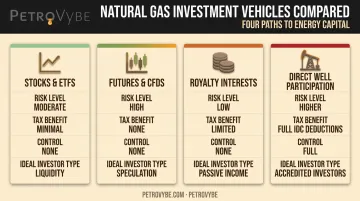
Here's how the four options compare on risk, tax treatment, and control:
| Investment Type | Risk | Tax Benefit | Control | Best For |
|---|---|---|---|---|
| Stocks & ETFs | Moderate | Minimal | None | Liquidity |
| Futures & CFDs | High | None | None | Speculation |
| Royalty Interests | Low | Limited | None | Passive income |
| Direct Well Participation | Higher | Full IDC deductions | Full | Accredited investors |
Natural Gas Stocks and ETFs
Buying shares in producers, midstream operators, or LNG infrastructure firms gives you liquid, publicly traded exposure without any operational involvement. Funds like the United States Natural Gas Fund track Henry Hub prices largely through NYMEX futures contracts rather than actual well ownership, so you're betting on price direction, not production revenue.
Natural gas ETFs can see dramatic single-day price swings, with supply shocks and extreme weather events sometimes driving double-digit percentage moves within hours. This path suits investors who prioritize liquidity and simplicity over control or tax benefits.
Natural Gas Futures and CFDs
Futures contracts and CFDs are leveraged, short-term instruments built for speculation or hedging. A standard CME Henry Hub contract controls 10,000 MMBtu with a fraction of that value in margin, and micro contracts scale down further.
That leverage cuts both ways: gains and losses move fast, and there's no production income or tax deduction attached. These instruments generate no ownership stake, and passive, long-term investors have no business here.
Royalty Interests
Royalty owners collect a share of gross production revenue without paying a dime toward drilling or operating costs, making this a genuinely lower-risk position.
The tradeoff is capped upside: royalty holders never access the deeper tax deductions available to working interest owners, and returns depend entirely on someone else's development decisions.
Direct Well Participation (Working Interest)
This is direct ownership of a proportional share in a well's production revenue, typically structured through a direct participation program like PetroVybe's limited partnership units.
It offers the highest return ceiling, monthly cash flow potential, and the only route that unlocks the full federal natural gas tax framework, including deductions against active income.
Because these deals are sold as private placements under SEC rules, they're restricted to accredited investors who can meet higher capital requirements and absorb greater risk.
How to Invest Directly Through Natural Gas Well Participation
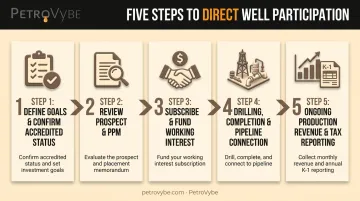
Operators like PetroVybe structure direct participation opportunities specifically for accredited investors chasing passive income, tax efficiency, and long-term tangible asset ownership. Here's how the process typically unfolds.
Step 1: Define Goals and Confirm Accredited Investor Status
Start by clarifying what you actually want: income, tax deduction, growth, or some combination. Then confirm you meet SEC accredited investor thresholds, generally a net worth above $1 million excluding your primary residence, or income above $200,000 individually ($300,000 jointly) in each of the prior two years. This status must be verified before you can review a specific prospect.
Step 2: Review the Prospect and Private Placement Memorandum (PPM)
The PPM should lay out target formation geology, offset well production history, projected drilling and completion costs, and risk factors. An operator's geophysics team matters enormously here.
PetroVybe's Chief Geophysicist, Michael Stamatedes, has posted a 75.2% well-success rate over a 48-year career, well above the industry peer average of below 40%. That track record directly feeds decline curve assumptions and project profitability, making it a genuine due-diligence checkpoint rather than a marketing footnote.
Step 3: Subscribe and Fund the Working Interest
Once you're comfortable with the prospect, you complete a subscription agreement and fund your capital allocation, receiving a proportional ownership percentage in the specific project. PetroVybe's current developments sit in South Texas's Lavaca County and the broader Gulf Coast Basin, with minimum participation typically starting around $100,000 in liquidity.
Step 4: Drilling, Completion, and Pipeline Connection
From here, the operator manages drilling, completion, and pipeline tie-in. Investors aren't doing any of the operational heavy lifting, but they should expect regular updates covering drilling plans and any contingency changes along the way. These typically arrive through email, quarterly reports, and direct access to the team.
Step 5: Ongoing Production Revenue and Tax Reporting
Once wells start producing, distributions arrive monthly based on your working interest percentage and prevailing Henry Hub or regional pricing. Year-end, you'll receive a K-1 documenting your share of Intangible Drilling Cost and depletion deductions, which is the paperwork that actually delivers the tax benefits covered next.
Tax Benefits That Make Natural Gas a Smart Investment
Natural gas wells qualify for the same IRC tax incentives as oil drilling, among the most favorable tax treatments available to individual accredited investors in the tax code.
Intangible Drilling Costs (IDCs)
94% tax deduction against ordinary income in 2024 and a 91% deduction in 2025. A redacted K-1 sample shows a $600,000 capital contribution generating $401,772 in deductions, illustrating how a well-structured program converts a large share of invested capital into an immediate write-off.
This tax treatment pairs with long-term return targets. PetroVybe's projections point toward a 10-year MOIC window of roughly 2.2x-5.8x and a target IRR near 26%. For high-income earners looking to cut their tax burden while building long-term wealth, that combination of an immediate deduction plus compounding cash flow is hard to replicate elsewhere.
Key Factors That Affect Natural Gas Investment Returns
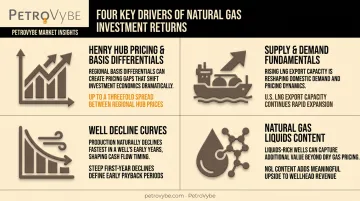
Outcomes depend on several market and well-specific variables that matter more than the commodity's broad macro narrative.
Henry Hub Pricing and Basis Differentials
Natural gas is priced in dollars per MMBtu at the Henry Hub benchmark, and regional basis differentials can push realized revenue up or down from that number. Prices swing hard: EIA data shows monthly Henry Hub averages ranging from $2.77/MMBtu to $7.72/MMBtu over a recent 12-month stretch. That's roughly a threefold spread, which is why any return model needs to test multiple price scenarios, not just one.
Supply and Demand Fundamentals
Those price swings trace back to supply and demand fundamentals: seasonal heating and cooling demand, storage inventory levels, and LNG export growth all move prices. The EIA projects U.S. LNG export capacity rising from 15.4 Bcf/d in 2025 to 29.3 Bcf/d by 2029, nearly doubling the country's ability to sell gas overseas.
Well Decline Curves
Beyond price and demand, production itself changes over time: output declines, and shale wells decline faster than conventional wells in their first year. This directly affects long-term revenue projections, which is why operators need continued development, not a single well, to sustain output.
Natural Gas Liquids (NGL) Content
Decline curves affect volume, but what a well produces matters just as much: wells that also produce NGLs like ethane, propane, and butane can meaningfully boost project economics. NGLs carry a higher per-BTU value than dry gas alone, which is one reason PetroVybe's development strategy in the Gulf Coast Basin focuses on liquids-rich production rather than dry gas plays.
Risks and Common Mistakes to Avoid When Investing in Natural Gas
Every natural gas investment carries risk. Informed investors manage it by choosing operators who address these factors head-on rather than glossing over them.
- Price volatility: Weather patterns, storage levels, and geopolitics drive monthly revenue swings, but low-cost-basin operators who spread capital across multiple wells minimize the impact.
- Dry holes and non-commercial wells: Partial or total capital loss remains a real risk, though operators using 3D seismic data in proven formations face far lower dry-hole risk than wildcat drillers.
- Skipping operator due diligence: Verify an operator's track record, third-party reserve validation, and regulatory licensing before committing capital.
- Ignoring pipeline and infrastructure access: Limited pipeline capacity can curtail production or force discounted wellhead pricing, so confirm midstream relationships before you invest.
Quick tip: Reputable operators willingly share independent, third-party reserve reports — if one hesitates, treat it as a red flag.
Frequently Asked Questions
Is it worth investing in natural gas?
For many investors, yes, given rising demand from data centers, LNG exports, and power generation. But "worth it" depends heavily on which vehicle you choose and how much risk you can stomach.
What's the best way to invest in natural gas?
Stocks and ETFs suit investors who want liquidity and simplicity. Direct working interest participation suits accredited investors seeking monthly cash flow and the full tax benefit package.
How much money do I need to start investing in natural gas?
ETFs and stocks require minimal capital, often just the price of a share. Direct participation programs typically require accredited investor status, with minimums commonly starting around $100,000.
Are natural gas investments tax deductible?
Direct working interest participation qualifies for Intangible Drilling Cost and percentage depletion deductions against active income. Stocks and ETFs offer no comparable direct tax benefits.
What's the difference between investing in natural gas and oil?
Both share the same federal tax framework for working interests, but they differ in price benchmarks, infrastructure needs, and demand drivers. Natural gas benefits distinctly from LNG export growth and power generation demand.
Do I need to be an accredited investor to invest in natural gas directly?
Yes. Direct well participation programs are typically offered as private placements under SEC Regulation D, restricted to verified accredited investors, unlike publicly traded stocks or ETFs.