This article is general education, not investment, tax, or legal advice. The US oil and gas industry underpins roughly 7.6% of national GDP and supported nearly $1.8 trillion in economic activity in 2021, according to an API-commissioned PwC study. That scale isn't going away. If anything, it's getting a new growth engine: AI.
Data centers consumed about 4.4% of US electricity in 2023, and the Department of Energy projects that could climb to 6.7%-12% by 2028. Natural gas already supplies over 40% of that load, and the IEA projects more than 130 additional terawatt-hours of annual gas-fired generation for US data centers through 2030.
This primer is built for accredited investors weighing oil and gas as an alternative asset class alongside stocks, bonds, and real estate. This guide covers industry structure, price drivers, investment vehicles, tax benefits, and risk.
Key Takeaways
- Oil and gas splits into upstream, midstream, and downstream, each with distinct risk/reward profiles
- Prices move on global supply/demand, OPEC decisions, and geopolitics, tracked via WTI and Brent benchmarks
- Investors can enter through stocks/ETFs, royalties, or direct working-interest participation
- Direct natural gas development can unlock large tax deductions (including IDC) against active income, not only passive income
- Match risk tolerance and liquidity needs to the investment type before committing capital. This treatment requires the investor to elect general partner status in the Subscription Agreement and may be limited in a given year by the excess business loss limitation under IRC §461(l).
Understanding the Oil and Gas Industry Structure
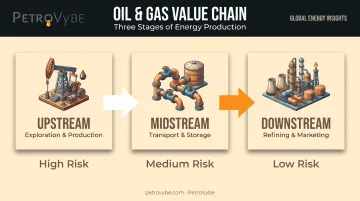
Every barrel of oil or cubic foot of gas moves through three distinct stages before it reaches a consumer or, increasingly, a data center's power grid:
- Upstream – exploration and production (finding and extracting the resource)
- Midstream – transport and storage (pipelines, terminals)
- Downstream – refining and marketing (turning crude into usable products)
Each segment carries a different risk profile, capital structure, and return timeline. Confusing them is one of the fastest ways investors set the wrong expectations.
Upstream: Where Value Is Created
Upstream is where geology meets capital. It's the highest-risk, highest-reward segment because success depends on picking the right rock in the right location before a single well is drilled.
That is why the operator's technical bench matters as much as the acreage. PetroVybe's Chief Geophysicist, Michael Stamatedes, brings a 48-year track record in well selection, including time as a geology leader at ExxonMobil where he led discoveries exceeding 3 TCF of natural gas. Company materials cite a 75.2% well-selection success rate against a peer average below 40% (results from prior roles). Disclaimer: these results were achieved at prior companies. Upstream returns still hinge on who is picking the locations.
Midstream and Downstream: Supporting Infrastructure
Midstream and downstream behave more like infrastructure investments than exploration bets:
- Pipelines and storage earn steadier, fee-based cash flow tied to throughput
- Refineries and marketing sit closer to end products and consumer demand
- Both are generally less exposed to well-level geologic risk than upstream
That steadier profile is also why fewer direct-participation deals are offered there. Most opportunities available to accredited investors sit in upstream projects. If you want ownership economics tied to production, upstream is where that access usually lives.
How Oil and Gas Prices Are Determined
Crude and gas prices respond to three main forces:
- Global supply and demand
- OPEC production targets
- Geopolitical shocks
The EIA notes that OPEC manages supply by setting member production quotas, and spare capacity (or the lack of it) can swing prices quickly when disruptions hit.
Two benchmarks dominate every report you'll read:
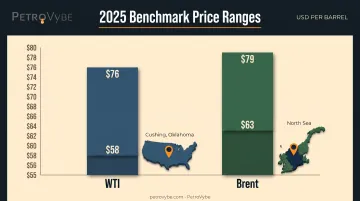
- WTI (West Texas Intermediate) – the US domestic benchmark, priced at Cushing, Oklahoma
- Brent – the North Sea-based international benchmark
Both are volatile. WTI ranged from roughly $58 to $76 per barrel across 2025 monthly averages, while Brent swung between about $63 and $79. That volatility is exactly why price exposure matters when evaluating any oil and gas position.
Natural gas is a different story. AI-driven electricity demand is creating a structural pull on gas as the preferred fuel for new generation capacity. That demand dynamic differs from crude oil's, and it's a major reason gas-focused development projects are drawing investor attention.
Common Ways to Invest in Oil and Gas
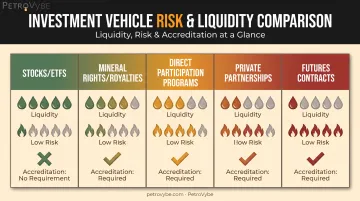
Not all oil and gas investments look alike. Here's how the main options stack up:
| Vehicle | Liquidity | Risk Level | Tax Benefits | Accreditation Required |
|---|---|---|---|---|
| Stocks/ETFs | High | Lower | Minimal | No |
| Mineral rights/royalties | Low | Moderate | Limited | Varies |
| Direct Participation Programs (working interests) | Low | Higher | Significant | Yes |
| Private partnerships (development projects) | Low | Higher | Significant | Yes |
| Futures contracts | High | Very high | None | No |
Stocks and ETFs offer the easiest entry point: diversified, liquid, lower-risk exposure to the sector without operational headaches.
Mineral rights and royalties generate passive income tied to production, without the operational risk of a working interest.
Direct Participation Programs and working interests put you directly on the hook for production and costs. FINRA defines a DPP as a structure providing flow-through tax consequences, which is why these vehicles carry the tax advantages covered in the next section. They require accredited investor status.
Private partnerships give accredited investors equity in early-stage development through a limited partnership structure, usually without day-to-day operational burden. PetroVybe is one example: partners hold positions across a 58,000-acre Gulf Coast Basin position in Lavaca County, Texas, backed by roughly 400 acquired legacy wells plus 57+ planned new wells.
Futures contracts exist mainly for advanced traders seeking short-term price exposure, not long-term ownership. They also carry high volatility.
Tax Advantages of Direct Oil and Gas Investment
For high-income earners, the tax treatment of direct oil and gas investment is often the deciding factor.
Intangible Drilling Costs (IDCs)
The IRS allows operators to elect to deduct qualifying intangible drilling costs as current business expenses rather than capitalizing them. These costs commonly represent a first-year deduction target of approximately 70–80% of invested capital of well costs in a new development project. This treatment requires the investor to elect general partner status in the Subscription Agreement and may be limited in a given year by the excess business loss limitation under IRC §461(l).
Qualifying IDCs typically include:
- Wages and labor tied to drilling
- Fuel and consumable supplies
- Contractor drilling work with no salvage value
The real advantage: the deduction can apply against active income, including W-2 wages and capital gains, not just passive income. Most other investment tax strategies are capped by passive-activity limitations.
Depletion Allowances
Beyond the initial deduction, eligible independent producers and royalty owners can claim percentage depletion, generally 15% of gross income from the property, as the well continues producing. This creates an ongoing tax benefit long after the drilling phase ends.
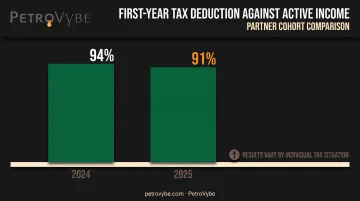
PetroVybe partners who joined in 2025 reported a 94% first-year deduction against active income. These figures reflect the company's own reported outcomes and shouldn't be read as a universal guarantee. Prior result; not a promise of any future deduction. IDC and depletion benefits depend on your specific tax situation, so consulting a tax advisor before committing capital is essential. This treatment requires the investor to elect general partner status in the Subscription Agreement and may be limited in a given year by the excess business loss limitation under IRC §461(l).
Risks and Factors to Evaluate Before Investing
Direct oil and gas investing isn't a set-it-and-forget-it play. Three risk categories deserve close attention:
Commodity price volatility. Well economics are directly tied to prevailing oil and gas prices. A drop in benchmark pricing can compress or eliminate expected returns even when a well performs geologically as projected.
Liquidity constraints. The SEC has warned that private oil and gas offerings often involve high risk, including total loss of investment, and investors should be prepared to hold restricted securities indefinitely. Direct participation programs typically require multi-year holding periods with no public exit ramp.
Due diligence gaps. Before wiring capital, evaluate:
- Operator track record – has the team executed similar projects before?
- Third-party reserve engineering – is production backed by an independent, licensed assessment?
- Financial transparency – is there an independent audit, and are reporting practices clear?
- Use of proceeds – how much of your capital actually funds drilling versus overhead and fees?
A project's paperwork matters as much as its geology. Reserve reports, audit opinions, and operator disclosures are where diligence either holds up or falls apart.
Frequently Asked Questions
What are intangible drilling costs?
IDCs are non-salvageable drilling expenses, like labor, fuel, and contractor work, that qualify for current-year deduction rather than capitalization. They typically represent a first-year deduction target of approximately 70–80% of invested capital of a well's total development cost. This treatment requires the investor to elect general partner status in the Subscription Agreement and may be limited in a given year by the excess business loss limitation under IRC §461(l).
How risky is oil and gas investing?
Risk varies significantly by vehicle. Stocks and ETFs carry lower, market-level risk, while direct working interests and private placements carry higher risk, including potential total loss of capital.
Do I need to be an accredited investor to invest in oil and gas?
Not for stocks or ETFs. But private placements and Direct Participation Programs require accredited status: $1 million net worth excluding your primary residence, or $200,000+ individual income ($300,000 joint) in each of the last two years.
Can I use oil and gas investments to generate passive income?
Yes. Mineral royalties and producing-well distributions from working interests both generate ongoing passive income, though timing and amounts depend on production performance and the specific offering.
How are oil and gas prices determined?
Prices are set by global supply and demand, OPEC production targets, and geopolitical events, with WTI and Brent serving as the two dominant pricing benchmarks investors track.
How do taxes work for oil and gas investments?
Qualifying working interests may allow current-year IDC deductions against active income plus ongoing depletion allowances as wells produce. Rules are technical, so consult a tax advisor before investing. This treatment requires the investor to elect general partner status in the Subscription Agreement and may be limited in a given year by the excess business loss limitation under IRC §461(l).
Informational requests only. PetroVybe projects are offered solely to verified accredited investors. Submitting this form does not create an investment or advisory relationship.