Introduction
Most high-income professionals have heard "private equity" thrown around in financial conversations — yet the mechanics remain genuinely unclear for many. What does a PE firm actually do? Who can invest? And does it belong in a well-structured portfolio?
Private equity involves acquiring and managing private companies — businesses not listed on any stock exchange — with the goal of growing them and selling at a profit. It's an asset class that has scaled at pace: according to Preqin's 2025 Global Report, global PE assets under management reached $5.8 trillion at end-2023, with projections reaching $12 trillion by 2029.
The potential returns are real — so are the tradeoffs: illiquidity, high minimums, fee drag, and wide performance variance across managers and vintages.
This guide breaks down how PE funds are structured, the major strategies with real examples, how value gets created, and the concrete options available to accredited investors today.
Key Takeaways
- PE involves pooling capital to acquire and manage private companies, then selling at a gain after multi-year hold periods
- The three core strategies — leveraged buyouts, growth equity, and venture capital — target different company stages and risk profiles
- PE has historically offered higher potential returns than public markets, with real tradeoffs in liquidity and hold period length
- Accredited investors can participate directly in private deals — including energy partnerships that carry substantial upfront tax deductions against active income
What Is Private Equity, and How Are PE Funds Structured?
Private equity is equity investment made into companies that are not publicly traded on a stock exchange. Professional investment firms manage these investments on behalf of institutional and accredited investors, with the goal of building value and exiting at a gain.
Unlike buying shares in Apple or Microsoft, PE involves active ownership over years — no daily trading, no quarterly earnings calls, and a different relationship between investor and company.
The GP-LP Partnership Structure
PE funds are organized as limited partnerships with two distinct roles:
- General Partners (GPs): The active investment managers who source deals, manage portfolio companies, and execute exits
- Limited Partners (LPs): Passive capital providers including pension funds, endowments, family offices, and accredited individual investors who don't participate in day-to-day decisions
GPs typically charge two fees. First, an annual management fee (commonly around 2% of committed capital). Second, a performance fee — known as carried interest — typically around 20% of profits above a hurdle rate. A 2023 Goodwin survey found that 80% of PE funds using a hurdle rate set it at 8%, making that a strong industry convention. This "2 and 20" structure aligns GP incentives with LP returns. It also creates real fee drag on net performance that LPs need to account for.
The PE Fund Lifecycle
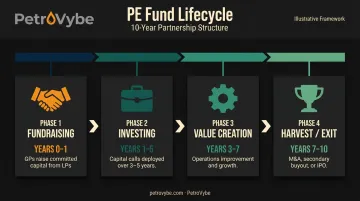
A typical PE fund runs approximately 10 years through four phases:
- Fundraising: GPs raise committed capital from LPs before any money moves into deals
- Investing: GPs deploy capital into portfolio companies through capital calls over 3–5 years
- Value creation: GPs work directly with portfolio company management to improve operations, cut costs, and grow revenue
- Harvest/Exit: GPs sell portfolio companies via M&A, secondary buyout, or IPO, then distribute returns to LPs
Types of Private Equity Strategies: With Real-World Examples
PE is not monolithic. Three primary strategies dominate the asset class, each targeting different company stages, risk profiles, and return mechanics.
Leveraged Buyouts (LBOs)
LBOs are the largest PE strategy by assets under management. The GP acquires a controlling stake in a mature, cash-flow-generating company using a combination of equity and significant borrowed debt (placed on the company's balance sheet, not the PE firm's). The company's own cash flows service the acquisition debt.
The defining example: KKR's 1989 acquisition of RJR Nabisco for $25 billion remains one of the largest LBOs in history. The deal illustrated both the power and the risk of leverage — using the target company's future earnings to fund its own acquisition.
The core LBO math: because borrowed capital funds most of the purchase price, the equity check is smaller. Any increase in the company's value is measured against that smaller equity base, amplifying percentage returns. If the company underperforms, however, that same debt amplifies losses rather than gains.
Growth Equity
Growth equity involves minority investments in established companies growing rapidly but not yet profitable — typically with little or no debt. Investors don't seek operational control; they provide capital to accelerate growth.
TPG Growth's investments in Uber and Spotify are recognizable examples. In 2016, Spotify raised $1 billion in convertible debt from TPG and Dragoneer — a growth equity transaction that provided capital without transferring control.
Venture Capital vs. Traditional PE: Quick Comparison
Venture capital is technically a PE subset, but it operates differently enough to warrant its own category:
| Factor | Venture Capital | Traditional PE (LBO) |
|---|---|---|
| Company stage | Early-stage startups | Mature, cash-flow-positive companies |
| Ownership stake | Minority | Typically controlling |
| Debt used | Rarely | Heavily |
| Industry focus | Tech, biotech, software | Broad across sectors |
| Risk profile | High failure rate, few big winners | More predictable cash flows |
Distressed and Secondary Strategies
Two additional strategies offer different entry-point advantages:
- Distressed debt investing: Acquiring the debt of financially troubled companies at a discount, often to gain control during restructuring. Returns depend on recovery value and creditor priority.
- Secondary transactions: Buying existing LP stakes or fund interests from investors seeking early liquidity. Secondaries can offer diversification across vintage years and managers, often at a discount to net asset value.
Recognizable PE Firms
The largest and most recognizable PE firms are now publicly traded, making their management businesses accessible to retail investors:
| Firm | Ticker | Primary Focus Areas |
|---|---|---|
| Blackstone | NYSE: BX | Real estate, PE, credit, infrastructure |
| KKR | NYSE: KKR | PE, real assets, credit, insurance |
| Apollo Global Management | NYSE: APO | Credit, equity, hybrid strategies, retirement services |
| Carlyle Group | Nasdaq: CG | Global PE, credit, investment solutions |
How Private Equity Firms Create Value
Early PE returns relied heavily on financial engineering — use cheap debt, buy a company, sell it when multiples expanded. That era is over.
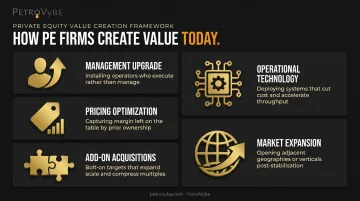
According to McKinsey's analysis, higher financing costs and compressed valuation multiples have shifted the return burden toward genuine operating improvement. Today's PE value creation strategies include:
- Bringing in new, more capable management teams
- Optimizing pricing and improving margins
- Executing strategic add-on acquisitions to build scale
- Implementing operational technology and process improvements
- Entering new markets or product categories
PE ownership offers one genuine structural advantage: freedom from quarterly public market reporting. Management can take a longer-term view on capital allocation without facing Wall Street pressure every 90 days.
Leverage as a Value Driver — and a Risk
Debt still plays a role. By reducing the equity capital required upfront, leverage amplifies returns on that equity.
One controversial application is the dividend recapitalization, where a PE firm loads new debt onto a portfolio company to pay itself a distribution before exit. PitchBook-LCD measured $69.3 billion in US PE-backed dividend recap volume through late 2024, with that year potentially setting a record.
Sponsors receive cash upfront while the additional debt remains on the portfolio company's balance sheet — a structure that can constrain the company's ability to invest, hire, or weather a downturn.
How Returns Are Measured
PE performance is measured using two metrics:
- MOIC (Multiple on Invested Capital): Total value returned divided by capital invested — an absolute multiple that doesn't factor in timing
- IRR (Internal Rate of Return): The discount rate at which the investment's cash flows have zero net present value — incorporates timing, and can be affected by early distributions
Both matter. A 3x MOIC over 10 years means something very different than a 3x MOIC over 4 years.
How to Invest in Private Equity
Accredited investors have more access options today than a decade ago. Each vehicle provides materially different exposure — understanding what you're actually buying matters before you commit.
Traditional PE Fund LP Commitments
The classic route: commit capital directly as an LP in a PE fund. Minimums traditionally start around $5 million, with 10-year lock-ups and the full "2 and 20" fee structure. This path remains primarily accessible to institutional investors and ultra-high-net-worth individuals who qualify as accredited investors or qualified purchasers.
SEC accredited investor criteria include:
- Net worth over $1 million, excluding primary residence
- Individual income over $200,000 (or $300,000 jointly) in each of the prior two years
- Certain professional licenses (Series 7, Series 65, or Series 82)
Publicly Traded PE Firms
Buying shares in Blackstone (BX), KKR, Apollo (APO), or Carlyle (CG) through a standard brokerage account provides exposure to the PE firm's management business and fee income (not direct ownership of their underlying fund portfolios). Performance differs from investing in the funds themselves, but it's liquid and requires no minimum commitment or accredited investor status.
PE-Focused ETFs
The Invesco Global Listed Private Equity ETF (PSP) trades on NYSE Arca and tracks the Red Rocks Global Listed Private Equity Index, with a 1.80% expense ratio. It holds listed PE-related companies — providing sector exposure without accredited investor requirements or large minimums, but it tracks public company performance, not private fund returns.
Co-Investments and Fund-of-Funds
- Co-investments: LPs invest directly alongside a GP in a specific deal, sometimes at reduced or zero fees. More transparency into individual positions, but requires existing GP relationships.
- Fund-of-funds: Pool capital across multiple PE managers, strategies, and vintage years. Broad diversification, but add another layer of fees on top of underlying fund fees.
Direct Private Investment in Operating Assets
For accredited investors seeking private market exposure with tax advantages that standard PE structures don't provide, direct participation investments — particularly in oil and gas development — offer a distinct pathway.
Unlike LP interests in traditional PE funds, direct oil and gas programs allow investors to access Intangible Drilling Cost (IDC) deductions under IRC Section 263(c). These deductions apply against active income — including W-2 wages and capital gains, not just passive income. That's a meaningful structural difference from most investment vehicles.
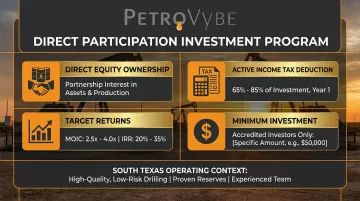
PetroVybe's oil and gas development partnerships in South Texas and Lavaca County operate on this model. Key structural features:
- Direct equity ownership in underlying wells and production assets, not a fund interest
- Active income tax deductions: 91% for 2024 partners, 94% for 2025 partners
- Returns tied to production performance, not portfolio company exits
- Target 10-year MOIC of 2.2x to 5.8x and IRR of approximately 26%
- $100,000 minimum investment
This isn't PE in the traditional sense. It's a different mechanism (direct asset ownership with inflation-linked production income and front-loaded tax efficiency) that some accredited investors use alongside or instead of conventional PE allocations.
Key Risks and Considerations for PE Investors
Illiquidity and Lengthening Hold Periods
PE capital is committed for years. Most funds have 10-year contractual lives, and McKinsey's 2026 report confirms the average PE portfolio company was held for more than 6.5 years in 2025 — and holds have been lengthening. Distributions as a percentage of PE AUM dropped to just 6% in the 12 months ending June 2025, compared to a 16% average from 2015 to 2019. Investors may wait significantly longer than expected to see capital returned.
Fee Drag and Performance Variability
The "2 and 20" fee structure reduces net returns, sometimes substantially. PE performance also varies dramatically across firms, strategies, and vintage years. Manager selection is one of the most consequential decisions in private markets investing. Top-quartile and bottom-quartile returns can differ by several multiples, making the choice of GP as important as the asset class itself.
Macro, Rate, and Regulatory Risks
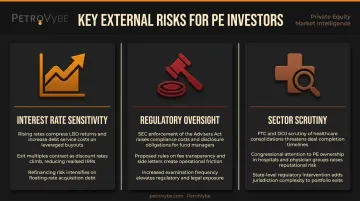
Three external factors are worth monitoring closely:
- Interest rate sensitivity: LBO-heavy strategies depend on affordable acquisition debt. Higher rates raise borrowing costs, compress the debt available at any given price, and slow exit activity, as demonstrated clearly in 2022–2024.
- Regulatory oversight: PE fund advisers are subject to SEC oversight under the Advisers Act. The SEC's 2023 Private Fund Adviser Rules were vacated by the Fifth Circuit effective June 5, 2024, but regulatory attention on the asset class isn't going away.
- Sector scrutiny: The FTC held a 2024 workshop on PE in healthcare, and bipartisan Congressional interest in PE's impact on sectors like nursing homes and healthcare continues to grow — a real, if uncertain, policy risk.
Frequently Asked Questions
What is private equity with an example?
Private equity is investment in non-publicly traded companies, managed by professional firms on behalf of institutional and accredited investors. The textbook example: KKR's $25 billion leveraged buyout of RJR Nabisco in 1989, where KKR acquired a controlling stake using equity plus debt, improved operations, then sold at a profit.
What are examples of private equity companies?
The most recognizable PE firms are now publicly traded: Blackstone (BX), KKR (KKR), Apollo Global Management (APO), and Carlyle Group (CG). Beyond these giants, thousands of PE firms operate across deal sizes, sectors, and geographies — from large-cap buyout shops to venture capital funds focused on early-stage technology.
How do private equity firms make money?
Two primary sources: an annual management fee (typically around 2% of committed or invested capital) paid by LPs regardless of performance, and carried interest (typically around 20% of profits above a hurdle rate) earned when portfolio companies are sold at a gain. The management fee covers operating costs; carry is where most GP wealth is created.
What is the minimum investment for private equity?
Traditional PE fund commitments start around $5 million for institutional and ultra-high-net-worth LPs. More accessible alternatives lower this barrier considerably — publicly traded PE stocks have no minimum, PE ETFs like PSP trade like any share, and certain direct investment programs (such as oil and gas development partnerships) start at $100,000 for accredited investors.
How long does a private equity investment last?
Most PE funds have a contractual life of approximately 10 years — the first 4-5 years focused on investing, the remainder on value creation and exits. Average hold periods have been lengthening; McKinsey reports the average portfolio company was held more than 6.5 years in 2025.
What are the main risks of investing in private equity?
Three core risks: illiquidity (capital is committed for years with limited ability to exit early), performance variability (returns differ widely across managers, strategies, and vintage years, making manager selection critical), and fee drag (management fees and carried interest reduce net returns to investors, particularly in average-performing funds).
Disclosure: PetroVybe and its team members are not licensed financial advisors, and nothing on this website constitutes financial or investment advice or a recommendation to buy, sell, or hold any investment. PetroVybe and its team members are not tax advisors, accountants, or tax strategists, and nothing on this website constitutes tax advice or a tax strategy. PetroVybe and its team members are not attorneys, and nothing on this website constitutes legal advice. All content is provided for general informational purposes only. You should consult your own independent financial advisor, tax professional, and legal counsel before making any decision.