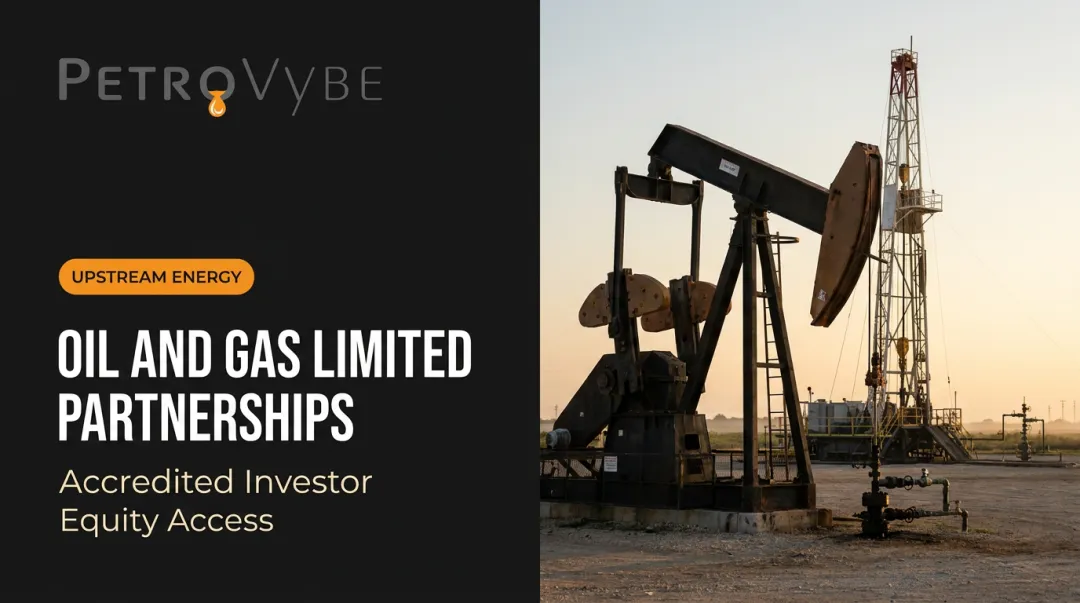

This article is general education, not investment, tax, or legal advice. Accredited investors are increasingly drawn to limited partnerships for one simple reason: passive income with real tax efficiency. Unlike a stock dividend or a rental property you have to manage yourself, an LP lets you contribute capital and step back while someone else runs the operation.
Many investors struggle with understanding exactly what they're signing up for. LPs show up constantly in real estate syndications, private equity funds, and oil & gas development projects, but the liability rules, tax treatment, and management restrictions are frequently misunderstood.
This guide breaks down what an LP actually is, how it's taxed, where it shines (and where it doesn't), and how the structure applies specifically to energy development investing.
Key Takeaways
- An LP needs one general partner (unlimited liability, runs the business) and one or more limited partners (capped liability, passive role)
- LPs are pass-through entities: partners get a Schedule K-1 and report profits/losses on personal returns
- Limited partners lose liability protection if they participate in management
- Oil & gas LPs give accredited investors direct, passive access to drilling projects with substantial upfront tax deductions
What Is a Limited Partnership (LP)?
A limited partnership is a business structure built around two distinct partner classes, each with different roles and different exposure to risk.
General partners (GPs) control operations. They manage day-to-day decisions, set strategy, and carry unlimited personal liability for the partnership's debts and obligations. If the business gets sued or can't pay its bills, a GP's personal assets are on the line.
Limited partners contribute capital and stay passive. Their liability is capped at whatever they invested. This is often called the "silent partner" role — and it has to stay that way. If a limited partner starts making operational decisions, state law may reclassify them as a general partner and strip that liability shield.
According to Cornell Law School's Legal Information Institute, a limited partner must generally maintain distance from decision-making, or state law may treat them as a general partner regardless of their title on paper.

Forming an LP involves:
- Filing a Certificate of Limited Partnership with the state's Secretary of State
- Drafting a governing partnership agreement outlining roles, profit splits, and exit terms
- Obtaining an EIN for tax reporting purposes
Common Uses of Limited Partnerships
LPs show up across several industries where one party wants operational control and others want passive exposure:
- Real estate syndications
- Private equity and venture capital funds
- Film financing
- Family estate planning
- Natural resource and energy development projects, including oil and gas drilling partnerships
In energy development, the GP typically runs acquisition, drilling, and production while limited partners commit capital and receive passive distributions plus any tax attributes the structure allows. That split is why accredited investors often use LPs for upstream oil and gas exposure without taking on day-to-day operating risk.
How Limited Partnerships Are Taxed
LPs don't pay federal income tax at the entity level. Instead, they're pass-through entities: profits and losses flow directly to the partners' personal returns.
Here's how the mechanics work, per IRS Publication 541:
- The partnership files an informational Form 1065
- Each partner receives a Schedule K-1 reporting their share of income, deductions, and credits
- Limited partners generally aren't subject to self-employment tax, since their income isn't treated as active or earned income

Why Oil & Gas LPs Offer Unique Deductions
Energy development LPs carry a specific tax advantage most other LP structures don't: intangible drilling cost (IDC) deductions. These costs (labor, chemicals, drilling fluids, and other non-salvageable expenses) can typically be deducted in the year incurred rather than depreciated over time.
PetroVybe's own investor data shows how significant this can be. Partners received a 94% first-year tax deduction against active income in 2025, driven by IDC deductions and depletion allowances. Prior result; not a promise of any future deduction. This treatment requires the investor to elect general partner status in the Subscription Agreement and may be limited in a given year by the excess business loss limitation under IRC §461(l).
A redacted 2025 K-1 sample from the company shows a $600,000 capital contribution generating $401,772 in deductions in year one alone.
IDC deductions typically run a first-year deduction target of approximately 70–80% of invested capital in a new-drilling project, and, unlike many passive-activity losses, they can offset active income, including W-2 wages and capital gains, in specific structures. This treatment requires the investor to elect general partner status in the Subscription Agreement and may be limited in a given year by the excess business loss limitation under IRC §461(l).

Treatment of unrelated business taxable income (UBTI), required minimum distributions, and passive activity loss rules still varies by investor. Talk to a tax professional before assuming any deduction applies to your return.
Limited Partnerships vs. Other Business Structures
LPs sit between general partnerships and LLCs on liability and control. That middle ground is why many investors choose them.
| Structure | Liability | Management |
|---|---|---|
| General Partnership | No protection for any partner | All partners can manage |
| Limited Partnership | GPs unlimited; LPs capped at investment | Only GPs manage |
| LLC | All members protected | All members can participate |
| LLP | All partners protected | All partners can participate |
The core trade-off: LPs trade management rights for liability protection.
LLCs and LLPs give every participant both protection and control. That flexibility costs the clean operator/investor split that makes LPs attractive for passive capital, especially in drilling programs where one operator needs unified control.
Pros and Cons of Investing as a Limited Partner
Before committing capital, weigh both sides honestly.
Advantages:
- Capped liability keeps personal assets beyond your investment protected
- Passive structure means no day-to-day time commitment—ideal for busy professionals
- Pass-through taxation can deliver deductions that meaningfully reduce your tax burden
Drawbacks:
- Illiquidity: LP interests are typically long-term holds with limited resale markets
- Dependence on the GP: returns hinge entirely on the operator's competence and integrity
- No voting control: you keep information and reporting rights, not management authority
The SEC's Investor Bulletin on private placements is blunt about this: private placement investors can lose their entire investment, and issuers aren't required to provide the same disclosure as registered offerings. That makes due diligence non-negotiable — check audited financials, management track record, and how prior offerings performed before wiring capital.
Forming or Investing in a Limited Partnership
If you're forming an LP, the steps are simple:
- Choose a formation state based on filing fees, privacy rules, and where the business will operate
- Draft a partnership agreement covering profit splits, reporting, GP authority, and exit terms
- File a Certificate of Limited Partnership with the state
- Obtain an EIN from the IRS for tax reporting and banking
Investing in an existing LP is far more common for individuals looking at oil & gas or real estate deals. The path is different.
Most private LP offerings, including energy development funds, are limited to accredited investors who meet SEC thresholds: $200,000+ individual income ($300,000 joint), or $1 million+ net worth excluding primary residence.
Before committing capital, review the partnership agreement for:
- Profit distribution terms, priority, and timing
- Capital call obligations and default remedies
- Reporting cadence and audit rights
- GP fees, promote, and expense allocation
- Exit, transfer, and dissolution provisions
How a sponsor verifies accreditation matters too. PetroVybe, for example, requires third-party verification through a CPA, tax attorney, or licensed financial advisor rather than self-certification—confirm the same standard with any sponsor you evaluate.
Limited Partnerships in Oil & Gas Development Investing
Energy development companies use the LP structure for a specific reason: it lets accredited investors get direct exposure to drilling projects while the operator keeps full management control over technical decisions.
This matters because drilling programs require constant operational judgment (well placement, contractor management, budget allocation) that passive investors aren't equipped, or legally permitted, to make. The LP structure formalizes that division cleanly.
The tax angle makes this structure particularly attractive. As covered above, IDC deductions unique to energy LPs can offset active income in ways most passive investments simply can't match. This treatment requires the investor to elect general partner status in the Subscription Agreement and may be limited in a given year by the excess business loss limitation under IRC §461(l).
PetroVybe illustrates this model in practice. The Texas-based natural gas developer offers accredited investors LP participation in its PetroVybe ONE project in Lavaca County, within the broader Gulf Coast Basin:
- 58,000-acre development position
- Roughly 400 acquired producing wells plus 57+ planned new wells
- Third-party engineering validation, including a $48 million PV-09 reserve valuation. Prepared by Lee Keeling & Associates, Tulsa, March 2026.

When the GP keeps full decision-making control, limited partners should underwrite the operating bench. President & COO Blaine Yeary scaled a $5 billion asset from zero to 35,000 BOEPD over eight years, and Chief Geophysicist Michael Stamatedes brings a 48-year track record from ExxonMobil.
Demand supports the thesis. The IEA's 2025 Energy and AI report projects U.S. data center electricity consumption to rise roughly 130% by 2030, with natural gas remaining the largest source of that additional power supply. That is a direct tailwind for producers positioned to deliver it.
Frequently Asked Questions
What is a limited partnership investment?
It's a passive ownership stake in a business, often real estate, private equity, or energy development, where you contribute capital, receive a share of profits, and carry liability limited to your investment.
Are limited partners involved in management?
No. Limited partners stay passive and don't manage daily operations. Getting involved in management risks losing your limited liability protection entirely.
How are limited partners taxed?
Limited partners receive a Schedule K-1 and report their share of income or losses on personal tax returns. Self-employment tax generally does not apply.
Can a limited partner lose their liability protection?
Yes. Active involvement in management can reclassify a limited partner as a general partner, exposing personal assets to full liability.
What's the difference between an LP and an LLC?
LLCs give liability protection to all members and allow shared management. LPs limit liability protection to limited partners, who must stay passive to keep it.
Who can invest in a limited partnership?
Many private LP offerings, including energy development funds like PetroVybe's, are restricted to accredited investors meeting SEC-defined income or net worth requirements.
Informational requests only. PetroVybe projects are offered solely to verified accredited investors. Submitting this form does not create an investment or advisory relationship.