
This article is general education, not investment, tax, or legal advice. Splitting partnership profits 50/50 sounds simple. It rarely is. One partner puts in cash, another puts in time, a third takes on operational risk, and suddenly a flat split feels unfair to everyone involved.
Get profit allocation wrong and you don't just create resentment. You create tax headaches. The IRS has specific rules about how partnerships can divide income, loss, and deductions, and ignoring them can unwind your entire structure during an audit.
This is especially true in capital-intensive ventures like oil and gas partnerships, where deductions like intangible drilling costs (IDC) can represent a first-year deduction target of approximately 70–80% of invested capital. Who gets those deductions, and when, changes the math for every partner at the table. This treatment requires the investor to elect general partner status in the Subscription Agreement and may be limited in a given year by the excess business loss limitation under IRC §461(l).
This guide covers what profit allocation actually means, the common methods partnerships use, how the IRS evaluates special allocations, and what to put in your partnership agreement to avoid disputes later.
Key Takeaways
- Profit allocation splits income, gains, losses, and deductions among partners—and does not have to match ownership percentage
- IRS rules require allocations to have "substantial economic effect" or match each partner's real economic interest to survive audit
- Special allocations can assign tax items such as IDC or depletion deductions disproportionately to specific partners
- Spell out allocation methods, distribution timing, and capital account rules in the partnership agreement before capital changes hands
What Is Partnership Profit Allocation?
Profit allocation is the division of a partnership's income, gain, loss, deduction, and credit items among its partners. It is not the same as a cash distribution—and mixing the two up is one of the most common mistakes new partners make.
- Profit allocation assigns tax items (income, loss, deductions, credits) to each partner.
- Cash distribution is money (or property) actually paid out to a partner.
Partnerships don't pay federal income tax themselves. They pass income and losses through to partners, who report their allocated share on Schedule K-1 and include it on their personal returns—whether or not any cash hit their bank account.
Allocations are typically laid out in the partnership or operating agreement. Ownership percentage is the default starting point, meaning a 25% owner would normally receive 25% of profits and losses. But partnerships can deviate from that baseline through a special allocation.
Example: A partner with 25% ownership might receive 80% of a specific loss item because they funded the underlying cost themselves. That's a special allocation, and it's completely legal, provided it's documented and meets IRS standards.
Why Allocation Isn't Just Ownership Percentage
Ownership percentage measures who owns what. It doesn't measure who contributed what, who's taking on risk, or who negotiated a better deal.
Allocations often reflect:
- Differing capital contributions (one partner puts in $500,000, another puts in expertise)
- Sweat equity from a partner managing day-to-day operations
- Risk exposure, such as who's on the hook for project debt
- Negotiated economic arrangements unique to that partnership
A passive capital partner and an active managing partner rarely have identical economic interests, so the agreement should allocate profits and losses to match those real differences.
Common Methods of Allocating Partnership Profit
Partnerships generally choose from a handful of allocation structures. Which one fits depends on how the partnership is capitalized and who's doing the work.
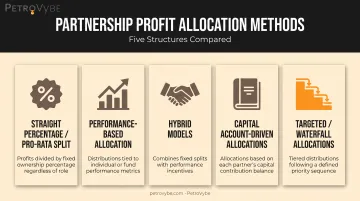
- Straight percentage / pro-rata split: Each partner’s share matches their ownership stake. Best for simple partnerships with similar contributions and a straightforward capital structure.
- Performance-based allocation: Ties profits to contributions, milestones, or operating duties—common when one partner puts up capital and another runs the business.
- Hybrid models: Pair a base ownership split with a performance bonus or preferred return. Example: a capital partner takes a guaranteed 8% first, then remaining profits follow ownership.
- Capital account-driven allocations: Follow IRS Section 704(b) “economic effect” rules and formal capital account maintenance as a safe harbor.
- Targeted / waterfall allocations: Back-solve tax allocations to a pre-negotiated distribution waterfall. Frequent in real estate and energy deals with tiered investor returns.
Whichever method you choose, the IRS standard is the same. Allocations need substantial economic effect, or they must reflect each partner’s interest in the partnership (partner’s interest in the partnership, or PIP).
The regulation asks a blunt question: could this allocation materially change what partners actually receive, independent of tax savings? If the answer is no, it can be rejected on audit.
Tax Implications and the Role of Special Allocations
Here's a detail that surprises a lot of new partners: allocated income is taxable whether or not cash gets distributed. If your K-1 shows $50,000 of allocated income and the partnership retained that cash for reinvestment, you still owe tax on it. This is exactly why cash flow planning matters as much as return projections.
Special allocations let partnerships direct specific tax attributes to the partners who benefit most from them:
- Depreciation
- Depletion
- Intangible drilling costs (IDC)
These allocations are a recognized structure when they reflect real economic substance and meet IRS substantiality rules.
How This Plays Out in Oil and Gas Partnerships
Natural gas and oil development partnerships are a textbook case for special allocations. IDC deductions, covering drilling and well-preparation costs with no salvage value, typically represent a first-year deduction target of approximately 70–80% of invested capital in a new drilling project. This treatment requires the investor to elect general partner status in the Subscription Agreement and may be limited in a given year by the excess business loss limitation under IRC §461(l).
Because these deductions can be claimed in the first year, partnerships often structure allocations to direct them toward partners who can use them against active income, meaning W-2 wages and capital gains, rather than partners who can only offset passive income.
At PetroVybe, accredited investors in the company's natural gas development projects have received substantial first-year deductions structured this way. Investors who joined in 2025 received a 94% deduction against active income. These figures come from the combination of IDC deductions and depletion allowances applied against the invested capital. Prior result; not a promise of any future deduction. This treatment requires the investor to elect general partner status in the Subscription Agreement and may be limited in a given year by the excess business loss limitation under IRC §461(l).

A word of caution: first-year deduction percentages this high depend on the specific costs incurred, the partnership's tax elections, and each partner's individual tax situation. According to the American Petroleum Institute's 2024 IDC handout, IDC can represent up to 85% of drilling cost, but that figure describes well-cost composition, not a guaranteed investor write-off. This treatment requires the investor to elect general partner status in the Subscription Agreement and may be limited in a given year by the excess business loss limitation under IRC §461(l).
Any partnership marketing specific deduction percentages should be able to back them up with actual K-1 data.
Capital Accounts vs. Tax Basis
One more distinction that trips people up: capital accounts and tax basis are not the same thing, and mixing them up creates problems at liquidation. Capital accounts track book value under the partnership agreement's rules. Tax basis tracks what a partner can actually deduct.
Partners should request K-1 detail that shows both, not just an ending capital account number, to avoid surprises when the partnership eventually winds down or sells assets.
Drafting a Partnership Agreement That Protects Everyone
A vague partnership agreement is where disputes are born. Before finalizing terms, get specific about:
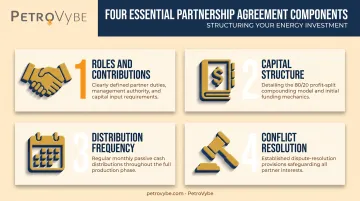
- Roles and contributions — Define who's contributing cash versus sweat equity, and how each factor influences profit share
- Capital structure — Spell out minimum contributions, capital call rights, and what happens if a partner can't meet a call
- Distribution frequency — Address whether cash gets distributed quarterly, annually, or on-demand, and keep this separate from tax allocation timing
- Conflict resolution — Include a clear process for disputes, plus a periodic review clause so the agreement can evolve as the partnership grows
That last point matters more than people expect. A partnership agreement written for two founding partners often doesn't fit once outside investors join. Build in flexibility from day one rather than renegotiating under pressure later.
Working With Professionals
Don't draft allocation terms in a vacuum. A CPA or financial modeler should run the numbers under multiple profit and loss scenarios before anyone signs anything. What looks fair in a best-case forecast can look very different if production comes in below projections.
PetroVybe's CFO, Clayton Riddle, models MOIC and IRR projections for partners as part of investor reporting. That same scenario planning belongs in any capital-intensive partnership before allocation terms are locked. When real dollars and real tax exposure are on the line, treat the modeling step as required.
Frequently Asked Questions
What is a profit allocation?
Profit allocation is the division of a partnership's income, gain, loss, deduction, and credit among its partners. It's distinct from a cash distribution and is typically defined in the partnership agreement.
How do you allocate profit in a partnership?
Common approaches include pro-rata splits, performance-based allocations, hybrid models, and targeted waterfalls. Whichever method is used, the allocation must align with partners' actual economic interests or meet the IRS's substantial economic effect standard.
Do partners pay tax on allocated profit even if they don't receive a distribution?
Yes. Because partnerships use pass-through taxation, each partner's K-1 allocated share is taxable regardless of whether cash was actually distributed that year.
What is a special allocation in a partnership?
A special allocation assigns specific tax items, such as depreciation or IDC deductions, disproportionately to certain partners. It's used to match the real economic deal rather than a flat ownership split.
Can profit-sharing percentages differ from ownership percentages?
Yes, as long as the arrangement is documented in the partnership agreement and meets IRS substantiality and economic effect standards. Undocumented deviations can be challenged on audit.
How often should partnership profits be distributed?
Distribution cadence varies by partnership: quarterly, annually, or on an ad hoc basis. Whatever the schedule, partnerships should maintain adequate reserves before distributing cash to partners.
Informational requests only. PetroVybe projects are offered solely to verified accredited investors. Submitting this form does not create an investment or advisory relationship.