

Partnerships are pass-through entities, meaning the business itself doesn't pay federal income tax. Instead, profits, losses, and deductions flow directly to the partners' personal returns. This guide breaks down what counts as partnership income, how it's calculated, what forms you'll file, and how self-employment tax applies. We'll also cover a lesser-known category: tax-advantaged partnership structures, like oil and gas working interests, that offer deductions ordinary pass-through income doesn't.
Key Takeaways
- Partners owe tax on their allocated share of profit, not just cash they physically receive.
- Form 1065 reports entity-level income; Schedule K-1 delivers each partner's specific slice.
- General partners usually owe self-employment tax on their share; limited partners typically don't.
- Basis tracking determines whether a distribution is tax-free or triggers a surprise gain.
- Oil and gas working interests, for example, let losses offset active income, not just passive gains.
What Is Partnership Income?
The IRS defines a partnership as two or more people or entities that contribute money, property, labor, or skill to a trade or business with the intent to share profits and losses. That's a broad definition. It covers everything from a two-person consulting shop to a multi-partner real estate syndicate.
Pass-through taxation is the core mechanic here. The partnership files an informational return, Form 1065, but doesn't write a check to the IRS for income tax. Instead, income, gains, losses, deductions, and credits pass through to each partner, who reports their share on their personal return.
This is where "phantom income" comes in. Partners are taxed on their distributive share of partnership income whether or not any cash actually landed in their account that year.
According to IRS Publication 541, a partner includes their share of income regardless of distribution status. A partnership might reinvest profits into equipment, inventory, or new projects instead of distributing cash, and the partners still owe tax on that reinvested profit.
This is also why income and distributions aren't the same thing. A distribution is governed by basis rules under the tax code: it's generally tax-free up to the partner's outside basis, and only becomes taxable if the distributed amount exceeds it. Income taxation happens regardless of distributions. Distribution taxation depends entirely on basis.
Types of Partnerships and How They Affect Income Treatment
Not every partnership structure treats income the same way:
- General partnerships - every partner shares management duties and unlimited personal liability for business debts.
- Limited partnerships (LPs) - general partners run the business and carry liability exposure; limited partners invest capital with liability capped at their contribution.
- Limited liability partnerships (LLPs) - partners typically aren't personally liable for another partner's misconduct or the firm's debts, though this varies by state.
- Multi-member LLCs - default to partnership tax treatment once there are two or more members, unless the LLC elects corporate status.
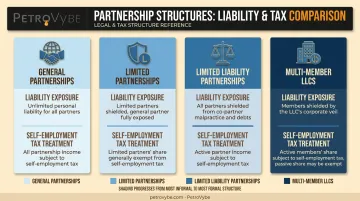
The liability distinction matters for taxes too. General partners face full self-employment tax exposure on their distributive share. Limited partners, by contrast, often only pay self-employment tax on guaranteed payments for services, not their full allocated share, though the IRS has scrutinized this exception closely in recent years.
How to Calculate Partnership Income
Calculating partnership income starts at the entity level, then flows down to individuals. Here's the sequence:
- Determine entity-level taxable income. Total revenue minus deductible business expenses equals partnership taxable income, reported on Form 1065.
- Allocate income per the partnership agreement. Profit-and-loss sharing ratios, not necessarily ownership percentages, determine each partner's share. Special allocations can shift this further.
- Issue Schedule K-1 to each partner. This form shows a partner's specific share of ordinary income, capital gains, interest, deductions, and credits, which are then reported on Form 1040 or Schedule E.
Guaranteed payments work differently: they're paid to a partner for services or capital without regard to whether the partnership actually turned a profit. The partnership deducts or capitalizes these payments, while the recipient reports them as ordinary income, separate from any distributive share of profit.
Basis tracking ties it all together. A partner's outside basis increases with income allocations and additional contributions. It decreases with distributions and allocated losses. This number determines whether a distribution is tax-free or triggers a taxable gain, so keeping a running basis schedule matters more than most business owners realize.
A quick example: Say an oil and gas development partnership earns $500,000 in profit for the year, split 60/40 between two partners under the partnership agreement. Partner A's K-1 shows $300,000 of ordinary income; Partner B's shows $200,000. Both owe tax on those amounts on their personal returns, regardless of how much cash the partnership actually distributed — a common scenario in upstream projects, where cash flow often gets reinvested into new wells rather than paid out.
Filing Requirements and Key Tax Forms for Partnerships
Partnerships face specific filing deadlines that differ from corporate returns.
- Form 1065 is due the 15th day of the third month after year-end, meaning March 15 for calendar-year partnerships.
- A six-month extension is available via Form 7004, filed by the original due date.
- Schedule K-1 must be furnished to each partner by the same deadline as the 1065, including extensions. For passive investors in structures like oil and gas development partnerships, this K-1 reports your share of income, deductions, and credits.
- Partners don't receive a W-2. They're not employees of the partnership, even if they work full-time in the business.
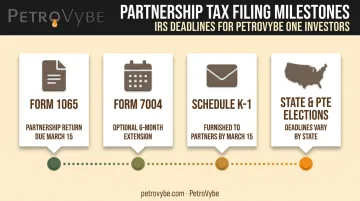
State obligations add another layer. Many states require their own information returns, and some mandate composite returns for nonresident partners.
More than 30 states have also enacted pass-through entity (PTE) tax elections, letting the partnership pay state tax at the entity level to work around the federal SALT deduction cap. These elections are state-specific and typically voluntary, so check what your state allows before assuming the default rule applies.
Does Partnership Income Count as Earned Income? Self-Employment Tax Explained
This is one of the most common points of confusion for business owners, and the answer depends on your partner classification.
General partners treat their distributive share of ordinary business income as self-employment income, subject to Social Security and Medicare tax through Schedule SE. This applies whether the income was distributed in cash or not.
In contrast, limited partners typically only owe self-employment tax on guaranteed payments received for services actually rendered, not their full distributive share. That said, the IRS has challenged this exception in several recent cases involving LLC and LLP members who function like active operators despite holding a "limited" title.
Keep these practical points in mind:
- Partners can deduct 50% of the self-employment tax they pay, representing the employer-equivalent portion, calculated on Schedule SE.
- Since partnerships don't withhold taxes from partner payments, most partners must make quarterly estimated tax payments using Form 1040-ES.
- The IRS requires estimated payments if you expect to owe $1,000 or more when you file. Partners who skip this step risk underpayment penalties, even if they pay in full by April.
Tax-Advantaged Partnership Structures: Beyond Ordinary Pass-Through Income
Not all partnership income gets the same tax treatment. The IRS separates activities into passive and active (non-passive) categories, and that distinction determines whether losses can offset other income, including W-2 wages.
Most limited partnership losses, think real estate syndications or private equity funds, are capped as passive losses. They can only offset passive income, not your salary or capital gains. There's a notable exception, though.
The Working Interest Exception
Under IRC Section 469(c)(3), a working interest in an oil and gas well is exempt from passive activity loss limitations, provided it's held in a form that doesn't limit the investor's liability.
That means qualifying working interest losses can offset active income directly, something most passive partnership structures simply can't do.
Intangible Drilling Costs (IDCs) are a major reason this exception matters. IDCs cover the labor, chemicals, and non-salvageable materials used in drilling, and they're typically deductible against ordinary income in the early years of the investment, including W-2 earnings and capital gains.
This is why some accredited investors and high-income W-2 earners look past traditional real estate and private equity partnerships toward direct natural gas and oil development partnerships. The tax efficiency stacks on top of the income potential, rather than replacing it.
PetroVybe ONE: A Real-World Example
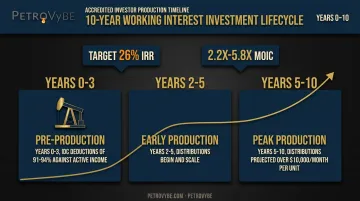
PetroVybe, a Texas-based natural gas development company, illustrates how this plays out in practice. Through its PetroVybe ONE partnership, structured around projects in South Texas and the Gulf Coast Basin, partners who joined in 2024 received a 94% first-year deduction against active income, with the 2025 cohort landing at 91%.
Here's roughly how the investment lifecycle unfolds:
| Phase | Timeframe | Distributions |
|---|---|---|
| Pre-production | Years 0-2/3 | None (IDC deductions available) |
| Early production | Years 2/3-5 | Begins, scales upward |
| Peak production | Years 5-10 | Projected to exceed $10,000/month per unit |
PetroVybe targets a 10-year MOIC of roughly 2.2x to 5.8x with an approximate 26% IRR, though these figures are forward-looking projections tied to commodity pricing and production performance, not guarantees.
Before pursuing any working-interest structure, talk to a tax advisor. Active participation requirements, investor accreditation rules, and liability structuring all affect whether you actually qualify for the exception, and getting the structure wrong can undo the tax benefit entirely.
Common Partnership Income Mistakes to Avoid
A few recurring errors trip up even experienced business owners:
- Confusing distributions with income. Partners owe tax on their allocated share regardless of whether cash changed hands, so a smaller distribution doesn't mean a smaller tax bill.
- Skipping basis tracking. Large upfront deductions, such as intangible drilling costs in an oil and gas partnership, shrink your basis fast, making it one of the most commonly missed items once distributions exceed what's left.
- Ignoring special allocation changes. Profit and loss sharing percentages can shift year to year based on the partnership agreement, so review these terms annually rather than only at formation.
Frequently Asked Questions
What is partnership income?
Schedule K-1 reports partnership income as a partner's allocated share of the pass-through entity's profits. It's taxable regardless of whether the partner actually received a cash distribution.
How do you calculate partnership income?
Total revenue minus expenses determines entity-level taxable income on Form 1065. The partnership then allocates that income to partners per the partnership agreement and reports it on each partner's Schedule K-1.
Does partnership income count as earned income?
The IRS generally treats a general partner's distributive share as self-employment (earned) income subject to SE tax. Limited partners typically only face this treatment on guaranteed payments for services.
What is the difference between a partnership distribution and partnership income?
The IRS taxes income as earned regardless of distribution status. A distribution is a cash or property payout that reduces the partner's basis, and it's only taxable if it exceeds that basis.
Can partnership losses offset W-2 income?
Most passive partnership losses cannot offset W-2 wages. Exceptions exist, though, such as the oil and gas working interest exception under IRC 469(c)(3), which allows certain non-passive losses to offset active income.
Do partners have to make estimated tax payments on partnership income?
Yes, generally. Since partnerships don't withhold taxes from this income, partners typically must make quarterly estimated payments to avoid IRS underpayment penalties.