If you guessed the Honda driver, you already understand something most people miss. Many households confuse looking rich with being rich, and that confusion drives some genuinely bad financial decisions.
Naval Ravikant, the investor and entrepreneur behind AngelList, put it bluntly: status is a social hierarchy game, while wealth is asset accumulation that works while you sleep. One is a competition. The other is math.
This article breaks down why the truly wealthy rarely broadcast it, and what a net worth number actually means for your social standing (spoiler: less than you'd think).
Key Takeaways
- Status is zero-sum — someone has to lose ground for another person to gain it
- Wealth is positive-sum, letting multiple people build it simultaneously
- The genuinely rich funnel money into income-producing assets, not depreciating symbols
- A $2.3 million net worth ranks in the top 10% nationally, but it won't buy a "rich" reputation
Status vs. Wealth vs. Money: Untangling the Confusion
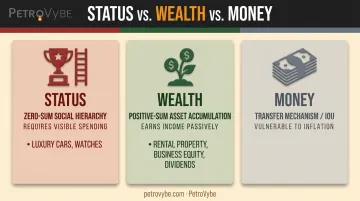
Most people use "status," "wealth," and "money" as if they're synonyms. They're not, and treating them the same way leads to spending decisions that feel good for a weekend and cost you for a decade.
What Is Status?
Status is your rank in a social hierarchy. It only exists in comparison to other people.
A Ferrari in your driveway only signals something if your neighbors don't have one. Put that same car in a Beverly Hills cul-de-sac full of supercars, and it says nothing at all.
Financial therapy researchers have identified a pattern called the "Money Status" script, where people equate their net worth directly with their self-worth and feel pressure to own the newest, most visible version of everything. Studies on this behavior link it to compulsive buying and, notably, lower net worth — not higher, meaning chasing status usually leaves you with less, not more.
What Is Wealth?
Naval's definition is simple: wealth is assets that earn while you sleep. Rental property collecting rent while you sleep. A business generating profit without your daily involvement. Dividend stocks paying out quarterly. Royalties from an oil and gas well you invested in years ago.
Here's a practical litmus test: if you stopped working tomorrow, how long could you maintain your current lifestyle? A month? Five years? Forever? That answer tells you more about your actual wealth than your job title, your car, or your zip code ever will.
What Is Money?
Money serves a different function than wealth: it's a transfer mechanism, an IOU society uses to move value around.
That distinction matters because money is fallible. Inflation erodes it. Currency policy can debase it overnight. Wealth-generating assets, on the other hand, tend to hold or grow their value because they're tied to real production, not to a number printed on a bill.
Why Status Games Are a Rigged, Zero-Sum Trap
Status requires a loser for every winner. There's no way around it. If you move up the hierarchy, someone else moves down relative to you. That structure makes status competition inherently combative, and frankly, exhausting.
Social media has turned this into a 24-hour arena. Every flex, every humble-brag vacation photo, every "just closed on the new house" post is a move in a hierarchy game. One person's win registers as another person's perceived loss, which is exactly why scrolling through it can leave you feeling worse rather than better.
The financial cost of playing this game is measurable. In 2025, 31% of Americans said they were willing to take on debt for a discretionary purchase, according to a Bankrate survey. That's down from 38% the year before — still nearly a third of the country. Breaking that down further:
- 22% cited travel
- 11% cited dining out
- 9% cited live entertainment
That's real debt, at real interest rates, funding experiences and appearances rather than assets. It's not proof that every dollar of consumer debt is status-driven, but it's a solid clue that a meaningful chunk of it is.
The Rich Play a Different Game: Wealth Accumulation as a Positive-Sum Strategy
Wealth creation flips the script entirely. It's positive-sum — total gains can exceed total losses, meaning your win doesn't require anyone else's defeat.
Warren Buffett described this mental shift using what he called the Inner Scorecard versus the Outer Scorecard, a concept documented in Alice Schroeder's biography The Snowball. People who operate on an Outer Scorecard measure themselves by how others perceive them. People who operate on an Inner Scorecard measure themselves against their own standards, regardless of applause.
This shows up in the data. Thomas Stanley and William Danko's research for The Millionaire Next Door found that roughly 80% of the millionaires they studied were first-generation affluent, not inheritors. These households lived well below their means, avoided leased or current-model-year cars, and invested close to 20% of their realized household income every year.
That research is now nearly three decades old, so treat it as an influential pattern rather than a current census. But the behavior it describes still holds up.
Here's the encouraging part: this isn't a personality trait you're born with.
- Learnable: swap Instagram likes for net worth as your success metric
- Deliberate: choose an appreciating asset over a depreciating one, every time
- Reversible: status-scorekeepers become wealth-scorekeepers with enough repetition
How the Rich Actually Build Wealth: Productive Assets Over Status Symbols
Here's the thesis in one sentence: the rich don't look rich because their capital is working, not sitting in a driveway depreciating.
Classic wealth-building assets share one trait — they produce income or appreciate (often both):
- Business equity — ownership stakes that generate profit independent of your hours worked
- Real estate — rental income plus long-term appreciation
- Dividend-paying stocks — quarterly cash flow from established companies
- Natural resource development — direct ownership positions in producing assets, an increasingly popular alternative for accredited investors
That last category matters more during inflationary periods. Cash sitting in a savings account loses purchasing power every year. Tangible, cash-flowing assets have a better shot at outpacing currency devaluation than idle cash. Still, no asset class is a guaranteed hedge — even diversified real-asset funds haven't always kept perfect pace with inflation.
A Modern Example: Direct Ownership in Producing Wells
This is precisely the territory PetroVybe operates in. The Texas-based development company gives accredited investors direct equity positions in producing natural gas and oil wells across Lavaca County and the broader Gulf Coast Basin. Investors hold actual ownership in the underlying asset, at the point where value gets created, rather than shares in a fund or a stock ticker.
That structure lines up almost exactly with Naval's definition of wealth: an asset that earns while you sleep. Investors receive K-1 tax documents as partners in the operating entity, not passive fund statements, and monthly distributions flow directly from well production.
There's also a tax angle most status-driven spending can't touch. Investors in projects like PetroVybe's can elect to deduct intangible drilling costs (IDCs) — typically 60% to 80% of invested capital — against active income, including W-2 wages and capital gains, in the year the well is drilled. PetroVybe's own partners saw deductions of 94% in 2024 and 91% in 2025 against active income.

Real estate deductions, by contrast, are usually restricted to passive income unless you qualify as a full-time real estate professional.
None of this is guaranteed. IDC treatment depends on entity structure, at-risk rules, and alternative minimum tax exposure. Accredited-investor eligibility — net worth above $1 million excluding a primary residence, or income above $200,000 individually — is a regulatory classification, not an endorsement of safety. But the principle holds: wealth-builders diversify into asset classes that status-chasers overlook, precisely because those assets aren't flashy enough to photograph.
What Does a $2.3 Million Net Worth Actually Mean for Status?
Let's put a real number on this. According to the Federal Reserve's 2022 Survey of Consumer Finances, the 90th-percentile net worth cutoff for U.S. families was $1.938 million. A household with $2.3 million clears that bar, placing it in the top decile nationally.
That same figure, $2.3 million, is also what the average American told Charles Schwab's 2025 Modern Wealth Survey they'd need to be considered "wealthy."
| Benchmark | Amount | What It Means |
|---|---|---|
| Median U.S. family net worth (2022) | $192,900 | The national midpoint |
| 90th-percentile cutoff | $1.938 million | Top 10% threshold |
| Median within top decile | $3.795 million | Typical net worth once you're already in the top 10% |
| Perceived "wealthy" threshold (2025 survey) | $2.3 million | What Americans say counts as rich |
Here's the twist: two people can both hit $2.3 million and look completely different to the outside world.
- Investor A holds the money in illiquid, income-producing assets (a rental portfolio, business equity, a working interest in producing wells) and drives a Honda.
- Investor B has a fraction of that net worth but leases a luxury car and carries revolving credit card debt to fund the lifestyle.
Guess who looks "rich" at the block party?
Net worth sits on a private balance sheet, invisible unless someone chooses to reveal it. Status plays out in public. Among people who are genuinely wealthy, the two are often inversely related: those who spend the least on visible status symbols tend to hold the most in actual net worth.
Frequently Asked Questions
What status is a $2.3 million net worth?
It places a household above the Federal Reserve's 90th-percentile cutoff of $1.938 million, putting it in the top decile nationally. Social status, however, depends on visible spending, not balance sheet totals — many people at this level live modestly.
What is the difference between wealth and money?
Wealth is assets that generate income without your ongoing labor, like rental property or business equity. Money is simply the medium used to transfer that wealth from one place to another.
Why do wealthy people avoid buying flashy, expensive things?
Every dollar spent on a depreciating status symbol is a dollar not deployed into an income-producing asset. Genuinely wealthy people tend to prioritize the latter because it compounds instead of losing value.
What does it mean that status is a "zero-sum game"?
In a fixed hierarchy, one person's rise requires another's relative fall. Wealth-building doesn't work that way; multiple people can grow richer at the same time without anyone losing ground.
How can I start shifting from status-seeking to wealth-building?
Start by tracking how much status purchases actually cost you over five years, including interest. Redirect that same capital into income-producing assets, and measure progress by your own numbers, not your feed.
What are examples of assets that generate passive income "while you sleep"?
Dividend stocks, rental real estate, business ownership stakes, and alternative assets like direct working interests in natural gas development all generate cash flow without requiring your daily labor.