This article is general education, not investment, tax, or legal advice. High-income earners are rethinking how they build wealth heading into 2026. With inflation running at 4.1% for the 12 months through May 2026 according to the Federal Reserve's Monetary Policy Report, and top federal tax rates hitting 37% above $640,600 for single filers, active income alone isn't cutting it anymore.
A paycheck can only stretch so far. That's why accredited investors and high earners are looking past traditional savings accounts toward alternative income streams, private funds, and tax-advantaged vehicles most people never hear about.
This article breaks down 10 passive income ideas for 2026, shows you how much capital different income goals actually require, and spotlights a tax-advantaged opportunity that flies under most investors' radar.
Key Takeaways
- Match the vehicle to risk: savings and bonds on the low end, private funds and energy deals on the high end
- Size capital to your target yield—not only the income number you want
- Diversify across asset classes and tax treatments to lift after-tax returns
- Accredited investors can reach private real estate and oil & gas deals with higher targeted returns and large tax deductions
What Is Passive Income Investing?
Passive income is money earned with minimal ongoing effort, the opposite of a salary or hourly wage that stops the moment you stop working.
The IRS draws a sharp line between the two:
- Active income: Wages, salaries, and business income where you materially participate
- Passive income: Rental activities or business interests where you don't materially participate
This distinction matters because passive losses typically can only offset passive income, not your W-2 earnings.
One exception stands out: working interests in oil and gas wells. The IRS classifies these as nonpassive regardless of your participation level, which lets you apply drilling-related deductions against active income. This treatment requires the investor to elect general partner status in the Subscription Agreement and may be limited in a given year by the excess business loss limitation under IRC §461(l). More on that later.
"Passive" doesn't mean zero effort. Most of these ideas still require upfront capital, due diligence, or both.
10 Passive Income Investment Ideas for 2026
1. High-Yield Savings Accounts & CDs
These remain the safest place to park cash. Top online savings accounts and CDs were offering up to roughly 4.15% APY as of mid-2026, according to Forbes Advisor's CD rate rankings.
The catch: yields move with Fed policy. The Fed held rates at 3.5%–3.75% in July 2026, so don't assume today's APYs will hold if policy eases—rate cuts typically compress savings and CD yields.
2. Dividend-Paying Stocks & Dividend ETFs
Companies distribute a portion of profits to shareholders regularly. "Dividend Aristocrats" are S&P 500 members with at least 25 consecutive years of dividend increases, a useful screen for stability-seeking investors.
What to weigh before you buy:
- Liquidity that private deals rarely match
- Dividend growth that still won't guarantee price stability
- Payouts that can be cut in a downturn
3. Bonds & Bond Funds
Bonds pay fixed interest over a set term, making them a conservative anchor for a passive income portfolio. Each fund's SEC yield, duration, credit quality, and expense ratio matter more than any advertised "average" rate. Suitable for investors prioritizing capital preservation over growth.
4. Publicly Traded REITs
REITs must distribute at least 90% of taxable income to shareholders, which explains their attractive yields. But don't mistake that payout rule for price stability.
Nareit's historical data shows REIT index volatility ranging between 11.6% and 21.9% annualized, with a median around 15.1%. REITs behave like equities, not bonds.
5. Private Real Estate Investment Funds
Available only to accredited investors, these pooled funds offer exposure to commercial or residential property without the management headache of direct ownership. Many use a preferred return structure, paying investors first before the sponsor takes a profit share.
The SEC warns that private placements are often highly illiquid, and investors may need to hold restricted securities indefinitely.
6. Peer-to-Peer Lending
You lend directly to borrowers through a platform, earning interest as they repay. Default risk is real and varies by loan grade, term, and vintage year.
- Diversify across many small loans, not one large one
- Review platform-specific default disclosures before committing
- Treat platform-wide "average return" claims with skepticism
7. Rental Property Ownership
Direct ownership offers cash flow plus potential appreciation. But it's the least "passive" option on this list unless you hire a property manager.
Pros:
- Monthly income
- Equity buildup
- Tax depreciation
Cons:
- Vacancy risk
- Maintenance costs
- Tenant management
- Illiquidity
8. Royalties from Creative or Intellectual Property
Books, music, and stock photography can generate ongoing licensing income long after the initial work is done. This works best for creators with an existing catalog, or investors buying an established royalty stream. There's no industry-wide benchmark yield here. Results depend entirely on the specific asset.
9. Digital Products & Online Courses
Professionals with specialized expertise can package it once and sell repeatedly: templates, courses, e-books. Low overhead, high scalability, but not truly passive early on. Building an audience and maintaining the product takes real work upfront.
10. Direct Investment in Natural Gas & Oil Development
An emerging alternative for accredited investors: direct working interests in gas wells. This pairs potential production income with meaningful tax deductions unavailable in public markets. This guide covers the structure, tax treatment, and risks in more detail below.
How Much Do You Need to Invest to Hit Your Passive Income Goals?
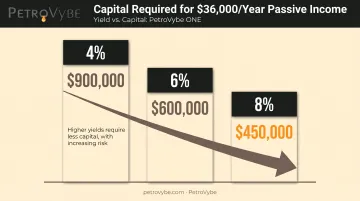
The math is simple, but the assumptions swing wildly:
Required capital = Annual income goal ÷ Target yield
Example: Wanting $3,000/month ($36,000/year)
| Target Yield | Capital Needed |
|---|---|
| 4% (savings/CDs) | $900,000 |
| 6% (dividend/bond mix) | $600,000 |
| 8% (higher-yield blend) | $450,000 |
Scale those yields to smaller monthly targets:
- $1,000/month ($12,000/year): $300,000 at 4%, or $150,000 at 8%
- $2,000/month ($24,000/year): $600,000 at 4%, or $300,000 at 8%
$100,000/year (~$8,300/month): At 6%, you'd need about $1.67 million. Higher private-market target returns shrink the capital requirement, but liquidity drops with it.
Once goals climb further, public-market yields alone get impractical for most households. $10,000/month ($120,000/year) at 4% means $3 million—territory where accredited-only vehicles targeting higher returns often enter the mix.
$1,000/day ($365,000/year): Plan on either a very large low-yield portfolio (roughly $9 million at 4%) or a smaller allocation to private placements aiming at double-digit returns. Verify historical yield data before you commit; advertised targets are not guarantees.
Spotlight: Natural Gas Development — A Tax-Advantaged Passive Income Idea for 2026
In 2026, AI is reshaping U.S. electricity demand. The International Energy Agency projects U.S. data-center electricity consumption to rise about 130% from 2024 to 2030. Natural gas is positioned to supply a large share of that load.
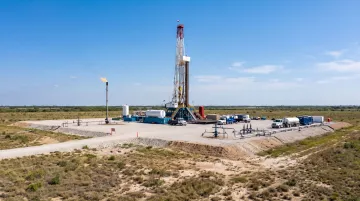
PetroVybe is a private Texas-based natural gas development company giving accredited investors direct equity access to early-stage development assets. Its focus is the Gulf Coast Basin—centered on Lavaca County, Texas—with additional inventory in East Texas' Haynesville/Middle Bossier area.
Why the Tax Treatment Matters
The standout feature is the intangible drilling cost (IDC) deduction, on top of production income. Because working interests in oil and gas wells are classified as nonpassive by the IRS, these deductions can offset active income, including W-2 earnings and capital gains, not just passive income. This treatment requires the investor to elect general partner status in the Subscription Agreement and may be limited in a given year by the excess business loss limitation under IRC §461(l).
- PetroVybe partners received 94% in 2025. Prior result; not a promise of any future deduction.
- Deductions can be claimed in year one or spread over five years via Schedule K-1
- This benefit depends on ownership structure, at-risk limitations, and excess-business-loss rules, so project-specific tax advice is essential
The Numbers Behind the Opportunity
PetroVybe's asset base includes roughly 400 acquired wells across 58,000 acres, plus 57+ planned new wells. A licensed third-party engineering firm valued proved reserves at $48 million (PV-09, prepared by Lee Keeling & Associates, Tulsa, March 2026), and Weaver delivered a clean 2025 independent audit.
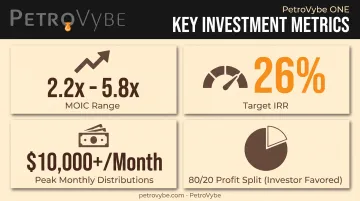
Reported targets over a 10-year hold:
- ~2.2x to 5.8x MOIC
- ~26% target IRR
- Peak quarterly distributions projected above $10,000
- 80/20 profit split favoring investors
Those targets rest on execution. Chief Geophysicist Michael Stamatedes brings a reported 75.2% success rate in well-location selection, versus an industry peer average below 40%. Disclaimer: these results were achieved at prior companies.
This is not a fit for everyone. PetroVybe requires accredited status and the stated minimum. Participation begins at one unit of $100,000, with add-on subscriptions from $25,000. It suits investors diversifying beyond stocks, bonds, and real estate—not those chasing a quick payout.
First distributions typically arrive after a 2–3 year development period. These are targets, not guarantees; actual results depend on drilling outcomes, commodity prices, and market conditions.
How to Choose the Right Passive Income Strategy for You
Before picking a vehicle, assess three things:
- Available capital — Can you meet minimums for private deals, or are you working with smaller amounts?
- Risk tolerance — Are you comfortable with illiquidity and operational risk, or do you need principal stability?
- Desired hands-off level — Rental property demands more involvement than a dividend ETF.
Rough matching guide:
- Lower capital, lower risk tolerance → savings accounts, bond funds, dividend ETFs
- Moderate capital, balanced risk → REITs, high-yield bond funds, or rental co-investments
- Higher capital, accredited status, longer time horizon → private real estate funds or natural gas development
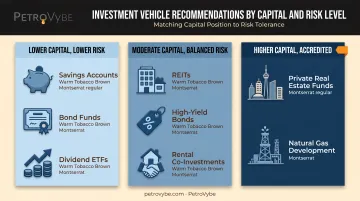
Once the fit is clear, factor in taxes—each income type is treated differently. Consult a tax and financial advisor before allocating capital, especially if you're weighing deductions against active income like IDCs. This treatment requires the investor to elect general partner status in the Subscription Agreement and may be limited in a given year by the excess business loss limitation under IRC §461(l).
Frequently Asked Questions
How much money do I need to invest to make $3,000 a month in passive income?
It depends on your target yield. At 4%, you'd need $900,000. At 8%, that drops to $450,000. Higher targeted yields usually mean more risk, less liquidity, or both.
How can I make $1,000 a month in passive income?
At a conservative 4% yield, you'd need roughly $300,000 invested. Higher-yield options can lower the capital needed, or you can stack several smaller income streams until you hit $1,000 a month.
How can I make $10,000 a month in passive income?
This usually requires either a multi-million-dollar diversified portfolio at conservative yields or a smaller allocation into accredited-only options—such as private oil and gas partnerships—that target higher returns. Review third-party reserve reports and historical distributions before committing.
How can I make $100,000 per year in passive income?
Capital needs range from roughly $1.67 million at 6% yield to under $1 million at higher private-market targets. Your mix of public yield products versus private placements drives the final number.
What is the best investment for passive income?
No single product wins for everyone. Dividend stocks and REITs suit liquid, smaller accounts; private credit and oil and gas partnerships can fit accredited investors who want higher targeted yield and can lock up capital.
How can I make $1,000 a day in passive income?
That's $365,000 annually, requiring roughly $9 million at a 4% yield or a much smaller allocation into higher-target private placements. Treat projected rates as targets only—underwrite to documented cash history, not marketing decks.
Informational requests only. PetroVybe projects are offered solely to verified accredited investors. Submitting this form does not create an investment or advisory relationship.