This article is general education, not investment, tax, or legal advice. Picture this: you're an accredited investor reviewing a limited partnership offering in oil and gas development. The projected returns look compelling. But before you sign, one question matters more than any number on the page: who actually controls this deal?
That's where the General Partner (GP) comes in. The GP runs operations, makes binding decisions, and carries unlimited personal liability. Limited Partners (LPs), by contrast, are passive investors whose risk is capped at what they put in — but they give up management control entirely.
This distinction shapes everything: liability exposure, tax treatment, and who actually calls the shots. This guide breaks down GP duties, liability rules, the GP vs. LP comparison, and how this structure plays out in natural gas and oil development partnerships.
Key Takeaways
- General Partners run day-to-day operations and take on unlimited personal liability
- Limited Partners stay passive, with liability capped at the capital they invest
- Every limited partnership needs at least one GP, often an LLC, for operator liability protection
- LPs give up management control after investing, so GP selection is critical
- Oil and gas and real estate deals often pair GP operating expertise with LP capital
What Is a General Partner in a Limited Partnership?
A General Partner is the partner legally responsible for running the partnership. Under Delaware's limited partnership statute, the GP is the person or entity named in the certificate or admitted under the partnership agreement to operate and bind the LP (Delaware Code). "Person" here isn't limited to individuals. It includes LLCs, corporations, and other legal entities.
That definition matters because GPs face unlimited personal liability for partnership obligations by default. Many GPs therefore organize as an LLC or corporation so the entity absorbs the exposure and its owners keep a layer of protection from the partnership's debts.
Core GP Responsibilities
A GP typically handles:
- Securing financing and structuring capital calls
- Sourcing deals, assets, or drilling opportunities
- Regulatory compliance (permits, licensing, filings)
- Investor reporting and communication
- Day-to-day operational execution
The GP's name and address usually appear on the public Certificate of Limited Partnership filed with the state. That filing is public record, so check it before you invest.
How GPs Get Paid
GPs are typically compensated through a management fee plus carried interest (performance-based upside). The SEC's small-business glossary cites 1-2% management fees plus 10-20% performance fees as an illustrative example, often called "2 and 20," and notes this is not a universal standard (SEC Glossary).
Actual fee structures vary widely by deal and sector. Benchmark each offering on its own terms rather than assuming a template applies.
Can a General Partner Be a Limited Partnership or Company?
Yes. Both Delaware and Texas define a GP as a "person," and that definition explicitly includes LLCs, corporations, partnerships, trusts, and other entities — not just individuals.
Entity-GP structures are now standard practice:
- The GP entity absorbs unlimited liability, not an individual
- Owners of that entity retain a liability shield behind it
- The structure scales more easily across multiple deals or funds
Can a limited partnership itself serve as GP of another partnership? Legally, often yes. The nuances vary by state, so confirm with counsel rather than assume uniformity across jurisdictions.
One caveat: an entity shield changes who is directly exposed. It doesn't erase the partnership's debts, and it doesn't make a thinly capitalized GP a safe bet. Before investing, ask for the GP entity's formation documents, ownership structure, capitalization, and insurance coverage.
General Partner vs Limited Partner: Key Differences
| Dimension | General Partner | Limited Partner |
|---|---|---|
| Management | Runs daily operations, binds the partnership | Passive; no operational role |
| Liability | Unlimited (or entity-level if GP is an LLC) | Capped at invested amount |
| Self-employment tax | Distributive share generally counts toward self-employment tax (26 U.S. Code § 1402) | Distributive share generally excluded, except guaranteed payments for services |
| Capital contribution | May contribute capital, but role is defined by management | Provides capital as passive investment |
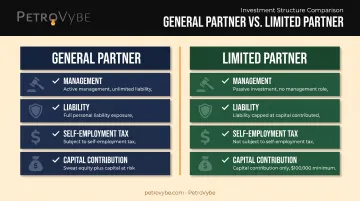
Profits and losses pass through to both partner types' personal tax returns. But the character of that income differs — GPs generally face self-employment tax on their share, while LPs typically don't on passive returns.
The trade-off: LPs sacrifice control in exchange for liability protection and access to deals normally reserved for institutions or insiders.
The "Control Rule" Risk
Here's something LPs often overlook. Older state law (the Revised Uniform Limited Partnership Act) could expose an LP to GP-like liability if they participated too actively in management.
Modern ULPA states have largely eliminated this risk, shielding LPs even when they participate in certain decisions. Delaware, however, still maintains a control-based provision with specific safe harbors (Delaware Code, Title 6, Ch. 17).
In practice, voting on major transactions isn't the same as running operations, but the exact rule depends on your state's governing law.
Why the GP-LP Structure Matters for Accredited Investors
Accredited investors gravitate toward the GP-LP model for one main reason: it grants access to specialized deals in oil and gas, real estate, and private equity without hands-on operational involvement. A strong GP with a proven track record and third-party validation reduces investor risk, even though the GP itself carries unlimited liability.
PetroVybe shows how this works in natural gas development. The team operates as an experienced GP managing development assets across South Texas and the Gulf Coast Basin:
- Roughly 400 acquired wells
- 57+ planned new wells
- A 58,000-acre position in Lavaca County

That structure lets accredited investors participate as passive limited partners while the operating team handles engineering, acquisitions, and day-to-day production management.
The Tax Efficiency Angle in Oil & Gas
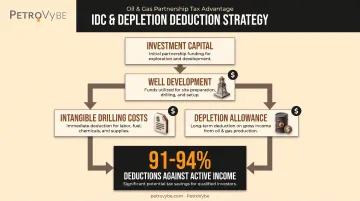
Oil and gas limited partnerships carry a specific tax feature. IRC Section 263(c) allows an election to currently deduct qualifying intangible drilling costs (IDCs), such as wages, fuel, and hauling tied directly to well development (26 CFR § 1.612-4).
Important nuance: IDC deductibility timing is separate from whether that deduction offsets active income. IRS Publication 925 notes that a working interest held through an entity that does not limit liability is treated as nonpassive, meaning it can offset active income like W-2 wages (IRS Publication 925). This treatment requires the investor to elect general partner status in the Subscription Agreement and may be limited in a given year by the excess business loss limitation under IRC §461(l).
PetroVybe reports that 2025 partners achieved 94% deductions against active income through this IDC and depletion strategy, documented in offering materials and sample K-1s available through the company's investor data platform. Prior result; not a promise of any future deduction. As with any tax position, review this with your own tax advisor against your specific situation. This treatment requires the investor to elect general partner status in the Subscription Agreement and may be limited in a given year by the excess business loss limitation under IRC §461(l).
How to Evaluate a General Partner Before Investing
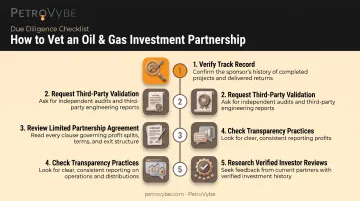
Before committing capital, run through this checklist:
- Verify the track record: Ask for specifics on prior projects, not just general claims of experience
- Request third-party validation: Independent engineering reports, audited financials, or reserve valuations
- Review the Limited Partnership Agreement (LPA): Check GP compensation structure, reporting cadence, and exit terms
- Check transparency practices: Confirm how often the GP communicates and through what channels
- Research verified investor reviews: Independent platforms provide trust signals beyond marketing claims
The SEC's investor alert on private oil and gas offerings recommends asking how proceeds divide among drilling, overhead, and fees. It also advises verifying the GP's history through FINRA BrokerCheck or state regulators (SEC Investor Alert).
A note on accreditation status: Being an accredited investor is an eligibility category, not an SEC endorsement of any particular GP or offering. Do your own diligence regardless of how the deal is packaged.
Frequently Asked Questions
Can you have a general partner in a limited partnership?
Yes. Every limited partnership legally requires at least one general partner to manage operations and assume liability. Without a GP, the entity structure doesn't function as an LP under state law.
Can a general partner be a limited partnership?
Yes. A GP can be an individual, LLC, corporation, or another limited partnership. Using an entity as GP is common for liability protection and is standard across private equity, real estate, and energy deals.
What are the two types of partners in a limited partnership?
General partners actively manage the business and carry unlimited liability. Limited partners are passive investors whose liability is capped at their investment amount.
What happens if a general partner is removed or dissolved?
The Limited Partnership Agreement typically dictates succession procedures. Without clear provisions, the partnership may face dissolution or require a partner vote to appoint a replacement GP.
Do general partners pay self-employment tax?
Yes. GPs owe self-employment tax on their distributive share of partnership income. Limited partners usually don't, since their returns are treated as passive.
Is investing as a limited partner considered passive income?
Yes. LPs have no management role, so their investment is typically treated as passive under Section 469, which affects how losses and deductions can be applied against other income.
Informational requests only. PetroVybe projects are offered solely to verified accredited investors. Submitting this form does not create an investment or advisory relationship.