

This guide covers what qualifies as royalty income, the major types with real-world examples, how payments are structured and calculated, and how the IRS taxes each category. For investors, we pay particular attention to oil and gas royalties — the one category that carries unique tax advantages unavailable anywhere else.
Key Takeaways
- Royalty income spans music, books, patents, franchises, oil and gas, and digital content
- Payments are ongoing, tied to usage or sales, and governed by a license or lease agreement
- All royalty income is taxable as ordinary income in the U.S. — reported on Schedule E
- Oil and gas royalties carry depletion allowances that can significantly cut effective tax rates
- Accredited investors can hold direct working interest positions in oil and gas development for ongoing production income
What Is Royalty Income?
Royalty income is compensation paid to an asset owner for granting another party the right to use, produce, or profit from that asset. The key distinction: you retain ownership and earn ongoing payments rather than selling the asset outright.
Three terms are often used interchangeably — and they're related but distinct:
- Royalty income — what the recipient earns
- Royalty payments — the funds transferred by the licensee (the party using the asset)
- Royalty fees — can refer to upfront and ongoing amounts combined
All three flow from a legally binding royalty agreement that defines the rate, payment schedule, scope, and duration — the contract that makes any payment enforceable.
IRS Publication 525 classifies royalties from copyrights, patents, and mineral properties as ordinary income, a distinction covered in detail in the tax section below.
Types of Royalty Income with Examples
Royalties aren't one-size-fits-all. Each category follows different rate structures, legal frameworks, and payment mechanics. Here's how the major types work in practice.
Music and Performance Royalties
Music royalties split across two separate copyright tracks:
- Composition royalties — cover the music and lyrics. These include performance royalties (paid when a song is played publicly, collected by Performing Rights Organizations like ASCAP and BMI on behalf of songwriters and publishers) and mechanical royalties (paid when a song is reproduced or streamed)
- Master recording royalties — belong to whoever owns the sound recording itself, typically a record label or the artist
U.S. recorded music revenue reached $17.7 billion in 2024, with streaming accounting for $14.9 billion (84%) of that total, according to the RIAA's 2024 Year-End Revenue Report. That revenue pool funds the royalty distributions flowing to rights holders.
Book Publishing Royalties
Publishers pay authors a royalty on each copy sold. Per the Authors Guild model contract, standard trade book royalty rates are:
- 10% of list price for the first 5,000 hardcover copies
- 12.5% for the next 5,000 copies
- 15% thereafter
- 7.5% of retail for trade paperbacks
- 25% of publisher net receipts for ebooks
One important mechanic: authors typically receive an advance against future royalties. Actual royalty payments only begin once cumulative sales exceed the advance amount — a process called "earning out."
Patent and Intellectual Property Royalties
A patent licensee pays the patent owner a negotiated fee for the right to manufacture or use the protected invention. Rates vary significantly by industry and exclusivity.
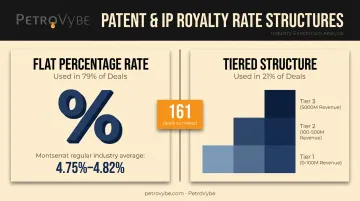
The Licensing Executives Society's high-tech survey found a 4.82% average and 4.75% median rate across 161 deals, with 79% using flat percentage rates and 21% using tiered structures. Trademark and software licensing royalties follow similar structures, though specific rates depend on technology type, exclusivity, and development stage.
Franchise Royalties
Franchisees pay the franchisor an ongoing royalty for the right to operate under the brand, use its systems, and access ongoing support. The payment base is typically gross monthly sales.
The International Franchise Association reports an average franchise royalty range of 5%–9% of gross sales. The FTC confirms these continuing payments are standard across franchise agreements, though rates vary by brand strength, category, and negotiated terms.
Oil, Gas, and Mineral Royalties
Landowners who hold mineral rights receive royalties from oil and gas producers for extracting resources from their property. The royalty is typically a negotiated percentage of gross production revenue, paid on a schedule defined by the lease.
Onshore U.S. leases commonly carry royalty rates between 12.5% and 25%, with the specific rate reflecting acreage location, production volume, and negotiating leverage. Unlike the royalty categories above — where a third party collects and distributes payments — mineral rights holders receive distributions directly tied to what comes out of the ground each month.
This category also carries distinct tax treatment: depletion allowances and intangible drilling cost (IDC) deductions can significantly reduce the tax burden on royalty income, a feature no other royalty type offers.
How Royalty Payments Are Structured and Calculated
The Two Primary Calculation Methods
Most royalty agreements use one of two approaches:
- Percentage of gross or net revenue — the most common structure across music, books, patents, franchises, and oil and gas
- Fixed fee per unit sold or per use — more common in certain software and patent licenses
The royalty rate is set in the license agreement and may be subject to minimums (guaranteeing the licensor a floor) or caps (protecting the licensee from runaway costs).
The rate is just one piece. A complete royalty agreement also defines the terms that govern how, when, and where payments are made.
What a Royalty Agreement Must Define
Key provisions include:
- The royalty rate or calculation formula
- Payment frequency (monthly, quarterly, or annually)
- Geographic and usage scope
- Exclusivity terms
- Audit rights allowing the licensor to verify reported figures
- Duration and renewal conditions
The 25 Percent Rule
The "25 percent rule" is an informal industry guideline suggesting a licensor should receive roughly 25% of the licensee's expected gross profit as a royalty. It's a negotiating starting point, not a legal standard — and courts have treated it as such.
In 2011, the Federal Circuit Court explicitly rejected this rule as a baseline for patent royalty calculations in Uniloc USA v. Microsoft, finding it fundamentally flawed because it fails to tie the rate to the specific patent, products, or parties involved. Courts now require fact-specific analysis using methods like the 15 Georgia-Pacific factors.
Oil and Gas Royalties: How They Work for Landowners and Investors
The Three Types of Interest
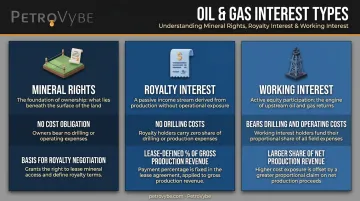
Understanding oil and gas royalties requires distinguishing three positions:
| Interest Type | Who Holds It | Cost Obligation | Revenue Share |
|---|---|---|---|
| Mineral rights | Landowner | None | Basis for royalty negotiation |
| Royalty interest | Mineral rights owner | No drilling costs | Lease-defined % of gross production revenue |
| Working interest | Operator/investor | Bears drilling and operating costs | Larger share of net production revenue |
How Oil and Gas Royalties Are Calculated
The calculation is straightforward: royalty rate × gross production revenue = royalty payment.
A simple example: a 20% royalty interest on $100,000 in monthly gross production revenue yields $20,000 per month to the mineral rights owner, with no operating costs deducted from the royalty owner's share.
Payment timing varies by state and lease terms. In Texas, the Railroad Commission notes that first-sale proceeds are generally due within 120 days after the sale month ends, with amounts below $100 sometimes accumulated under aggregation rules. "Paid monthly" is a reasonable general description, but the lease governs.
The Depletion Allowance: Oil and Gas's Unique Tax Advantage
Oil and gas royalty owners have a tax advantage that music, book, patent, and franchise royalty recipients simply don't: the depletion deduction.
This deduction accounts for the gradual exhaustion of the resource, and it comes in two forms:
- Percentage depletion — qualifying independent producers and royalty owners may deduct 15% of gross income from the property, subject to production and taxable income limitations
- Cost depletion — allocates adjusted basis over estimated recoverable units, deducting the portion attributable to units sold in a given year
Eligible taxpayers generally compare both methods and take the larger deduction.
Direct Working Interest: The Investor Angle
Accredited investors don't need to own land to participate in oil and gas production economics. A direct working interest position in a development project provides production-linked cash flow, plus tax advantages that go beyond what royalty owners receive.
Working interest holders who qualify under IRC 469(c)(3) may access Intangible Drilling Cost (IDC) deductions — expenses covering survey work, drilling services, wages, and supplies incurred during development. Under 26 CFR 1.612-4, 100% of IDCs are deductible in the year incurred.
For oil and gas development partnerships, this deduction is not restricted to passive income. It can offset active W-2 earnings and capital gains directly — a distinction that separates working interest from nearly every other investment structure.
PetroVybe, a Texas-based natural gas development company operating in Lavaca County and the Gulf Coast Basin, structures accredited investor positions exactly this way. Partners achieved a 94% IDC deduction against active income in 2024 and 91% in 2025 — a benefit structurally unavailable to royalty trust investors or MLP unitholders.

The Natural Gas Demand Tailwind
Timing matters for any production investment. The IEA projects U.S. data-center electricity consumption to rise approximately 240 TWh — a 130% increase — by 2030, driven primarily by AI infrastructure expansion. Natural gas currently supplies over 40% of U.S. data-center electricity and is projected to add over 130 TWh of annual generation through 2030.
That demand profile creates a durable tailwind for natural gas producers in well-positioned basins. PetroVybe concentrates its development activity on natural gas liquids (NGLs) in South Texas, where liquid hydrocarbons command stronger margins than dry gas — making basin selection a direct function of the demand outlook.
How Royalty Income Is Taxed in the U.S.
The IRS Baseline
IRS Publication 525 is unambiguous: royalties from copyrights, patents, and mineral properties are ordinary income, taxable at the recipient's marginal rate.
Where you report it depends on your relationship to the income:
- Schedule E — passive royalty income (most individuals receiving book, music, patent, franchise, or mineral royalties)
- Schedule C — self-employed creators who actively produce and license their work as a business (writers, inventors, artists)
Form 1099-MISC Reporting
Payers must issue Form 1099-MISC to any recipient who receives $10 or more in royalty payments during the year. Royalties appear in Box 2. The IRS receives a copy directly from the payer, so discrepancies between reported and filed amounts get flagged automatically.
The Oil and Gas Depletion Deduction in Detail
Oil and gas royalty owners can apply either percentage depletion (15% of gross property income for qualifying independent producers) or cost depletion — whichever yields the larger deduction. This deduction directly lowers the effective tax rate on oil and gas royalty income, an advantage no other royalty category offers.
When Royalty Interests Are Sold
That depletion benefit, however, comes with a catch at sale. Selling a royalty interest generally produces capital gain rather than ordinary income, potentially subject to lower tax rates than ongoing royalty payments. IRC 1254 can recharacterize some of that gain as ordinary income to the extent of prior depletion deductions taken. Before any disposition, a qualified tax advisor should review your specific depletion history to avoid unexpected recapture.
Royalty Income as a Passive Investment Strategy
Investors who want production-linked income without owning land have several vehicles to consider:
Royalty Income Trusts
Publicly traded royalty trusts — like the Permian Basin Royalty Trust (PBT) — hold overriding royalty interests and distribute production revenue to unitholders monthly. Key characteristics:
- No direct well-cost obligation for unitholders
- Distributions fluctuate with commodity prices and production volumes
- Unitholders report pro-rata income and may claim depletion deductions
- No IDC deduction — trust documents allocate depletion, not intangible drilling costs
These trusts provide commodity-linked income but offer no entry-point tax advantage against active income.
Alternative Royalty Investment Vehicles
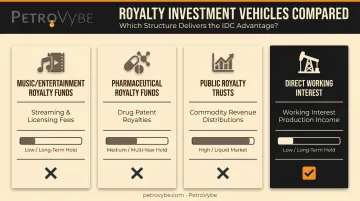
| Vehicle | Income Source | Liquidity | IDC Access |
|---|---|---|---|
| Music/entertainment royalty funds | Song catalog cash flows | Varies | No |
| Pharmaceutical royalty funds | Drug patent royalties | Low-medium | No |
| Public royalty trusts | Mineral production revenue | High (publicly traded) | No |
| Direct working interest (oil & gas) | Production revenue + IDC deductions | Low (private, long hold) | Yes |
The Direct Participation Advantage
For accredited investors seeking both passive income and immediate tax efficiency, direct participation in oil and gas development projects stands apart from the alternatives above. The IDC deduction — unavailable through royalty trusts or MLPs — can offset active W-2 income and capital gains in the year of investment, delivering value before the first distribution arrives.
PetroVybe's direct working interest model in South Texas NGL development is one example of how this structure works in practice. Partners receive K-1 reporting, first-year IDC deductions (typically 60–80% of invested capital), and long-term monthly distributions projected to scale during the production phase — tax advantages that royalty trusts and MLPs are structurally unable to pass through.
Frequently Asked Questions
What qualifies as royalty income?
Royalty income is any payment received for granting another party the right to use owned intellectual property, creative works, or natural resources: music, books, patents, trademarks, franchise systems, and mineral extraction rights. The IRS treats it as ordinary income, reportable on Schedule E or Schedule C depending on the recipient's role.
What is the 25 percent rule for royalties?
The "25 percent rule" is an informal guideline suggesting a licensor should receive roughly 25% of the licensee's expected gross profit as a royalty. Courts treat it as a negotiating reference only — federal courts have explicitly rejected it as a reliable baseline in patent royalty disputes.
What is a typical royalty payment?
Rates vary by industry: franchise royalties typically run 5%–9% of gross sales, book royalties 7.5%–15% of retail or net, high-tech patent royalties average around 4.75%–4.82%, and oil and gas royalties are negotiated by lease. Specific rates depend on exclusivity, asset demand, and negotiating leverage.
How is royalty income taxed in the U.S.?
Royalty income is reported as ordinary income on Schedule E (or Schedule C for self-employed creators). Payers must issue Form 1099-MISC for $10 or more in royalties paid annually (Box 2). Oil and gas royalties may benefit from depletion deductions (percentage or cost) that reduce effective taxable income.
Are oil and gas royalties considered passive income?
Royalties received by mineral rights owners are generally treated as passive income reported on Schedule E. Working interest holders who participate in operations may be treated differently under IRC 469(c)(3). For qualifying working interests, IDC deductions can be applied against active income like W-2 wages, not just passive income.
What is the difference between a royalty interest and a working interest in oil and gas?
A royalty interest receives a share of production revenue without bearing any drilling or operating costs. A working interest shares in both production revenues and the costs of drilling and operating the well. Working interest holders typically earn a larger revenue share in exchange for carrying those costs, and may access IDC deductions unavailable to royalty interest owners.
Disclosure: PetroVybe and its team members are not licensed financial advisors, and nothing on this website constitutes financial or investment advice or a recommendation to buy, sell, or hold any investment. PetroVybe and its team members are not tax advisors, accountants, or tax strategists, and nothing on this website constitutes tax advice or a tax strategy. PetroVybe and its team members are not attorneys, and nothing on this website constitutes legal advice. All content is provided for general informational purposes only. You should consult your own independent financial advisor, tax professional, and legal counsel before making any decision.