

Terms like NRI, decimal interest, suspense, and ORRI show up on statements with zero explanation. Many owners have no idea whether their check is accurate or whether they're leaving tax savings on the table. Googling the answer — or asking a chatbot — often produces generic, state-blind advice that doesn't hold up against your actual lease.
This guide breaks down the real distinctions: interest types, how royalty statements work, what the tax code actually allows, and the options owners have beyond simply cashing checks.
Key Takeaways
- Mineral, royalty, NPRI, ORRI, and working interests carry different rights, risks, and tax treatment
- Division orders and decimal interests determine your exact payment share; always verify against your lease
- Royalty income qualifies for depletion; working interests unlock IDC deductions against active income
- Owners generally choose between holding, selling for a lump sum, or moving into active development
- Never rely on generic web answers for state-specific rules; confirm against your documents or a professional
Types of Oil & Gas Interests Every Owner Should Know
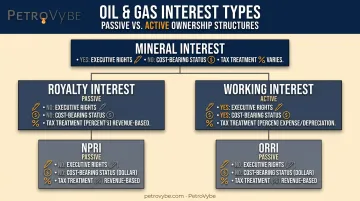
A mineral interest is ownership of the subsurface estate. It typically includes the executive right to negotiate and sign a lease, the right to collect a lease bonus, and the right to a royalty once production begins. It's the broadest form of ownership in the oil-and-gas world.
Royalty Interests vs. Working Interests
A royalty interest is a share of production revenue with no cost-bearing obligation. You don't pay for drilling, completion, or operating expenses; you simply receive a percentage of what's produced.
A working interest is entirely different. It's a cost-bearing, active development position. Working interest owners:
- Fund their proportional share of drilling, completion, and operating costs
- Carry real operational and financial risk
- Access tax benefits royalty owners can't touch
Two related carve-outs matter here too. A non-participating royalty interest (NPRI) is a royalty share carved directly from the mineral estate, but without executive leasing rights or bonus payments. An overriding royalty interest (ORRI) is carved from the lessee's working interest instead, and it generally expires when the underlying lease ends, according to a 2019 legal analysis from Oil and Gas Lawyer Blog.
Why the Distinction Matters for Taxes and Returns
This isn't just legal trivia. Working interest owners can deduct intangible drilling costs (IDCs) against active income — a benefit royalty owners simply don't have access to. Royalty owners are generally limited to the depletion allowance, which we'll unpack next. The gap between these two tax treatments is one of the biggest reasons some owners eventually look beyond passive royalty checks.
Understanding Your Royalty Statement: Division Orders, Decimals & Deductions
A division order identifies the property, the payor, the payee, and the decimal share used to calculate your payment. According to the Texas Railroad Commission, a division order doesn't amend your lease; it's simply the payment mechanism (Texas RRC, Royalties FAQ). Sign one with a wrong decimal, though, and you may lock in the wrong payment share, or be asked to refund an overpayment later.
How Your Decimal Interest Is Calculated
The standard formula:
Decimal = mineral ownership fraction × lease royalty fraction × (tract acres / unit acres)
Example: You own a 1/4 mineral interest, your lease royalty is 1/4, and your 40-acre tract sits inside a 160-acre unit.
1/4 × 1/4 × (40/160) = 0.015625
That number should match what's printed on your division order and statement. If it doesn't, ask why before you sign anything.
Common Deductions and What They Mean
Statements often list post-production deductions such as:
- Gathering and compression
- Dehydration and processing
- Transportation and marketing
- Severance or production taxes
Whether these are allowed depends entirely on your lease language, not the label on the statement. "At the well" clauses often permit net-back deductions; gross-proceeds language may not.
What "Suspense" Means
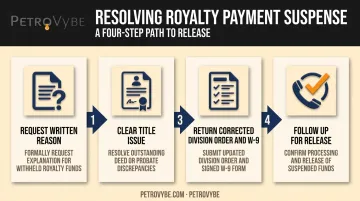
Suspense is when your operator withholds payment. Common causes include title defects, missing or unreturned division orders, unresolved heirship, or an operator who simply can't locate you. Resolving it usually means:
- Request the written reason for suspense from the payor
- Clear the title issue: record a probate order, deed, or heirship affidavit
- Return a corrected division order and W-9 with current information
- Follow up for release and a full accounting of withheld funds
Suspense aside, every statement deserves a quick gut-check before you file it away:
- Confirm the well and lease identifiers match your records
- Recalculate your decimal interest independently
- Compare deduction line items against your actual lease wording
- Check volumes and prices against prior periods for consistency
Tax Rules Every Interest Owner Should Understand
Royalty and working interest owners live under very different tax rules. Knowing which one applies to you changes what you can deduct.
Depletion: The Royalty Owner's Main Benefit
Under Section 613A, qualifying independent producers and royalty owners can claim a 15% percentage depletion rate, subject to statutory limits on production, property income, and overall taxable income (26 U.S. Code § 613A). It's not an automatic 15% exclusion on every check: the limitations matter. Royalty income itself is reported on Form 1099-MISC and taxed as ordinary income on Schedule E, with depletion as one of the few offsets available.
Working Interests: A Different Playbook
Working interest owners operate under a different section of the code entirely. Section 263(c) allows current-year expensing of qualifying intangible drilling costs (IDCs) — things like labor, fuel, and supplies that have no salvage value. And under Section 469(c)(3), a working interest held without limited liability is excluded from the passive-activity loss rules, meaning those deductions can offset active income, not just passive income (26 U.S. Code § 469).
That last point is the key difference: a royalty owner's depletion allowance only offsets royalty income. A working interest owner's IDC deduction can offset W-2 wages, capital gains, and other active earnings.
A Real-World Example: PetroVybe's Structure
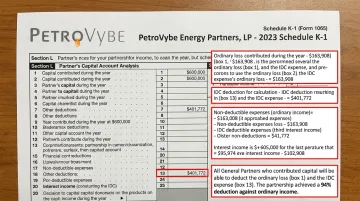
PetroVybe, a Texas-based natural gas development company, structures its working interest partnerships specifically around this IDC advantage. Partners who joined in 2024 received a documented 94% tax deduction against active income; 2025 partners saw 91%, both verified through K-1 documentation.
The company targets roughly 70% first-year deduction and up to 100% total deduction, applicable against W-2 earnings and capital gains. Actual results in both 2024 and 2025 exceeded that structural target.
One documented example: a partner with a $600,000 capital contribution received $401,772 in deductions tied to IDCs and ordinary business loss.
Deduction eligibility depends entirely on individual circumstances, income mix, and how capital is deployed. Confirm your specific outcome with a CPA before assuming any deduction percentage applies to you.
Should You Hold, Sell, or Go Deeper? Your Options as an Interest Owner
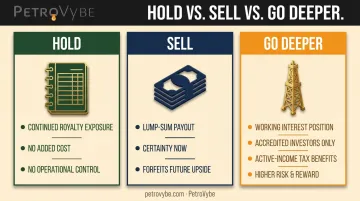
Every interest owner eventually faces the same three-way decision.
Hold
Holding means continued exposure to royalty checks that move with production decline curves and commodity prices. There's no additional cost, but there's no additional upside either. You have no say in the operational decisions that drive your return.
Sell
Selling converts an uncertain future income stream into a lump sum today. You trade long-term upside for certainty now. This fits owners who want liquidity, are managing an estate, or simply don't want to track statements for another 20 years. Many owners split the difference, selling a portion of their interest while retaining the rest.
Go Deeper
For accredited investors, there's a third path most royalty owners never consider: moving from passive ownership into a direct working interest in active development.
PetroVybe offers this through PetroVybe ONE, its working interest partnership structure in South Texas and the Gulf Coast Basin:
- $100,000 minimum investment, accredited investor status required and verified by a CPA, tax attorney, or licensed advisor under SEC Regulation D 506(c)
- A targeted 10-year MOIC of roughly 2.2x to 5.8x and ~26% IRR, per PetroVybe's ProForma model
- Monthly passive distributions projected to exceed $10,000/month per unit at peak production, typically beginning 2-3 years after initial investment
- An 80/20 profit split favoring investors, backed by a $48MM third-party reserve valuation (PV-09)
This isn't a fit for someone needing immediate cash flow. The early years deliver tax benefits well before they deliver distributions. But for owners with a long time horizon and appetite for the tax benefits covered above, it's a meaningfully different path than a royalty check ever offers.
Common Pitfalls & Questions Interest Owners Face
Inherited title complications cause more delayed payments than almost anything else. Common culprits include:
- Multiple heirs with competing claims
- Unprobated estates lacking clear legal transfer
- Missing chain-of-title documents
Any one of these can keep an operator from issuing a new division order, leaving your check in suspense until the title work is resolved.
Relying on generic or AI-generated answers is another recurring trap. Pooling rules, post-production deduction standards, and payment timelines vary meaningfully by state:
| State | Pooling Approach | Post-Production Costs |
|---|---|---|
| Texas | Contractual; RRC hears Mineral Interest Pooling Act cases | Often allowed under "at the well" lease language |
| Oklahoma | Forced pooling with a 20-day election window | Costs to reach marketable product generally stay with producer |
| New Mexico | Compulsory pooling requires notice to uncommitted owners | Deductible when lease language permits |
A national chatbot answer can't account for these differences. Always verify against your actual lease and state agency guidance.
Untracked lease and pooling activity quietly erodes value too. Lease expirations and missed pooling election deadlines change what your interest is worth, and nearby offset-well drilling can shift it further still. None of this shows up as an obvious signal in your monthly statement.
Frequently Asked Questions
What is the difference between a mineral interest and a royalty interest?
A mineral interest includes ownership plus the executive right to lease, collect bonus payments, and negotiate terms. A royalty interest is only a share of production revenue, without those leasing or executive rights.
How do I know if my royalty payments are accurate?
Recalculate your decimal interest independently, compare deduction line items against your specific lease language, and check volumes and pricing against prior statements for consistency.
What tax deductions are available to oil and gas interest owners?
Royalty owners typically qualify for the 15% percentage depletion allowance under Section 613A. Working interest owners can deduct intangible drilling costs against active income — PetroVybe partners saw 91-94% deductions in 2024-2025.
Should I sell my mineral rights or keep them?
It depends on whether you value certainty or long-term upside more. Selling converts future royalties into cash today; holding keeps exposure to production and price swings. Many owners sell a portion and keep the rest.
What is a working interest, and how is it different from owning royalties?
A working interest bears a proportional share of drilling and operating costs but unlocks IDC deductions against active income. A royalty interest is cost-free but limited to depletion as its main tax benefit.
How can accredited investors participate directly in oil and gas development?
Companies like PetroVybe offer accredited investors direct working interest positions in natural gas projects, such as its South Texas and Gulf Coast Basin operations, combining tax efficiency with long-term passive income.