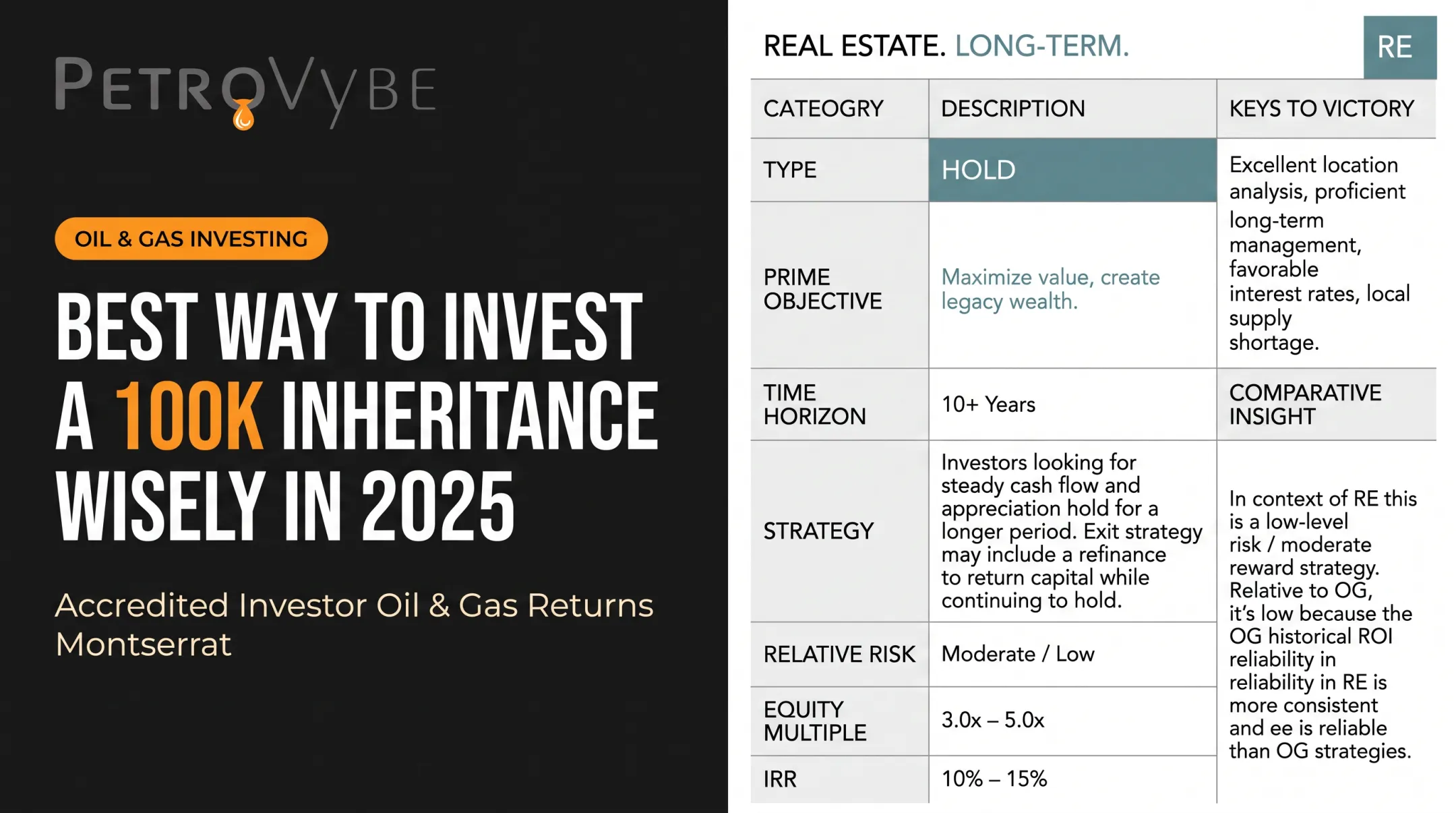
Inherited assets follow a different rulebook than money you've earned and invested yourself. Step-up in basis, RMD deadlines, estate thresholds — these aren't concepts most people deal with until grief and paperwork collide. This guide breaks down the tax mechanics, smart allocation strategies, and where alternative investments like direct natural gas development fit into the picture.
Key Takeaways
- A step-up in cost basis on inherited assets can erase years of embedded capital gains
- Most non-spouse beneficiaries face strict 10-year distribution rules on inherited IRAs
- Tax-advantaged investments can offset taxes owed on inherited income and other gains
- Coordinating tax, legal, and investment advisors protects more of the estate than going it alone
Understanding the Tax Rules That Apply to Inherited Assets
Estate Tax vs. Inheritance Tax
These two terms get mixed up often, but they are not the same:
- Estate tax is paid by the deceased's estate before assets are distributed. The federal exemption is $13,990,000 per individual in 2025, so most estates owe nothing federally.
- Inheritance tax is paid by the beneficiary. Only a handful of states impose it: Kentucky, Maryland, Nebraska, New Jersey, and Pennsylvania.
Some states also levy their own estate tax with far lower exemptions than the federal threshold — Oregon's kicks in at just $1 million. Check your state's rules, since state estate and inheritance tax exemptions vary dramatically.
The Step-Up in Basis: Your Biggest Advantage
When you inherit an appreciated asset such as stock, real estate, or a business interest, its cost basis typically resets to fair market value on the date of death.
If your parents bought a stock for $10,000 decades ago and it is worth $200,000 today, you inherit it at that $200,000 basis. Sell it immediately, and you owe little to no capital gains tax.
That is why selling inherited assets sooner often makes more tax sense than holding them indefinitely—especially versus older, non-inherited holdings with years of unrealized gains.

Inherited IRA Rules Are Stricter Than You Think
Non-spouse beneficiaries generally must empty an inherited IRA within 10 years of the original owner's death. Some circumstances also require annual RMDs during that window.
Exceptions apply to "eligible designated beneficiaries":
- Surviving spouses
- Minor children of the deceased (until they reach majority)
- Disabled or chronically ill individuals
- Beneficiaries less than 10 years younger than the deceased
Missing these deadlines can trigger penalties, so this isn't a "figure it out later" situation.

Building a Tax-Efficient Investment Strategy for Inherited Wealth
Don't just dump inherited assets into your existing portfolio. That's the fastest way to accidentally overconcentrate in a sector or blow past your actual risk tolerance.
Instead:
- Reassess your full picture first — combine the inheritance with your existing holdings before deciding anything, not after
- Build goal-based buckets — separate near-term needs, education funding, and retirement into distinct allocations with different time horizons
- Put idle cash to work — if lump-sum investing feels too risky emotionally, dollar-cost averaging into the market over several months is a reasonable middle ground
- Max out tax-advantaged accounts — IRA and 401(k) contributions still need earned income, so use inheritance for spending or rebalancing while you hit 2025 limits ($7,000 IRA, or $8,000 if 50+; $23,500 401(k)) and shelter more of what you earn
- Consider 529 plans for education — the 5-year gift tax election lets you front-load up to five years of annual exclusion gifts into one contribution
When the inheritance is far larger than annual contribution caps, other tax-efficient tools matter more—including structures that can deploy six-figure capital with deductions against active income (for example, intangible drilling cost deductions on qualifying energy development interests).

Charitable Giving as a Tax Lever
If the inheritance pushes you into a higher bracket, charity can offset part of the tax hit while you support causes you care about.
- Donor-advised funds — contribute now, claim the deduction, and grant to charities over time
- Appreciated inherited stock — gift directly to charity to avoid capital gains; long-term positions are generally deductible at fair market value up to 30% of AGI
Diversifying Beyond Traditional Assets: The Case for Alternative Investments
Inherited liquidity often brings new eligibility. Families who suddenly have $500,000 or $1 million in liquid assets frequently qualify as accredited investors for the first time — and gain access to private markets that were closed to them before. Alternatives offer:
- Return potential and diversification uncorrelated to public markets
- Higher risk and lower liquidity than stocks or bonds (capital you will not need next year)
- Access to asset classes institutions have used for decades
Why Natural Gas Development Stands Out
Direct working interests in U.S. oil and gas wells qualify for Intangible Drilling Cost (IDC) deductions under IRC §263(c). Unlike many deductions, IDCs can offset active income — including W-2 wages and capital gains — not just passive income. PetroVybe, a Texas-based natural gas developer, shows how that structure can work in practice. Accredited investors who redeployed capital, including inherited liquidity, into PetroVybe development projects received 91–94% tax deductions against active income in 2024 and 2025 through combined IDC and depletion allowances. Project scale and stated targets:
- Flagship position: 58,000 acres in Lavaca County, Texas
- ~400 acquired legacy wells plus 57+ planned new wells
- $48 million third-party reserve valuation (PV-09)
- 10-year MOIC target range of 2.2x–5.8x and roughly 26% IRR (forecasts, not guarantees)
- Passive monthly distributions projected to build over time, with peak-production examples above $10,000/month Before committing inherited capital to any operator:
- Ask for independent, third-party engineering reports validating reserves
- Confirm accredited investor status through a CPA, tax attorney, or licensed advisor
- Review the full PPM with legal and financial counsel — projected returns always carry a "high degree of risk" disclosure for good reason That diligence matters more as the demand backdrop shifts. Rising electricity use from AI and data centers is reshaping natural gas markets. The IEA projects global data center electricity use could top 1,000 TWh by 2030, with natural gas already supplying over 40% of U.S. data center power needs. For families evaluating energy-sector alternatives, that trend is part of the underwriting case — not a substitute for operator-level review.

Coordinating Inheritance Decisions With Your Family's Broader Estate Plan
Receiving a significant inheritance is itself a trigger to update your own estate plan. Your will, trust documents, and beneficiary designations should reflect your new financial reality, not the one that existed before the inheritance.
Consider these moves:
- Irrevocable trusts can move newly inherited assets out of your taxable estate, preparing for the next generational transfer.
- Annual gifting — the exclusion is $19,000 per recipient in 2025 — lets you shift wealth to children or grandchildren tax-free, year after year.
- Life insurance reviews help you recalibrate coverage for a larger estate, or place a policy inside an irrevocable life insurance trust.

How you title and structure newly inherited assets shapes both your current tax picture and what the next generation receives. Keep investment choices aligned with these documents so the estate plan works as one system.
Common Mistakes Families Make When Investing an Inheritance
Grief and money decisions don't mix well. Give yourself permission to wait.
Families still tend to trip over the same four mistakes:
- Rushing the timeline. Park inherited cash in a money market fund for 6-12 months while you think clearly, rather than locking in permanent decisions in month one.
- Following unsolicited tips. Relatives, coworkers, and social media "experts" love to weigh in on new money — most have no idea about your tax situation.
- Keeping overconcentration. If you inherit a portfolio heavy in one stock or sector, don't leave it that way just because it feels familiar.
- Going it alone. A CPA, estate attorney, and financial advisor working together will catch things a single advisor might miss.
There's a commonly cited claim that 70% of wealthy families lose their wealth by the second generation. The research behind that figure is actually thinner than most people assume, but the underlying lesson holds: rushed decisions and poor planning do real damage.
Frequently Asked Questions
What is the best way to invest money from an inheritance?
It depends on your goals, timeline, and tax bracket. Pay off high-interest debt first, build an emergency fund, then allocate across tax-advantaged traditional and alternative investments with professional guidance.
How soon do I need to make decisions about an inherited IRA?
Most non-spouse beneficiaries must fully withdraw funds within 10 years, and some situations require annual RMDs during that window. Talk to a tax advisor early to avoid penalties.
Do I have to pay taxes on an inheritance?
There's no federal inheritance tax. A few states (Kentucky, Maryland, Nebraska, New Jersey, Pennsylvania) impose one, and federal estate tax only applies above $13.99 million per individual in 2025.
Can I use inherited money to invest in alternative assets like oil and gas?
Yes, if you qualify as an accredited investor. Direct natural gas development can offer intangible drilling cost (IDC) deductions against active income and diversification from public markets, with higher risk and lower liquidity.
Should I sell inherited stocks or hold them?
The step-up in basis often makes selling soon after inheritance more tax-efficient than holding, especially if you need to rebalance. Compare that to older holdings with years of embedded gains before deciding.