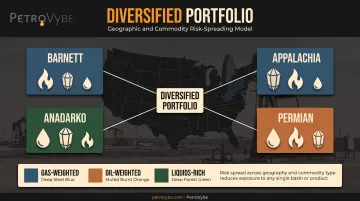
This article is general education, not investment, tax, or legal advice. Diversified Energy grew into a multi-billion-dollar operator by buying up producing wells across Appalachia, the Barnett, the Anadarko, and the Permian instead of betting on one basin or one well. That's the roll-up model, and it works because spreading risk across geography, commodity type, and well maturity smooths out the bumps that sink single-asset bets.
Most individual investors never get near this kind of deal. They don't understand what "diversified asset acquisition" actually means, or how it's different from funding one wildcat well and hoping.
This guide breaks down the strategy, how professionals actually value acquisition targets, and how accredited investors can get direct exposure to similar principles at a private scale.
Key Takeaways
- Diversification spreads risk across basins, commodity mix, and well maturity instead of concentrating it in a single asset
- Valuation hinges on EV/EBITDA multiples, PV-10, and price-per-flowing-barrel
- Private partnerships give accredited investors tax-advantaged, passive access to diversified development strategies
What Is Diversified Oil and Gas Asset Acquisition?
Diversified asset acquisition means buying producing and undeveloped properties across multiple basins, commodity types, and development stages—not concentrating capital in one well or one region. If gas prices soften in one basin, oil-weighted production elsewhere can offset the decline. Diversified Energy is a clear public-market example. Its portfolio spans Appalachia (Marcellus and Utica shales) and a Central Region built from the Barnett, Anadarko, and Permian basins, according to the company's 2026 SEC filing. Acquisitions replenish cash flow as older wells decline—necessary because base production falls every year without new wells or workovers.
From Pure Acquisition to Acquisition Plus Drilling
Diversified is no longer purely acquisitive. In August 2026, it added a one-rig operated-drilling program in Oklahoma, citing more than 450 economic locations at $65/Bbl oil and $3.25/MMBtu gas, per its Q2 2026 results release. That shift underscores three points:
- Pure roll-ups eventually exhaust attractive acquisition targets
- Organic drilling extends inventory life
- Buying existing production and drilling new wells work best together
Why Commodity Mix Matters
Oil, natural gas, and NGLs don't move in lockstep. When gas prices dip, liquids-rich production can carry cash flow. That is why many acquirers favor liquids-rich targets over purely gas-weighted ones. Large public roll-ups operate at a scale individual investors can't touch directly. Private development partnerships offer another path: smaller, earlier-stage basin positions with direct equity instead of public shares tied to market swings. Firms such as PetroVybe use that model so accredited investors can hold working interest in U.S. upstream assets—acquisition plus development—without buying a diversified public roll-up.
How Acquisition Targets Are Evaluated
Professional acquirers don't just eyeball a deal. They run it through a specific set of metrics, and recent Diversified transactions illustrate exactly how these numbers get used.
The Core Valuation Metrics
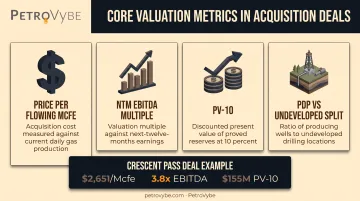
| Metric | What It Measures |
|---|---|
| Price per flowing Mboe/Mcfe | Purchase price divided by current daily production |
| NTM EBITDA multiple | Purchase price relative to next-twelve-month cash flow |
| PV-10 | Present value of proved reserves, discounted 10%, pre-tax |
| PDP vs. undeveloped | Split between currently producing reserves and future inventory |
Diversified's 2024 acquisition of Crescent Pass assets in East Texas closed at roughly $106 million, priced at $2,651 per flowing Mcfe and a 3.8x NTM EBITDA multiple, against an estimated $155 million PV-10, according to the company's announcement.
A separate East Texas joint acquisition that same year priced closer to 3.5x.
These multiples aren't universal benchmarks; they're deal-specific. Different consideration structures, PDP weightings, and commodity price assumptions all shift the number. Buyers consistently anchor to cash-flow multiples, not just headline purchase price.
PDP vs. Undeveloped Inventory
Proved Developed Producing (PDP) reserves come from wells already online. They carry less uncertainty than undeveloped locations because there's real production history to underwrite against. Acquirers weight PDP heavily in valuation, then layer in drill-ready inventory as upside.
Buyers also assess:
- Years of remaining runway at current drilling pace
- Drill-ready locations with permits and infrastructure in place
- Decline curves on existing wells to project future cash flow
Financing and Independent Validation
Large deals rarely close on cash alone. Diversified's Maverick acquisition combined roughly $207 million cash, 21.2 million shares, and assumed debt, per the company's release.
Others use asset-backed securitization. The Camino Resources deal structured an SPV that issued debt backed by production cash flows, with Carlyle holding roughly 60% and Diversified operating the remaining 40% stake.
Before any deal closes, independent third-party engineers validate reserve and production estimates. This isn't optional paperwork. It's the check that keeps buyers from overpaying based on inflated seller projections.

Why Investors Are Drawn to Diversified Asset Acquisition Strategies
Diversification across basins and commodity types produces steadier cash flow than a single well ever could. One dry hole doesn't sink the whole position when you're spread across dozens of wells and multiple formations.
Oil and gas assets also offer real inflation protection. Energy has historically delivered some of the strongest inflation-adjusted returns when inflation surprises to the upside, according to Reuters reporting on Goldman Sachs data. Producing assets generate income tied to commodity prices, which tend to rise alongside broad inflation.
The Tax Advantage Most Investors Miss
Here's where oil and gas development stands apart from stocks or real estate: Intangible Drilling Cost (IDC) deductions can offset active income, including W-2 wages and capital gains, not just passive income. The IRS permits this election for qualifying U.S. wells where the investor holds a genuine working interest. This treatment requires the investor to elect general partner status in the Subscription Agreement and may be limited in a given year by the excess business loss limitation under IRC §461(l).
PetroVybe brings that same diversified, working-interest model to accredited investors at a private scale. Partners take direct positions in East Texas and Gulf Coast Basin natural gas and NGL assets, targeting:
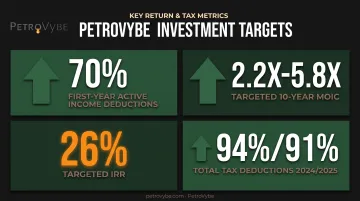
- First-year deductions of roughly 70% against active income
- 10-year targeted MOIC of 2.2x to 5.8x
- Targeted IRR near 26%
For context, PetroVybe partners saw 94% total tax deductions in 2025 against active income. This treatment requires the investor to elect general partner status in the Subscription Agreement and may be limited in a given year by the excess business loss limitation under IRC §461(l). , combining IDC and depletion allowances.
Risks and Due Diligence Considerations
No diversification strategy eliminates risk. It manages it. Investors need to understand where the real exposure sits before writing a check.
Commodity price volatility remains the biggest wildcard. Operators hedge production to smooth this out, but hedging cuts both ways. Rystad Energy found that shale producers had hedged 46% of expected 2022 crude output, and when prices ran hot, projected hedge losses topped $10 billion across the sample, per Rystad's research. Hedges protect the downside but cap the upside.
Other risks worth reviewing before committing capital:
- Integration risk in large corporate M&A, where merging systems and operations creates disruption
- Execution risk in smaller private partnerships, where drilling timelines and costs can slip
- Reserve estimation error, which is why independent engineering reports matter so much
Before committing to any deal, check:
- The operator's track record on prior projects, not just marketing claims
- Third-party reserve reports, not internal seller estimates
- Documented success rates on well-site selection and drilling outcomes
PetroVybe's Chief Geophysicist, for instance, brings a documented 75.2% career success rate in well-site selection across 48 years, well above the industry peer average, which typically runs below 40%. Disclaimer: these results were achieved at prior companies.

How Accredited Investors Can Participate
There are two different ways to get exposure to this strategy, and they carry very different risk and access profiles.
Public equity in acquisition-driven companies like Diversified Energy is liquid and open to anyone. But you're buying into corporate-level decisions, share dilution, and stock market volatility that has nothing to do with the underlying wells.
Private development partnerships offer direct positions in specific assets. These are typically restricted to accredited investors under SEC Regulation D, meaning:
- Net worth over $1 million (excluding primary residence), or
- Income over $200,000 individually ($300,000 jointly) in each of the prior two years, or
- Certain professional securities licenses in good standing
This restriction exists because private offerings carry less regulatory disclosure than public markets. The SEC assumes accredited investors can evaluate and absorb that risk.
For investors who meet those thresholds, private partnerships like PetroVybe offer a direct path into specific development assets. Participation begins at one unit of $100,000, with add-on subscriptions from $25,000.
PetroVybe's leadership brings direct acquisition-evaluation experience to this space. CFO Clayton Riddle evaluated more than 70 upstream and midstream acquisition opportunities during his time at Odyssey Energy, building financial models used by CEOs and capital sponsors to underwrite deals.
That same evaluation discipline now applies to PetroVybe's East Texas and Gulf Coast Basin development projects, backed by independent engineering review and a $48 million PV-09 proved-reserves valuation from a licensed third-party firm. Prepared by Lee Keeling & Associates, Tulsa, March 2026.
Frequently Asked Questions
What is the difference between an oil and gas acquisition and a merger?
An asset acquisition involves buying specific producing properties or reserves directly, with no goodwill recognized. A merger combines entire companies, including equity, governance, and corporate structure, not just physical assets.
How do companies finance large oil and gas asset acquisitions?
Financing typically blends cash, debt, and equity issuance. Larger deals also use asset-backed securitization, where a special purpose vehicle (SPV) issues debt backed by the acquired assets' production cash flows.
What does PDP mean in oil and gas acquisitions?
PDP stands for Proved Developed Producing reserves, meaning reserves recoverable from wells already drilled and currently producing. PDP assets carry lower uncertainty than undeveloped inventory, so they typically anchor a deal's valuation.
Is investing in oil and gas asset acquisitions risky?
Yes, commodity price swings and execution risk are real factors. Diversification across basins and commodity types, along with hedging programs, helps manage that risk but doesn't eliminate it.
Can individual investors participate in oil and gas asset acquisitions?
Non-accredited investors can buy public equity in energy companies. Direct private partnerships—such as PetroVybe limited partnership units—offer more targeted exposure and tax advantages but are limited to accredited investors under SEC rules.
What tax benefits come with oil and gas development investments?
Intangible Drilling Costs (IDCs) can be deducted against active income, including W-2 wages, often covering a first-year deduction target of approximately 70–80% of invested capital in the first year. Depletion allowances provide additional deductions tied to resource extraction over time. This treatment requires the investor to elect general partner status in the Subscription Agreement and may be limited in a given year by the excess business loss limitation under IRC §461(l).
Informational requests only. PetroVybe projects are offered solely to verified accredited investors. Submitting this form does not create an investment or advisory relationship.