

Nobody covered this in medical school. Between residency, boards, and building a practice, tax literacy never made the curriculum. That gap leads plenty of doctors to either overpay every April or get pitched into "shelters" that don't hold up under audit.
This guide breaks down real, legal deductions for three groups: W-2 employed physicians, self-employed and practice-owner doctors, and high earners looking for one advanced strategy most tax guides skip entirely: using active-income offsets like oil and gas investments.
Key Takeaways
- Your deduction strategy hinges on whether you're W-2, 1099, or a practice owner
- Maxing tax-deferred retirement accounts and HSAs remains the safest move for most physicians
- Self-employed doctors unlock the QBI deduction, business write-offs, and family-hiring strategies
- W-2 doctors facing capped relief can explore alternatives like oil and gas IDC deductions
- Any advanced strategy needs sign-off from a physician-focused CPA first
Why Doctors Carry Such a Heavy Tax Burden
Most physician income shows up as ordinary W-2 wages. That's the most heavily taxed income category in the entire code, with fewer built-in shelters than business or investment income enjoys.
The math gets brutal fast. For tax year 2026, the top federal marginal rate of 37% applies above $640,600 for single filers and $768,700 for married couples filing jointly, according to IRS inflation adjustments for 2026. Two attendings earning $380,000 each land in that bracket almost immediately once combined.
Here's why this matters for planning: a deduction is worth more to a high-bracket earner than to an average taxpayer.
- A $10,000 deduction saves a 37%-bracket doctor $3,700
- The same deduction saves a 32%-bracket physician $3,200
- The same deduction saves a 22%-bracket taxpayer just $2,200
That gap compounds over a 25-30 year career. Coordinated planning, meaning retirement accounts, HSAs, and business deductions working together rather than in isolation, multiplies savings in a way piecemeal tax prep never will.
Tax Deductions for W-2 Employed Physicians
W-2 doctors have fewer levers than business owners, but the ones available are powerful when stacked correctly.
Retirement Accounts: 401(k) and 403(b)
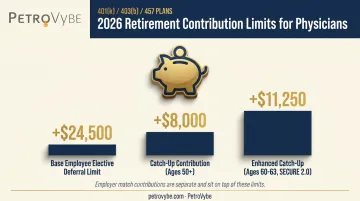
The 2026 employee elective-deferral limit is $24,500 across 401(k), 403(b), and most governmental 457 plans, per the IRS 401(k) limit announcement. Catch-up contributions add:
- $8,000 for physicians age 50 and older
- $11,250 for ages 60-63 under SECURE 2.0's enhanced catch-up
Any employer match sits on top of these limits and costs you nothing to claim. If your hospital or group offers one, maximize it.
Backdoor Roth IRA
High-earning doctors get phased out of direct Roth contributions, so the workaround is a two-step move: make a nondeductible traditional IRA contribution, then convert it to Roth.
The pitfall is the pro-rata rule. The IRS aggregates every traditional, SEP, and SIMPLE IRA you own as of December 31 when calculating how much of the conversion is taxable. Forgetting an old rollover IRA from residency can turn a clean backdoor Roth into a surprise tax bill.
HSA's Triple Tax Advantage
Paired with a High Deductible Health Plan, an HSA delivers three tax breaks at once: deductible contributions, tax-free growth, and tax-free withdrawals for qualified medical expenses.
- 2026 contribution limits: $4,400 self-only and $8,750 family
- Minimum HDHP deductibles: $1,700 self-only and $3,400 family
Few accounts offer this combination. Treat it like a stealth retirement account, not just a medical expense fund.
Itemized Deductions and the SALT Cap
Mortgage interest and charitable contributions remain deductible if you itemize. The One Big Beautiful Bill Act raised the SALT deduction cap to $40,400 for 2026, though it phases down by 30% of MAGI above $505,000.
Also worth checking: unreimbursed medical and dental expenses exceeding 7.5% of AGI qualify under Publication 502, a category many doctors overlook entirely.
The Post-2018 Limitation
Since the 2018 Tax Cuts and Jobs Act, W-2 employees cannot deduct unreimbursed work expenses. That means CME, licensing fees, and equipment purchases paid out of pocket get you nothing on your return.
Negotiate the benefit directly: push your employer to cover CME, licensing, and equipment pre-tax as a compensation benefit rather than paying out of pocket and hoping to write it off later.
Physicians who've maxed out these levers and qualify as accredited investors have another avenue worth knowing about: direct participation in oil and gas development. Structures like PetroVybe's limited partnership units use intangible drilling cost deductions to offset a significant share of active income, including W-2 earnings, though the $100,000 minimum investment and accredited investor requirement limit who can use them.
Tax Deductions for Self-Employed and Practice-Owner Doctors
Self-employed and practice-owner physicians have a much deeper toolkit than their W-2 colleagues.
Retirement Plan Stacking
A SEP-IRA allows contributions up to the lesser of 25% of compensation or $72,000 for 2026. A Solo 401(k) works similarly, combining a $24,500 employee deferral with employer contributions, capped at the same $72,000 aggregate limit.
Practice owners in peak earning years can go further by layering a Defined Benefit or cash-balance plan on top of a 401(k). Because the funding is actuarially determined, this combination can shelter $150,000 to $300,000 or more annually, far beyond what a solo 401(k) allows alone.

The QBI Deduction
Section 199A allows up to 20% of qualified business income to be deducted for eligible pass-through businesses, according to the IRS QBI deduction overview. Medical practices are classified as a specified service trade or business (SSTB), which limits access at higher incomes.
For 2026, the SSTB phase-out:
- Begins above $201,750 (single) or $403,500 (married filing jointly)
- Fully phases out at $276,750 or $553,500, respectively
Managing taxable income near these thresholds, often through retirement plan contributions, can preserve some or all of this deduction.
Core Business Expense Deductions
Practice owners can deduct:
- Home office costs, provided the space meets the exclusive-use requirement
- CME travel and licensing fees
- Medical equipment and supplies
- Section 179 vehicle deductions for qualifying vehicles with a GVWR between 6,000 and 14,000 pounds, capped at $32,000 for 2026
Kids on Payroll
Paying your children a legitimate wage for real work performed shifts income into their lower bracket. In a sole proprietorship or a partnership owned solely by the child's parents, wages to a child under 18 are exempt from Social Security and Medicare taxes. Wages to a child under 21 also skip FUTA entirely.
Beyond the tax shift, that earned income can fund a Roth IRA for your child decades ahead of schedule.
Self-Employment Tax and the PTE Workaround
The self-employment tax rate is 15.3%, and half of it is deductible when computing AGI. Separately, the Pass-Through Entity (PTE) election lets your practice pay state income tax at the entity level, sidestepping the individual SALT cap. Now enacted in 38 states plus New York City, this workaround is available to most practice owners.
Advanced Strategy: Using Oil and Gas Investments to Offset Active Income
Here's the gap most physician tax guides never address: retirement accounts reduce taxable income, and passive losses only offset passive income. Neither one touches your W-2 wages or 1099 earnings directly. For high-earning doctors already maxing out retirement contributions, that leaves active income largely unprotected.
Intangible Drilling Cost (IDC) deductions, authorized under IRC Section 263(c), are one of the few provisions in the tax code built to change that. A working interest held directly, or through a structure that doesn't limit liability, doesn't automatically qualify as passive under IRC Section 469(c)(3). That means a qualifying IDC deduction can offset wages and other active income, not just passive gains.
This opens the door for accredited investor doctors, who can participate as limited partners in natural gas and oil development programs and often deduct a substantial majority of their investment against ordinary income in year one.
PetroVybe, a Texas-based natural gas development company operating on Biblical Stewardship principles, illustrates how this plays out in practice. Partners received a 94% first-year tax deduction against ordinary income in 2024 and 91% in 2025, backed by third-party engineering validation and a clean independent audit.
The company's flagship project, a 58,000-acre basin in Lavaca County, Texas, backs these deductions with tangible assets:
- Roughly 400 acquired producing wells already generating revenue
- 57+ planned new wells slated for future development
- A $48 million proved reserves valuation (PV-09) from a licensed engineering firm
This kind of strategy fits a specific profile:
- Doctors with $100,000+ in liquidity seeking diversification beyond stocks, bonds, and real estate
- Physicians who've already maxed retirement accounts and want an active-income offset
- Investors comfortable with a longer hold period in exchange for passive income and legacy wealth building
Oil and gas investments carry a different risk and liquidity profile than a 401(k) or HSA. Work with a tax strategist to confirm suitability before committing capital, since accredited investor rules and IDC treatment both require careful documentation.

Common Tax Deduction Mistakes Doctors Should Avoid
Even well-intentioned physicians leave money on the table. Watch for these three recurring errors:
- Not maxing every retirement option available - This includes catch-up contributions and mega backdoor Roth conversions where the employer plan allows after-tax contributions. Many doctors simply don't realize these limits exist.
- Ignoring moonlighting income as a deduction opportunity - Side 1099 work, even a few shifts a month, opens the door to business deductions a pure W-2 job never allows.
- Treating tax prep and financial planning as separate tasks - A broken backdoor Roth from an overlooked rollover IRA, or a Roth conversion that pushes you into a higher bracket, often stems from decisions made in isolation. The same disconnect causes doctors to overlook alternative tax-advantaged investments, such as direct oil and gas development partnerships offering intangible drilling cost deductions against active income.
Frequently Asked Questions
What tax benefits are available to doctors?
Doctors can access retirement account deductions, HSA contributions, and business expense write-offs if self-employed or a practice owner. High earners can also pursue advanced strategies, such as oil and gas IDC deductions, to offset active income.
How much do doctors get back in taxes?
Savings vary widely based on income structure, tax bracket, and which deductions apply. A physician-focused CPA can run personalized numbers based on your specific W-2, 1099, or practice-owner situation.
Can W-2 employed doctors deduct business expenses?
No. Since the 2018 TCJA, unreimbursed employee expenses like CME and licensing are no longer deductible. W-2 doctors should negotiate employer-paid coverage for these costs or consider 1099 side work instead.
What is the Qualified Business Income (QBI) deduction for doctors?
QBI allows self-employed and practice-owner doctors to deduct up to 20% of qualified business income. Because medicine is a specified service trade, the deduction phases out above certain income thresholds.
Are oil and gas investments a legitimate tax strategy for doctors?
Yes. IDC deductions are an IRS-recognized code provision available to accredited investors. PetroVybe gives accredited physician-investors direct access to this strategy, applying deductions against active income rather than just passive gains.
Do doctors need a specialized CPA for tax planning?
Physician-specific rules, including QBI thresholds, backdoor Roth mechanics, and entity structuring, are complex enough that most doctors benefit from a CPA or tax strategist experienced with medical professionals.