
This guide walks through realistic monthly income estimates across savings accounts, bonds, dividend stocks, annuities, real estate, and a tax-advantaged alternative most investors never consider: direct natural gas development. The right answer depends on your risk tolerance, tax bracket, and whether you need income now or want long-term compounding.
Key Takeaways
- $300k can yield under $100/month in savings or $1,800–$1,900/month via annuities—vehicle choice sets the range
- Savings, CDs, and bonds stay liquid but often tax as ordinary income and lag inflation
- Accredited investors with $100k+ liquidity can use tax-advantaged natural gas deals to cut taxable income and target long-term cash flow
How Much Monthly Income Will $300,000 Generate?
Monthly income comes down to one formula:
(Annual Return % × $300,000) ÷ 12 = Monthly Income
- 4% return → $1,000/month
- 6% return → $1,500/month
- 8% return → $2,000/month
- 10% return → $2,500/month
Real-world rates vary more than the formula suggests:
| Vehicle | Approx. Annual Rate | Monthly Income on $300k |
|---|---|---|
| National savings account | 0.39% | ~$98 |
| 12-month CD | 1.63% | ~$408 |
| Investment-grade bonds | 5.23% | ~$1,308 |
| S&P 500 dividend yield | 1.4% | ~$350 |
| REIT dividend yield | 4.07% | ~$1,018 |
| Immediate annuity (age 65, male) | ~7.6% payout | ~$1,890 |
| Immediate annuity (age 65, female) | ~7.2% payout | ~$1,806 |

(Source: FRED/FDIC national rate data, ImmediateAnnuities.com age-65 tables)
Important distinction: annuity payouts include both interest and a return of your original principal. A bond or dividend "yield," by contrast, is income only: your $300,000 stays intact. Annuities pay more per month partly because they're slowly handing your own money back to you.
So can you actually live off $300k? A retiree drawing a conservative 4% withdrawal gets $1,000/month. Someone willing to accept more risk or illiquidity for higher yield might land closer to $1,500-$1,900/month.
Neither figure works alone for most households. Supplemental income (Social Security, a pension, or part-time work) usually fills the gap.
Monthly Income by Investment Type: A Closer Look
Fixed-Income & Cash Options
Savings accounts and CDs are the safety-first choice. On $300k, expect:
- Savings accounts: roughly $98/month
- CDs: roughly $408/month
- Investment-grade bonds: roughly $1,308/month
These options offer liquidity and principal protection, but they barely keep pace with inflation. Interest is also generally taxed as ordinary income, so a high earner in the 32-37% bracket keeps far less than the headline rate suggests.
Dividend Stocks, REITs, and Equity ETFs
Dividend yields run modest: the S&P 500 currently yields about 1.4%, translating to roughly $350/month on $300k. REITs pay more generously, averaging around 4.07%, or roughly $1,018/month.
Share prices can appreciate over time, adding upside beyond the cash flow. REIT distributions, though, are frequently taxed as ordinary income (some portions as capital gains, reported via Form 1099-DIV), which matters if you're already in a high bracket.
Annuities and Real Estate Syndications
Immediate annuities offer the closest thing to guaranteed income. A 65-year-old male buying a single-life annuity averages about $630 per $100,000, or roughly $1,890/month on $300k.
Women see slightly lower payouts due to longer life expectancy, around $1,806/month. You avoid market risk, but you generally can't reclaim the principal once purchased.
Real estate syndications target higher returns, but preferred returns are deal-specific and not standardized or guaranteed across the industry. They also come with a real tradeoff:

- Illiquidity, often 5+ years
- No guaranteed monthly distribution
- Returns tied to a specific property's performance
Can You Live Off the Interest of $300,000?
Honestly? Not easily on its own. Even an aggressive 8% return only generates about $2,000/month.
Compare that to average annual spending for households age 65+: $61,432 in 2024, or roughly $5,119/month, according to BLS data via FRED.
That's a meaningful gap. The math changes when you add other income:
- Average Social Security benefit (July 2025): $2,006.69/month
- Conservative bond yield on the same $300k: about $1,308/month
- Combined total: roughly $3,315/month
Still short of that $5,119 benchmark, but much closer. $300k works best as one piece of a retirement income puzzle, not the entire plan.

A Tax-Efficient Alternative: Natural Gas Development Income
Here's the problem with most of the vehicles above: savings, bonds, REITs, even most dividend income gets taxed as ordinary income. For someone in a high bracket, that erodes the effective monthly cash flow significantly.
Direct investment in natural gas development is a category most investors overlook entirely, largely because it requires accredited-investor status. PetroVybe offers accredited investors direct equity participation in upstream gas projects, structured around Intangible Drilling Cost (IDC) deductions.
Key details:
- IDC deductions typically represent 60-80% of invested capital in a new drilling project
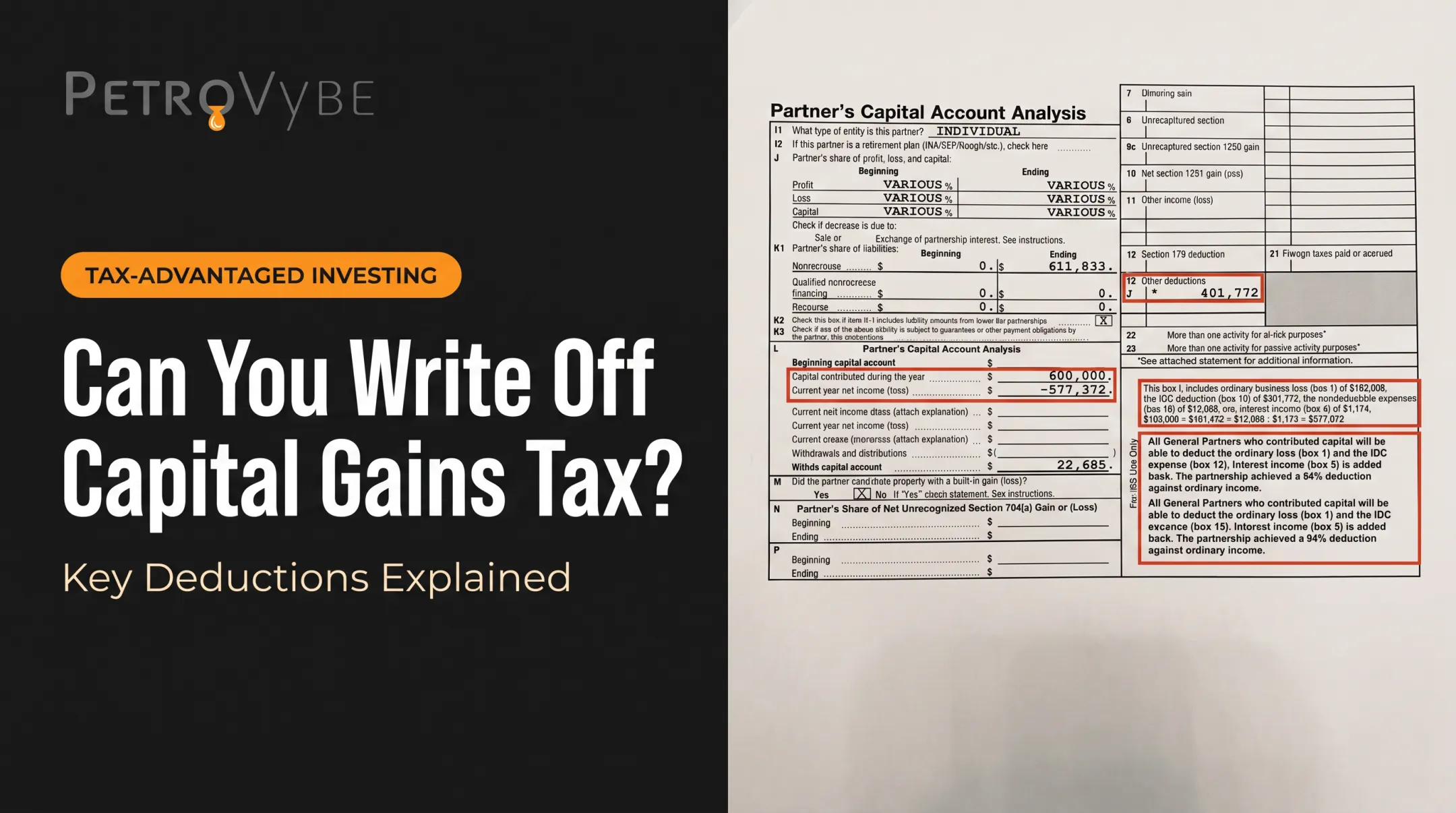
- PetroVybe partners achieved a 94% deduction against active income in 2024 (91% in 2025); historical results, not guarantees for new partners
- The deduction can offset active income, including W-2 wages and capital gains, for qualifying investors, unlike most REIT or dividend structures
- PetroVybe's projected 10-year targets: approximately 2.2-5.8x MOIC and 26% IRR, both forecast-dependent
This isn't a monthly annuity substitute. Distributions typically don't start until 2-3 years after investment, once development work is complete. Projected peak-production distributions can exceed $10,000/month for a unit, but that's a modeled ceiling for later years, not a starting income stream.

Who this fits:
- Accredited investors with $100,000+ in liquidity
- High W-2 earners or investors with capital gains looking to offset tax liability
- Those seeking diversification beyond stocks, bonds, and traditional real estate
- Investors comfortable with illiquidity and commodity-market risk in exchange for tax efficiency and long-term upside
This is not a low-risk, principal-guaranteed product. It's an illiquid, asset-backed investment tied to gas development outcomes, best used as one component of a diversified $300k strategy, not the whole thing.
Strategies to Maximize Monthly Income from $300,000
- Diversify across 2-3 vehicles. Blending a dividend ETF, a real estate position, and a tax-advantaged allocation spreads risk and smooths out income timing.
- Check the tax treatment before you allocate. Ordinary income, qualified dividends, capital gains, and deductible structures each hit your tax return differently. Model it before committing capital.
- Talk to a tax or financial advisor. Your income bracket, time horizon, and liquidity needs should drive the split, not a generic percentage rule.
Frequently Asked Questions
How much income will $300,000 generate per month?
Anywhere from about $100/month (savings accounts) to roughly $1,900/month (annuities), depending on the vehicle and risk level. See the comparison table above for specifics by asset type.
Can I live off the interest of $300,000?
It's difficult alone — even an 8% return only nets about $2,000/month. Combined with Social Security or a pension, it becomes far more feasible for many retirees.
What is a realistic average return to expect on $300,000?
Expect a range of roughly 0.4% to 8%+ depending on the asset class, with safer options (savings, CDs) at the low end and higher-yielding options (annuities, alternative investments) at the top.
Is $300,000 enough to retire on?
It depends heavily on your monthly expenses, other income sources like Social Security, and your withdrawal rate. On its own, it typically falls short of average retiree spending.
How can I reduce taxes on income generated from my $300,000 investment?
Consider tax-advantaged accounts, and for accredited investors, alternative investments like natural gas development that offer IDC deductions against active income. A tax advisor can help match the strategy to your bracket.
What's the safest way to generate monthly income from $300,000?
High-yield savings accounts, CDs, and immediate annuities carry the lowest risk. The tradeoff is lower yield compared to bonds, dividend stocks, or alternative investments.