The shift raises real questions. Which vehicle actually fits your goals? How do the tax deductions work in practice? And how do you vet an operator before wiring six figures into a well you'll never see in person?
This guide walks through why the timing matters right now (hint: it has a lot to do with AI), the different ways to invest, the tax mechanics that make this asset class unusual, the risks worth taking seriously, and how to evaluate a partner before you commit capital.
Key Takeaways
- Oil and gas investing ranges from public stocks and ETFs to direct partnerships, each with distinct risk and tax profiles.
- Intangible Drilling Costs let direct investors deduct a large share of first-year costs against active income, including W-2 wages.
- AI-driven electricity demand is fueling a structural growth case for natural gas that didn't exist ten years ago.
- Commodity volatility, geological risk, operator dependence, and illiquidity are the four key risks to weigh.
- Direct programs typically require $50,000–$100,000+ minimums and accredited investor status.
Why Invest in Oil and Gas Now?
Two forces are converging to make this a compelling entry point: inflation sensitivity and an electricity demand surge nobody predicted a decade ago.
Inflation hedging is where oil and gas earns its keep. Goldman Sachs Research studied five inflationary periods over the past 50 years and found that a 1 percentage-point upside surprise in inflation was associated with a 7 percentage-point increase in real commodity returns, while real stock and bond returns actually declined. Hard assets like oil and gas reserves tend to move with inflation rather than against it.
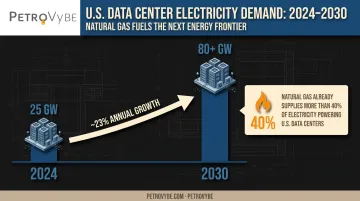
Then there's the AI factor. Data centers are becoming one of the largest new sources of electricity demand in the country. McKinsey projects U.S. data-center power demand will jump from roughly 25 GW in 2024 to more than 80 GW by 2030, a growth rate near 23% annually. This growth pushes data centers to 11-12% of total U.S. power demand within five years.
Natural gas is filling much of that gap. The IEA reports gas already supplies more than 40% of the electricity powering U.S. data centers, and it's projected to remain the largest source of additional supply through 2030. It's a bridge fuel with a very long bridge.
Portfolio Diversification Beyond Stocks, Bonds, and Real Estate
Beyond the AI-driven demand story, oil and gas offers a second case for investment: real diversification. Most portfolios are stacked with paper assets that move together. Stocks fall, bonds often follow. Energy and commodities have historically behaved differently.
Separate Goldman Sachs analysis found that in every historical 12-month period where stocks and bonds both delivered negative real returns, either commodities or gold produced a positive one. That's not a guarantee for any single well or partnership, but it's a strong argument for adding an asset class that doesn't march in lockstep with your 401(k).
Tangible Asset Ownership and Passive Income Potential
Direct oil and gas participation puts you in ownership of a physical, income-producing asset, not a claim on future earnings that trades on sentiment. Producing wells generate cash distributions tied to actual output and commodity prices, not quarterly earnings calls.
Long-term supply backs this up. The EIA estimates roughly 3,359 Tcf of technically recoverable U.S. dry natural gas as of early 2022, which pencils out to about 86 years of supply at current production rates. This domestic resource base is built to outlast most investment horizons.
Ways to Invest in Oil and Gas: Comparing Your Options
Oil and gas investments fall on a spectrum. On one end sits public markets: liquid, familiar, but disconnected from the tax advantages that make this sector unique. On the other end sits direct participation: less liquid, but with far more control and tax advantages.
| Investment Type | Liquidity | Tax Benefits | Typical Minimum |
|---|---|---|---|
| Stocks / ETFs | High | Minimal | Any amount |
| Royalty interests | Low | Limited | Varies |
| Working interests | Very low | Substantial (IDCs) | $50,000+ |
| Development partnerships | Very low | Substantial (IDCs + depletion) | $100,000+ |
Indirect Investments: Stocks, ETFs, and Mutual Funds
Buying shares in an E&P company or an energy-sector fund is the easiest on-ramp. You get liquidity and diversification across many operators, with no accreditation requirements or minimum investment to clear. The tradeoff: your returns correlate closely with broader market swings, and there's no direct tax benefit tied to drilling activity. This route suits investors who prioritize liquidity over tax efficiency.
Direct Participation: Working Interests, Royalties, and Joint Ventures
This is where the sector gets interesting for tax planning.
- Working interests give you a share of net revenue, but you also carry a proportional share of operating costs. That cost exposure is what unlocks IDC deductions.
- Royalty and mineral interests pay you from gross production revenue with zero cost exposure, but historically come with far fewer tax advantages.
- Modern joint venture and direct participation program (DPP) structures apply tax deductions against active income, unlike older partnerships restricted to passive income only—a critical distinction for high-earning W-2 professionals.
Direct Natural Gas Development Partnerships
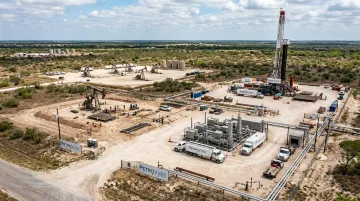
PetroVybe gives accredited investors direct entry into early-stage natural gas and NGL development projects in proven basins, including South Texas and the Gulf Coast. These partnerships pair operational and geological expertise with tax-advantaged structures built for long-term wealth, rather than short-term speculation. PetroVybe's approach centers on a proven basin in Lavaca County, combining roughly 400 acquired producing wells with 57+ planned new wells, backed by third-party engineering validation.
Accredited Investor Requirements and Minimum Investment Amounts
Direct participation offerings are restricted to accredited investors under SEC rules. You qualify through either:
- Income test: Over $200,000 individually (or $300,000 jointly with a spouse) in each of the past two years, with a reasonable expectation of the same this year.
- Net worth test: Over $1 million, excluding your primary residence.
Minimum investments for direct programs commonly run from $50,000 to $100,000 or more. That threshold reflects the higher-risk, higher-reward structure of the asset class, and it's why these offerings target investors who can absorb illiquidity and volatility without disrupting their financial plan.
Tax Benefits That Set Oil and Gas Apart
No other widely available asset class offers this combination of upfront deductions and ongoing income shelter.
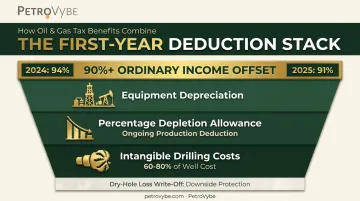
Intangible Drilling Costs (IDCs) cover the labor, fuel, chemicals, and site preparation involved in drilling a well. These costs have no salvage value, and the IRS allows taxpayers to elect to deduct them in the year incurred rather than capitalizing them.
Across PetroVybe's projects, IDCs have typically represented 60-80% of a well's upfront capital cost, meaning a large chunk of your investment can generate a deduction in year one.
Here's the part that surprises most investors: this deduction isn't limited to passive income. Under the working interest exception in IRC Section 469(c)(3), a working interest held without limited liability is treated as non-passive, which means the deduction can offset active income, including W-2 wages and capital gains.
That's a distinctly different tax posture than most real estate deductions, which are generally boxed into passive income unless you qualify as a real estate professional.
Beyond the initial write-off, the Percentage Depletion Allowance provides an ongoing deduction against production income, compensating for the fact that every well's output declines over time. It's the sector's answer to depreciation.
PetroVybe's own results illustrate how this plays out in practice:
| Year | Total Tax Deduction Against Ordinary Income |
|---|---|
| 2024 | 94% |
| 2025 | 91% |
Those numbers combine IDCs, depletion, and depreciation into a single first-year outcome. And there's a downside cushion built in: if a well turns out to be a dry hole, the invested capital can typically be written off as a loss, softening the blow of exploration failure.
Understanding the Risks Before You Invest
No credible guide skips this part. Oil and gas carries real risk, and pretending otherwise does investors a disservice.
Commodity price volatility is the most visible risk, and 2025 pricing shows the swing:
- Cushing WTI crude averaged $57.97 to $75.74 per barrel
- Henry Hub natural gas ranged $2.91 to $4.26 per MMBtu
Geopolitical events, OPEC decisions, and shifting supply drive these numbers, and partnership economics move with them. Geology introduces its own layer of risk.
Geological and production risk varies by well type:
- Development wells are drilled near proven reserves and carry historically higher success rates.
- Exploratory wells carry meaningfully higher dry hole risk.
- Every well, successful or not, follows a natural production decline curve over its life.
Geology sets the stage, but the operator running the project determines whether that potential turns into profit.
Operator dependence is often underrated. Your returns hinge on the operator's track record, financial discipline, and how honestly they report results. A great basin with a mediocre operator is still a mediocre investment.
Illiquidity rounds out the list. Direct oil and gas investments typically lock up capital for 5-15+ years with no public exchange for resale. Only commit money you won't need on short notice.
How to Choose the Right Operator and Get Started
Due diligence separates a good investment from a costly mistake. Before writing a check, confirm:
- Verified track record and well success rate — ask for actual numbers, not marketing language.
- Independent third-party engineering review of reserves, not just internal projections.
- Transparent investor reporting on production, costs, and distributions.
- Fee structures tied to performance, not front-loaded regardless of outcome.
Technical leadership matters more than most investors realize. An operator with a Chief Geophysicist who has decades of experience and a well success rate above industry averages improves the odds of a commercially viable project.
PetroVybe's Chief Geophysicist, Michael Stamatedes, brings a 48-year track record with a career hit rate of 75.2%, against a peer average below 40%. That gap compounds across dozens of wells.
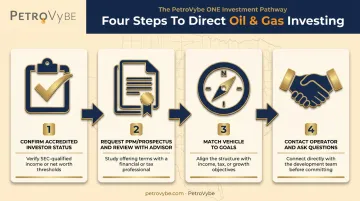
Once you're confident in an operator's technical credentials and transparency, here's how to move forward:
- Confirm your accredited investor status using the income or net worth test.
- Request the PPM or prospectus and review it with a tax and legal advisor before committing.
- Match the vehicle to your goals: liquidity needs, tax situation, and risk tolerance all point toward different structures.
- Contact the operator directly to review current offerings and ask hard questions about past performance.
Frequently Asked Questions
What is the best way to invest in oil and gas?
It depends on your goals. Public stocks and funds offer liquidity, while direct participation in working interests suits accredited investors seeking tax deductions and higher return potential.
Is oil and gas a good investment now?
Rising AI-driven electricity demand and natural gas's role as a near-term bridge fuel support a favorable long-term case, though commodity price volatility remains a real factor to plan around.
How much money do you need to invest in oil and gas?
Direct participation programs typically require accredited investor status with minimums between $50,000 and $100,000 or more. Public stocks and ETFs require far smaller amounts of capital.
What tax benefits are available for oil and gas investors?
The two primary benefits are Intangible Drilling Cost deductions, often 60-80% of well costs and deductible against active income, and the Percentage Depletion Allowance on ongoing production income.
Who qualifies as an accredited investor for oil and gas deals?
Accredited investor status requires meeting an income test ($200,000 individual or $300,000 joint income for two years) or a net worth test (over $1 million, excluding primary residence).
What are the biggest risks of investing in oil and gas?
Commodity price volatility, geological and dry hole risk, operator dependence, and illiquidity are the primary risk categories to evaluate before committing capital.