
Interest in this corner of investing is climbing fast. Investors tired of stock market swings are looking at alternatives, and energy royalties in particular are getting fresh attention as AI data centers push electricity demand higher. The International Energy Agency projects more than 130 TWh of additional gas-fired generation will be needed for U.S. data centers by 2030 alone.
Outcomes here vary widely — by royalty type, by the vehicle you choose, and by how much homework you do first. This guide walks through the categories available, a step-by-step process for getting started, what actually drives returns, common mistakes, and how the major investment vehicles stack up against each other.
Key Takeaways
- Royalty income is largely passive and tends not to move in lockstep with stocks or bonds.
- Three main access points exist: publicly traded trusts, online marketplaces, and private placements.
- Returns and risk differ sharply across energy, intellectual property, and business-financing royalties.
- Royalty income is usually taxed as ordinary income, though depletion allowances and IDC deductions can lower that burden.
- Confirming legal ownership before you buy matters more than any other single step you'll take.
What Is Royalty Income? Types of Royalty Investments
A royalty is a payment made to an asset's owner in exchange for another party's right to use that asset. The terms (how much, how often, for how long) get set in a licensing or lease agreement, and they vary enormously depending on what's being licensed.
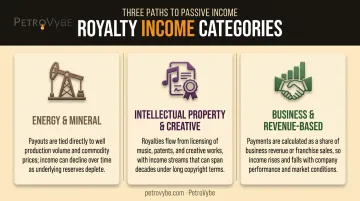
Energy & Mineral Royalties
Landowners and investors can hold a right to a percentage of the value of oil, gas, or minerals pulled from a specific property. There's no single, defensible "typical yield" for oil and gas royalties: payouts depend on production volume, decline rate, commodity prices, and the terms of the underlying lease. Recent mineral acquisitions illustrate the scale involved. Viper Energy paid roughly $1.05 billion for about 32,000 net royalty acres in the Permian Basin in 2023. It then closed a $461 million deal for over 3,700 additional net royalty acres in 2024.
Intellectual Property & Creative Royalties
Music, books, patents, and trademarks all throw off royalties every time they're streamed, performed, licensed, or sold. Global recorded-music revenue hit $29.6 billion in 2024, its tenth straight year of growth, according to IFPI's Global Music Report. Copyright terms run long, generally the life of the author plus 70 years, or 95 years from publication for works made for hire. That length means a single successful catalog can pay out for decades.
Business & Revenue-Based Royalties
Startups and small businesses increasingly use revenue-based financing (RBF) as an alternative to giving up equity. Instead of selling shares, they pay investors a fixed percentage of monthly revenue until a set repayment cap is reached. Payments rise and fall with the business's top line, which makes this category more volatile than an established royalty stream but often faster to deploy.
How to Invest in Royalty Income: Step-by-Step
Step 1: Define Your Goals, Risk Tolerance, and Investor Status
Before picking a category, get clear on what you actually need. Are you after steady monthly cash flow, a tax offset against W-2 income, or long-term appreciation? Each answer points toward a different type of royalty.
Check your accreditation status early, since many of the higher-yielding private and direct royalty deals are restricted. The SEC's accredited investor thresholds require:
- Net worth over $1 million, excluding your primary residence, or
- Income over $200,000 individually (or $300,000 jointly) in each of the past two years, or
- Holding a Series 7, 65, or 82 license in good standing
Step 2: Choose a Royalty Category That Matches Your Expertise
Start with a category you actually understand rather than chasing whatever's trending. If you've spent years in music publishing, catalog royalties will make more sense to you than an oil lease ever will, and vice versa.
Each category has its own value driver:
- Energy: depletion timeline and reserve quality
- Music/IP: copyright term length and streaming trends
- Business financing: revenue stability and customer concentration
Step 3: Select Your Investment Vehicle
Three main paths exist, each with a different risk-liquidity tradeoff:
- Publicly traded royalty trusts: bought like stocks through any brokerage account
- Online marketplaces: auction-style bidding on individual music, patent, or energy royalty streams
- Direct/private placements: accredited-investor partnerships in development-stage projects
Direct placements sit at a different point in the value chain entirely. Rather than buying an already-producing royalty stream, you're entering at the point where the asset is being built. Firms like PetroVybe structure natural gas development projects this way, pairing direct equity participation with intangible drilling cost (IDC) deductions that can offset active income. This tax benefit isn't typically available to royalty trust or marketplace investors.
Step 4: Conduct Due Diligence, Diversify, and Monitor
Verify legal ownership before you commit a dollar. For energy deals specifically, that means:
- Checking the operator's license with the relevant state regulator (in Texas, that's the Railroad Commission's public database)
- Cross-referencing API well numbers against the project's stated location
- Reviewing third-party engineering or reserve valuation reports where available
Then diversify. Don't let a single royalty stream, well, or catalog make up too much of your portfolio, and keep revisiting new opportunities as your capital and goals evolve.
Key Factors That Affect Royalty Investment Returns
A handful of variables, some you can control, some you can't, determine whether a royalty investment actually delivers.
Underlying Asset Quality & Depletion Rate Reserve quality or catalog strength determines how long and how much income a royalty produces. Well-selection track record matters enormously here: industry-wide, roughly 90.8% of drilled wells reach productive status, but success at the individual-operator level varies widely based on geological expertise. Higher-quality assets sustain payouts longer and delay the eventual decline that every depleting asset faces.
Commodity Price & Market Demand Volatility Energy prices and shifts in streaming behavior directly affect payout size. Henry Hub natural gas prices rose 56% in 2025 versus the 2024 average, a swing that shows how quickly cash flow can move based on conditions entirely outside your control.
Contract Structure & Duration Whether a deal pays a flat fee, a percentage of revenue, or a unit-based rate changes the entire income profile. Shorter or capped agreements limit long-term upside compared with open-ended royalty structures.
Tax Treatment & Available Deductions Most royalty income gets taxed as ordinary income. Oil and gas investors, however, can access percentage depletion allowances and IDC deductions that offset active income, a meaningfully different outcome than what a typical royalty trust investor sees.
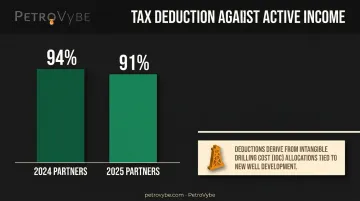
PetroVybe's 2024 and 2025 partners, for example, received tax deductions of 94% and 91% against active income, respectively, derived from IDC costs tied to new well development. That's real, delivered data, not a projection, and it materially changes after-tax returns compared with categories that lack similar deductions.
Risks and Common Mistakes to Avoid
Royalty investing has real upside, but it also has a handful of well-worn ways to lose money:
- Valuation risk: overpaying for a royalty because of hype around a song, patent, or well rather than its actual cash-flow math
- Counterparty/legal ownership risk: failing to confirm the seller genuinely holds the rights they're selling, before money changes hands
- Concentration mistakes: putting too much capital into a single stream, or ignoring the depletion and expiration timelines that will eventually push payouts toward zero
None of these risks are exotic. They're the same due-diligence gaps behind fraud cases and disappointing deals across every royalty category, from music catalogs to mineral rights. Verify ownership, model the decline curve, and price the risk before you commit capital.
Comparing Royalty Investment Vehicles: Trusts vs. Marketplaces vs. Direct Private Placement
| Vehicle | Liquidity | Tax Treatment | Control | Best For |
|---|---|---|---|---|
| Royalty Trusts | High (trades like a stock) | Pass-through, ordinary income | None — fixed asset base | Investors wanting easy entry/exit |
| Online Marketplaces | Low-to-moderate, thin resale | Ordinary royalty income baseline | None over the asset | Smaller capital, single-stream exposure |
| Direct Private Placement | Low, multi-year hold | IDC deductions against active income | None over daily operations, but earlier entry point | Accredited investors seeking tax efficiency |
Royalty Trusts
Trusts trade on public exchanges, offer easy liquidity, and pass through income without entity-level tax. The catch: they have a fixed lifespan, can't raise new capital once established, and the underlying wells or leases will eventually deplete. You're buying into a shrinking asset base from day one.
Online Marketplaces & Exchanges
These platforms let you bid on fractional interests in music, oil and gas, or patent royalties, often for a few thousand dollars. That lowers the entry barrier considerably. What you give up is any operational influence: you're a passive check-collector with no say in how the underlying asset is managed, and secondary-market liquidity is often thin.
Direct Private Placement in Energy Development
Accredited investors can invest directly in development-stage natural gas projects, capturing value at the point it's created rather than paying a premium for an already-established royalty stream.
PetroVybe structures its flagship project this way, with a minimum $100,000 commitment into LLC partnership equity. The deal includes:
- 58,000-acre south-central Texas basin position
- Roughly 400 acquired wells plus 57-plus planned new wells
- $48 million third-party engineered PV-09 reserve valuation
- Clean 2025 independent audit
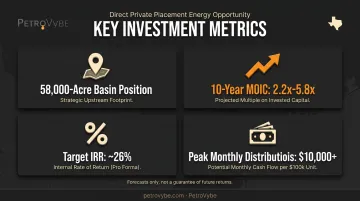
The firm targets a 10-year MOIC of roughly 2.2x to 5.8x and an IRR near 26%, with monthly distributions projected to peak above $10,000 during production. These are forecasts, not guarantees: actual results depend on commodity pricing, drilling outcomes, and operating costs.
What makes this structure distinct from a trust or marketplace deal is the combination of substantial Year 1 IDC deductions against active income and a position entered before the royalty stream even exists.
Frequently Asked Questions
How do you invest in royalty income?
You can buy shares of publicly traded royalty trusts through a brokerage, bid on individual royalty streams through an online marketplace, or invest directly in a private development project if you're an accredited investor.
Is buying royalties a good investment?
Royalties can offer steady, diversified passive income with attractive yields, but returns depend heavily on asset quality, the vehicle you choose, and how thoroughly you vet the deal before committing capital.
How are royalty payments taxed?
Most royalty income is taxed as ordinary income at your marginal rate. Selling a royalty interest outright, claiming depletion allowances, or using IDC deductions can shift that tax treatment considerably.
What is the difference between a royalty trust and a direct royalty/working interest investment?
Trusts are publicly traded, passive, and finite-lived. Direct placements give accredited investors entry into development-stage projects, typically with different tax treatment (including active-income deductions) and no public trading market.
How much money do you need to start investing in royalties?
Marketplace deals can start in the low thousands. Direct private placements in development projects, like PetroVybe's, require accredited investor status and typically a minimum around $100,000.
Is royalty income considered passive income?
The IRS treats royalty income as passive, but taxes it at ordinary rates rather than capital gains rates. IDC deductions from working-interest investments are an exception, since they can offset active income.