
This article is general education, not investment, tax, or legal advice. Whether the IRS treats your investment income or loss as "passive" or "active" can decide whether you save thousands on your tax bill or get stuck with a deduction you can't use for years. Many investors don't discover this distinction until tax season, when a promising K-1 loss turns out to be locked away by IRC Section 469.
This isn't a minor technicality. It affects whether losses offset your W-2 wages, how much of your tax bracket exposure you can manage, and whether high-income earners can meaningfully reduce their active income tax burden through investing.
This guide breaks down the IRS material participation rules, the seven tests that determine your classification, and how special exceptions (like those for oil and gas working interests) change the equation entirely.
Key Takeaways
- Passive losses only offset passive income; excess amounts get suspended and carried forward under IRC Section 469
- Seven IRS tests determine material participation—meet just one to qualify as active
- Oil and gas working interests allow active-income deductions regardless of participation level (statutory exception)
- Document hours and involvement when claiming material participation through the standard tests
Passive vs Active Participation: Quick Comparison
| Factor | Passive | Active/Material |
|---|---|---|
| Tax Treatment | Losses limited to passive income; excess suspended and carried forward | Losses may offset wages, business income, and capital gains |
| Involvement Required | Minimal or no day-to-day involvement | Regular, continuous, substantial involvement (or a qualifying exception) |
| Common Examples | Rental real estate, limited partnership interests, silent LLC ownership | Owner-operated businesses, real estate professionals, certain working interests |
| IRS Test Basis | Fails all seven material participation tests | Meets at least one of the seven tests |
| Investor Impact | Predictable income, restricted deductions | Greater tax leverage, requires proof or a qualifying structure |
What Is Passive Participation?
Passive participation means you're involved in an activity that isn't regular, continuous, or substantial. Think of it as an investor role: you review statements, you might monitor performance, but you're not managing day-to-day operations.
The core impact: Under IRC Section 469, passive losses can only offset passive income. If your passive losses exceed your passive income, the excess doesn't disappear.
It gets suspended and carried forward indefinitely until you have passive income to absorb it, or until you dispose of the entire interest in a fully taxable transaction.
Limited partners are treated as passive by default. You only escape that default if you meet one of three narrow paths:
- The hourly safe-harbor test
- Historical participation in five of the prior ten years
- The personal-service activity test
Where This Shows Up Most
Passive classification is the norm in:
- Rental real estate held by non-professionals
- Real estate syndications
- Limited partnership investment structures
- Silent LLC ownership positions
Consider an accredited investor who wires capital into a fund but never touches the operational side. That's a classic passive role—and the loss-offset limits apply in full.
Suspended passive losses aren't rare. IRS Statistics of Income data from 2015 showed $82.3 billion in prior-year unallowed rental real estate losses and another $86.6 billion in unallowed losses from all other passive activities, reported across 2015 IRS SOI individual returns. That's a lot of capital sitting in tax limbo, waiting for future passive income to unlock it.
What Is Active/Material Participation?
Material participation means your involvement is regular, continuous, and substantial, as defined under IRC Section 469(h). To claim it, you need to satisfy at least one of seven IRS tests.
The Seven Material Participation Tests
Under Treasury Regulation 1.469-5T, meeting any single test qualifies you:
- More than 500 hours of participation during the tax year
- Substantially all participation in the activity comes from you
- More than 100 hours, with no one else participating more than you
- Significant participation activities aggregating more than 500 hours across multiple businesses
- Material participation in five of the prior ten years (consecutive or not)
- Three prior years of participation in a personal-service activity
- Facts and circumstances showing regular, continuous, substantial involvement (fails automatically at 100 hours or less)
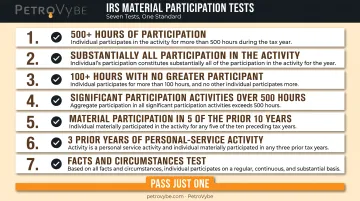
You only need to pass one test. Limited partners are generally restricted to tests 1, 5, and 6.
When you materially participate, losses can offset ordinary income—including W-2 wages and capital gains—not just passive income from similar activities.
The Oil and Gas Exception
IRC Section 469(c)(3) creates a statutory exception for investors who will not meet the hour tests: a working interest in an oil or gas property is not treated as passive, regardless of material participation, if you hold it directly or through an entity that does not limit your liability.
Congress built this rule to encourage domestic energy development. Qualifying working-interest income and losses can offset active income such as W-2 wages and capital gains without day-to-day operational involvement.
PetroVybe's natural gas development structure is built on this framework, so partners can apply first-year Intangible Drilling Cost (IDC) deductions against active income—something standard passive real estate or brokerage investments do not offer. This treatment requires the investor to elect general partner status in the Subscription Agreement and may be limited in a given year by the excess business loss limitation under IRC §461(l).
Where Active/Material Participation Shows Up
- Owner-operators running their own trade or business
- Real estate professionals who meet the material participation hours
- Direct working-interest holders in oil and gas drilling programs (via the statutory exception)
- Partners in personal-service firms who meet the multi-year tests
Passive vs Active: Which Matters More for Your Tax Strategy?
The right classification depends on three questions:
- What's your income mix? Heavy W-2 or capital gains exposure means you likely need losses that can offset active income, not sit behind passive limits.
- How much time can you realistically commit? Material participation through the standard tests requires documented hours.
- Does the investment vehicle itself carry a statutory exception? Some structures—including certain oil and gas working interests—bypass the usual passive-loss limits by statute. This treatment requires the investor to elect general partner status in the Subscription Agreement and may be limited in a given year by the excess business loss limitation under IRC §461(l).
If you're a high-income W-2 earner looking to offset salary or bonus income, chasing the standard material participation tests is a heavy lift. Look instead for structures with built-in exceptions, such as IDC-eligible working interests, that can offset active income without meeting the hour tests. This treatment requires the investor to elect general partner status in the Subscription Agreement and may be limited in a given year by the excess business loss limitation under IRC §461(l).
If you're simply diversifying and don't need active-income offsets, a passive-classified asset with loss limitations can be the right fit. Not every investor needs to fight for active treatment.
Real-World Example: Turning Passive Capital into Active Tax Savings
Picture a high-income earner: a physician, a tech executive, or a business owner pulling in $400,000+ in W-2 wages plus capital gains from a stock portfolio. Taxes are eating a significant chunk of that income every year.
The problem: most traditional passive investments don't help. Rental property losses and stock fund losses only offset passive income. If this investor has little or no other passive income, those losses just sit there, suspended, doing nothing against the salary or bonus income that's actually driving the tax bill.
The shift: this is where a working-interest structure changes the math. A natural gas development partnership structured to pass through IDC deductions against active income operates under a completely different rule set than passive real estate. This treatment requires the investor to elect general partner status in the Subscription Agreement and may be limited in a given year by the excess business loss limitation under IRC §461(l).
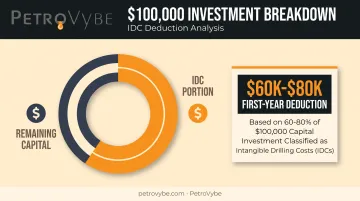
PetroVybe's model targets roughly a 70% first-year deduction, with total deductions potentially reaching up to 100% over time. On a $100,000 investment (one unit; participation begins at one unit of $100,000, with add-on subscriptions from $25,000), the first-year math often looks like this:
- IDCs typically represent a first-year deduction target of approximately 70–80% of invested capital of invested capital in new-drilling projects
- That can mean $60,000–$80,000 in first-year IDC deductions
- Those deductions can apply against active income, not only passive income. This treatment requires the investor to elect general partner status in the Subscription Agreement and may be limited in a given year by the excess business loss limitation under IRC §461(l).
Documented partner results support the structure: a 94% deduction against active income in 2025. Prior result; not a promise of any future deduction. Those figures are results, not projections—though future performance still depends on execution and individual eligibility.
The takeaway: the investment vehicle's structure matters just as much as your personal participation level. A hands-off passive investor can still access active-income tax treatment if the underlying asset carries the right statutory exception.
For accredited investors comparing options that pair passive involvement with active-income deductions, review how PetroVybe's development partnerships are structured for near-term deductions and long-term asset growth.
Conclusion
"Passive" and "active" aren't casual descriptions of how much effort you put in. They're formal IRS classifications with real, dollar-and-cents consequences for how your losses and income get taxed.
The right approach depends on your income profile, how much time you can dedicate, and whether the investment itself carries a special tax structure.
For high-income earners and wealth builders, getting this distinction right can open deductions that cut your tax bill—while still keeping the hands-off, passive experience you want. Match the participation rules and the investment structure to your goals before you commit capital.
Frequently Asked Questions
What is the difference between active and passive participation?
Active participation means regular, continuous, substantial involvement that meets an IRS material participation test. Passive participation is investor-only involvement with no material engagement, which limits how losses can be deducted.
What are passive participants?
Passive participants are investors who contribute capital but don't manage operations or make regular decisions. Limited partners and silent LLC members typically fall into this category by default.
What are the three types of community participation?
This question often comes from nonprofit or civic contexts (informing, consulting, empowering/collaborating). In the tax context this article covers, the relevant framework is the IRS's material participation classifications, not civic engagement models.
What is an example of active participation?
An LLC member spending more than 500 hours a year managing operations qualifies. So does a working-interest holder directly involved in drilling decisions, or someone who meets any one of the seven material participation tests.
Can passive investors still get tax deductions?
Yes, in specific cases. While standard passive losses are limited to passive income, oil and gas working interests carry a statutory exception allowing IDC deductions against active income regardless of participation level. This treatment requires the investor to elect general partner status in the Subscription Agreement and may be limited in a given year by the excess business loss limitation under IRC §461(l).
How do I prove my level of participation to the IRS?
Keep contemporaneous logs, calendars, or narrative summaries documenting hours worked and tasks performed. The IRS accepts "any reasonable means" of substantiation, but reconstructed records after an audit notice rarely hold up.
Informational requests only. PetroVybe projects are offered solely to verified accredited investors. Submitting this form does not create an investment or advisory relationship.