That question matters more now than it did five years ago. Tax law shifted again in 2025, inflation concerns haven't fully faded, and AI-driven data centers are quietly reshaping natural gas demand. This article breaks oil investing into three practical lanes: direct ownership, indirect market exposure, and diverse derivative instruments, then walks through how to pick the one that actually fits your situation.
Key Takeaways
- Oil investing spans direct ownership, indirect funds/stocks, and derivatives like futures and MLPs.
- Each path carries distinct risk, liquidity, and tax tradeoffs; none is universally best.
- Direct private development deals offer some of the largest tax advantages for accredited investors.
- Your capital, timeline, and tax exposure should drive the decision, not whichever option is trending.
What Is Oil Investing and Why It Matters
Oil investing simply means putting capital into an asset whose value or income is tied to crude oil, natural gas, or the infrastructure that moves them. That could be a stock, a futures contract, or a direct stake in a producing well.
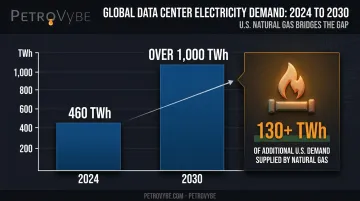
Oil still runs transportation and manufacturing, but its newest growth driver is electricity. The International Energy Agency projects global data-center electricity consumption will jump from 460 TWh in 2024 to more than 1,000 TWh by 2030, and natural gas is expected to supply more than 130 TWh of that additional U.S. demand.
That's a documented demand shift, not a promise of higher oil prices. Still, it explains why natural gas has become a talking point in energy portfolios again.
Without understanding the different investment types, investors tend to make one of a few common mistakes:
- Over-concentrating in high-volatility instruments they don't fully understand
- Missing more tax-efficient, long-term wealth-building routes entirely
- Overlooking how direct, indirect, and diversified structures carry very different risk and tax profiles
Neither is a great outcome. The next section breaks down exactly what separates them.
Types of Oil Investment: Direct, Indirect, and Diverse
Oil investing isn't one-size-fits-all. The three broad categories differ by ownership structure, liquidity, and tax treatment, and mixing them up can cost you real money at tax time. Here's a quick snapshot before we go deeper:
| Category | Ownership Type | Liquidity | Tax Treatment |
|---|---|---|---|
| Direct | Working interest in a well | Illiquid, multi-year hold | IDC deductions, nonpassive treatment possible |
| Indirect | Public stock/ETF shares | Highly liquid | Standard 1099/capital gains |
| Diverse | Futures, options, ETNs, MLPs | Liquid but complex | Section 1256 gains or K-1 reporting |
Direct Investment (Private Working Interests & Development Partnerships)
Direct investment means buying an actual ownership stake, called a working interest, in an oil and gas development project, usually through a private operator rather than a public security. Your capital funds drilling and development costs directly. In exchange, you receive a share of production revenue and access to tax deductions tied to the well itself.
This looks nothing like owning a stock. There's no ticker symbol, no daily price quote, and no market sentiment swinging your position. Your outcome is tied to well performance, intangible drilling cost (IDC) deductions, and the operator's geological expertise.
Who it's built for:
- Accredited investors meeting SEC Regulation D thresholds: $1 million+ net worth (excluding primary residence), or $200,000+ individual/$300,000+ joint income for two consecutive years
- High-income W-2 earners or those with capital gains who want to offset active income
- Long-term wealth builders comfortable holding an illiquid position for years
The IRS allows taxpayers to elect current-year deductions for domestic intangible drilling costs under IRC 263(c), rather than capitalizing them over time. Depending on the well and the operator, that can mean a substantial first-year deduction against active income, a deduction almost no public market oil investment offers.
Trade-offs to weigh:
- No secondary market. The SEC's own investor bulletin warns that private oil and gas offerings may need to be held indefinitely.
- Requires accreditation and third-party verification of that status.
- Returns depend heavily on operator track record and underlying geology, not broad market sentiment.
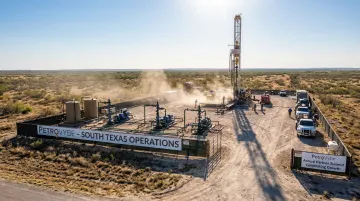
This is the space where a company like PetroVybe operates. PetroVybe offers accredited investors direct participation in natural gas and NGL development across Lavaca County and the broader South Texas/Gulf Coast Basin, backed by roughly 400 acquired wells, third-party engineered reserves valued near $48 million (PV-09), and a clean 2025 independent audit.
Partners who joined in 2024 and 2025 saw first-year tax deductions of 94% and 91% respectively against active income, a concrete example of what IDC deductions can look like in practice. Individual results vary by project and tax situation.
Indirect Investment (Oil Stocks, ETFs, and Mutual Funds)
Indirect investment means buying shares of publicly traded oil companies, or funds that hold a basket of energy equities. You purchase through a standard brokerage account, and your return depends on company earnings or how closely a fund tracks an energy index.
This is the most accessible route into oil exposure. It's exchange-traded, diversified across multiple companies, and doesn't tie your outcome to a single project's output.
Best suited for:
- Beginner-to-intermediate investors who want oil exposure without large capital commitments
- Anyone prioritizing liquidity over tax efficiency
Strengths:
- Low minimums — many energy ETFs trade under $100 per share
- Instant diversification across dozens of producers
- Simple to buy and sell during market hours
- Professionally managed portfolios
Limitations:
- Correlated with broader stock market swings, not just oil prices
- Ongoing management fees erode returns over time
- No tax-shelter benefit — gains are taxed as standard capital gains
- Company-specific risk (bad management, debt, unrelated business lines) can dilute your pure oil exposure
Diverse Exposure (Futures, Options, ETNs, and MLPs)
This category covers derivative and structured instruments: futures and options contracts, exchange-traded notes, and midstream master limited partnerships (MLPs). Futures and options let traders speculate on or hedge future oil prices. MLPs pass through midstream infrastructure income (pipelines, storage, processing) directly to unit holders.
Unlike stocks, these instruments offer pure price exposure or leveraged structures rather than equity ownership or a physical production interest.
Best suited for:
- Experienced traders comfortable with leverage and margin calls
- Income-focused investors willing to navigate MLP tax complexity
Key risks worth understanding:
- Standard NYMEX WTI futures cover 1,000 barrels per contract, with margin requirements at just 3%–12% of contract value, meaning percentage swings in your capital can dwarf the actual oil price move.
- Contango erodes fund performance over time. In April 2020, the expiring NYMEX WTI contract fell from $17.73 to negative $37.63 per barrel, showing how sharply futures-based products can diverge from spot oil.
- MLPs issue Schedule K-1 forms instead of the standard 1099, adding complexity at tax time and sometimes delaying filing.
How to Choose the Right Type of Oil Investment
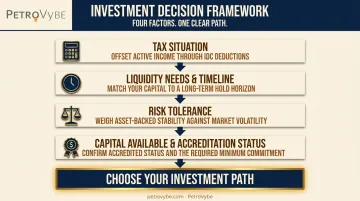
The right choice depends on your circumstances — not on what's trending in your investing group chat. Run through these four factors before committing capital:
- Tax situation. Are you actively trying to offset W-2 income or capital gains? Direct working interests offer deduction mechanisms public securities simply can't match.
- Liquidity needs and timeline. Need access to your capital in months, not years? Public markets fit better than a multi-year private hold.
- Risk tolerance. Comfortable with leverage, margin calls, and illiquidity? Or do you need something you can exit on a Tuesday afternoon?
- Capital available and accreditation status. Private direct deals typically require six-figure minimums and verified accredited investor status.
If you're prioritizing long-term passive income, tax efficiency, and tangible asset ownership, consider evaluating direct development partnerships like PetroVybe ONE. You'll need to meet accredited investor requirements and commit capital for a multi-year hold.
Mistakes to Avoid Before Finalizing Your Oil Investment
A few recurring errors trip up otherwise smart investors:
- Chasing the highest-risk instrument: leveraged futures can amplify gains, but margin calls and contango can just as easily amplify losses, so understand the mechanics before you trade.
- Overlooking illiquidity and due diligence in private deals: ask about operator track record, third-party reserve validation, and audit history before wiring six figures into a working interest.
- Ignoring tax treatment differences: MLP K-1 complexity, IDC deductions, and standard ETF capital gains represent three distinct tax situations, and confusing them at filing time is a common, costly mistake.
Conclusion
Oil investing spans direct ownership, indirect market instruments, and diverse derivative or income vehicles, and each comes with its own risk-reward and tax profile. Matching the vehicle to your goals, liquidity needs, and tax situation (rather than chasing whatever's popular) tends to produce better long-term outcomes.
For accredited investors focused on tax efficiency and legacy wealth building, direct development partnerships warrant a real place alongside traditional stocks and funds in the portfolio conversation.
Frequently Asked Questions
Where is the best place to invest in oil?
It depends on your goals. Liquid public markets like stocks and ETFs suit beginners who want simplicity, while direct private development partnerships suit accredited investors seeking tax efficiency and passive income.
Is investing in oil stocks safer than futures?
Yes, in most cases. Stocks and ETFs are diversified and unleveraged, while futures carry margin requirements and can move sharply against you due to leverage and contract expiration mechanics.
Can I invest directly in an oil well?
Accredited investors can participate through private working-interest offerings from operators like PetroVybe, gaining direct exposure to production and associated intangible drilling cost (IDC) tax benefits.
What are the tax benefits of investing in oil and gas?
Direct participation can allow significant first-year deductions against active income through intangible drilling costs, unlike most public market oil investments, which offer standard capital gains treatment only.
How much money do I need to start investing in oil?
Public options like ETFs can start under $100. Direct private development deals typically require accredited investor status and a six-figure minimum commitment.
Is oil a good hedge against inflation?
Oil and natural gas have historically tracked rising costs of goods, making production assets and energy equities a potential inflation hedge, though price volatility remains a real factor to plan around.