The distinction affects executive control, cost exposure, tax treatment, and what happens when the asset passes to heirs. Mineral ownership in Texas is frequently severed from surface ownership, sometimes going back several generations, according to Texas A&M AgriLife's research on determining mineral ownership. Wyoming alone reports 11.6 million acres of split-estate federal minerals beneath private surface land, a useful proxy for how widespread severed and fractionated ownership has become across producing states.
If you've inherited a fraction of an estate or you're reviewing an old family deed, this guide breaks down exactly what each interest means and what to do next.
Key Takeaways
- Mineral interest includes resource ownership plus leasing, bonus, and royalty rights.
- Royalty interest pays only a revenue share, with no executive or leasing rights.
- Mineral owners hold the "dominant estate," allowing reasonable surface use to develop the minerals below.
- These interests generally last indefinitely, except an ORRI, which ends when its lease expires.
- Choose mineral rights for control and upside, or royalty rights for hands-off passive income.
Mineral Interest vs Royalty Interest: Quick Comparison
Before covering the definitions, here's the side-by-side breakdown most owners actually need:
| Factor | Mineral Interest | Royalty Interest |
|---|---|---|
| Ownership scope | Real property interest in the minerals themselves | No mineral ownership — just a right to share in production revenue |
| Executive/leasing rights | Can negotiate and sign leases, set bonus terms | No authority to negotiate leases or set terms |
| Cost bearing | Cost-free unless the owner elects to participate as a working interest | Always free of drilling and operating costs |
| Income sources | Lease bonus, delay rentals, and royalties | Royalty checks only, once a well produces |
| Duration | Typically perpetual, passes like real property | Landowner's royalty and NPRI: usually perpetual. ORRI: ends with the lease |
The core difference comes down to control. A mineral owner decides whether and how a tract gets leased. A royalty owner simply waits to see if production ever begins.
What Is a Mineral Interest?
A mineral interest is a property right created when minerals are severed from the surface estate, whether by grant, reservation, or conveyance. If you inherited land or a deed fraction, this is likely what's involved when family members are managing an oil and gas estate together.
The Rights Bundle That Comes With It
Mineral ownership can include several severable rights, and owners don't always hold every one:
- Development rights: the ability to enter, explore, and produce
- Executive rights: the authority to negotiate and sign a lease
- Bonus rights: payment received when a lease is signed
- Delay rental rights: periodic payments during a lease's primary term before production starts
- Royalty rights: a share of production revenue once a well produces
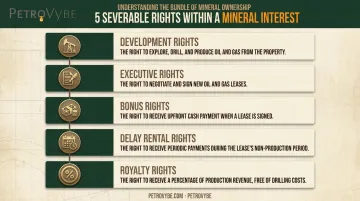
These rights don't always travel together. A non-executive mineral interest (NEMI) holder still owns minerals and may collect royalties and bonuses, but can't sign a lease. Someone else, usually named in the deed, holds that authority instead.
Why It's Called the Dominant Estate
Mineral ownership is described as the "dominant estate" because the owner (or their lessee) can use the surface reasonably to access and produce minerals, without needing the surface owner's permission for every step. For example, a lessee can build access roads, position tanks, or run pipelines across the surface even if the owner objects, as long as the activity stays reasonable and doesn't needlessly damage existing uses.
This doesn't mean unlimited surface control. Operators still must give reasonable regard to existing surface uses when practical alternatives exist. But it does mean mineral rights carry real leverage that royalty interests simply don't.
Fractional Interests and Inheritance
Fractional mineral interests are common after estates split among heirs. Three siblings inheriting equal shares each hold a fractional mineral interest, and each retains the same bundle of rights in their portion unless a specific right (like the executive right) was separately severed.
A real case shows what's at stake. In Manges v. Guerra, one owner held 53.4% of the minerals along with the executive rights over the entire estate; the Guerra family held the remaining 46.6% as non-executive minerals. The executive leased more than 25,900 acres to himself for a nominal $5 total bonus and a 1/8 royalty.
The Texas Supreme Court ruled he owed the non-executive owners "utmost good faith," canceled the lease, and awarded damages. The lesson: royalty-only and non-executive owners depend entirely on someone else's leasing decisions, for better or worse.
Mineral owners remain active today in South Texas and the Gulf Coast Basin, where operators continue negotiating leases tied to new drilling permits and development activity.
What Is a Royalty Interest?
A royalty interest is a revenue-only right, created either through a lease reservation or a standalone royalty deed. It exists free of drilling and operating costs and carries zero executive authority, a tradeoff for its simplicity.
Three Subtypes, Different Lifespans
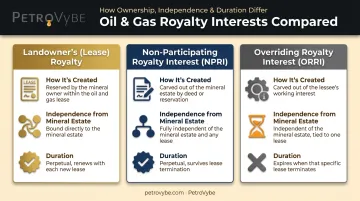
- Landowner's (lease) royalty: reserved by the mineral owner when signing a lease; tied to that specific lease
- Non-participating royalty interest (NPRI): carved out by deed, independent of the mineral estate; usually perpetual
- Overriding royalty interest (ORRI): carved from a lessee's working interest, often assigned to landmen or geologists in lieu of cash fees. Expires when the lease ends.
What Actually Shows Up on the Check
Royalty owners don't pay drilling or lease-operating costs, but post-production costs can still cut into the net check. Gathering, processing, compression, and transportation fees often get deducted, depending on how the lease is worded. A "market value at the well" clause typically permits these deductions, while carefully drafted "no-deduction" or "gross proceeds" language can prevent them.
Texas also imposes production taxes of 4.6% on oil and 7.5% on gas market value, typically remitted by the first purchaser.
Royalty rates vary widely by lease quality and location. According to Texas A&M's petroleum production research, 3/16 (18.75%) became fairly common across Texas and Oklahoma. Rates still range from as low as 1/8 on marginal prospects to as high as 40% in exceptionally productive areas.
Use Cases in Practice
- A landowner who sold mineral rights but reserved an NPRI keeps collecting income indefinitely, with zero leasing responsibility going forward.
- A geologist or landman assigned an ORRI instead of a cash consulting fee gets upside tied to that one lease's production.
- Net royalty shrinks proportionately based on net mineral acres in a drilling unit: a 20-acre owner in a 640-acre unit with an 18.75% lease royalty nets a 0.586% decimal interest.
Mineral Interest vs Royalty Interest: Which Is Better?
There's no universal winner here. The right answer depends on five factors:
- Control: do you want to negotiate leases, or let someone else handle it?
- Risk tolerance: are you comfortable with working-interest cost exposure, or do you want cost-free income only?
- Liquidity needs: do you need cash now, or income over time?
- Tax treatment: mineral sales, lease bonuses, and royalty income are taxed differently
- Estate planning goals: how do you want this asset to pass to the next generation?
A common trigger: a nearby operator files a drilling permit, and suddenly the landowner has to decide fast. Sell mineral rights outright for immediate cash, or retain a royalty interest and bet on future production.
Selling gives certainty. Retaining gives upside if the well performs, but no guarantee it ever gets drilled at all.
A Third Option: Direct Development Participation
Both mineral and royalty ownership are fundamentally passive positions once a lease is signed: you're waiting on someone else's operational decisions.
For accredited investors who want more than that, PetroVybe offers a structurally different path — direct equity participation in natural gas development projects across South Texas and the Gulf Coast Basin, including active operations in Lavaca County.
Instead of a revenue-only royalty stream, PetroVybe partners hold a limited partnership unit tied to the asset itself, participating in the company's PROTECT and SCALE strategy of acquiring legacy production, running workovers, and reinvesting cash flow into new drilling.
That structure comes with tax advantages neither mineral nor royalty ownership typically delivers on its own:
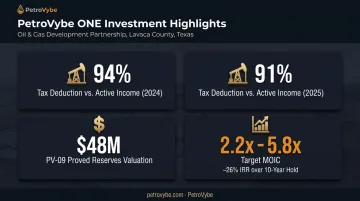
- Partners received a **94% tax deduction against active income** in 2024 and 91% in 2025, driven by Intangible Drilling Cost (IDC) deductions
- Unlike most passive deductions, IDCs can offset W-2 wages and capital gains, not just passive income
- Projects carry a $48 million third-party engineered proved reserves valuation (PV-09)
- Target returns run ~2.2x to 5.8x MOIC with a ~26% IRR over a 10-year hold
This isn't a fit for every landowner: the minimum investment is $100,000 and accreditation is required. But for someone weighing "sell my minerals" against "keep the royalty," a third lane exists: active development exposure with tax efficiency built in.
If passive mineral or royalty ownership feels too limited for your goals, explore PetroVybe's accredited investor opportunities to see how direct participation compares.
Conclusion
There's no single "better" choice between mineral interest and royalty interest. It comes down to whether you value control and long-term upside, or simplicity and cost-free passive income. Before assuming which one you hold, read the actual deed or lease language — don't rely on what a relative told you or what the document is titled.
Getting the classification right affects:
- How you report income for taxes
- How much leverage you have negotiating a future lease or sale
- How the asset should be structured in an estate plan
When in doubt, a title professional or oil and gas attorney can confirm exactly what you own before you make a decision you can't undo.
Frequently Asked Questions
What is the difference between mineral interest and royalty interest?
Mineral interest is ownership of the resource itself, including executive rights to lease and collect bonuses. Royalty interest is only a right to a share of production revenue, with no leasing authority.
Is land worth more with mineral rights?
Land with intact mineral rights typically carries higher value potential because of leasing bonuses and royalty upside, especially in active development areas. Land where minerals were previously severed loses that upside entirely.
Can you own royalty rights without owning mineral rights?
Yes. A non-participating royalty interest (NPRI) can be carved out and sold or reserved separately from the mineral estate, existing as its own independent property interest.
Do royalty owners pay drilling or operating costs?
No. Royalty interests are always free of drilling and operating costs. Post-production deductions and severance taxes, however, can still reduce the net check depending on lease wording.
Which passes to heirs — mineral rights or royalty rights?
Both pass to heirs like real property, through a deed, will, or intestate succession. Operators typically require updated title documents before releasing payments, so delays in filing can suspend checks.
How do I know which interest I own from my deed?
Deed language is the deciding factor: phrases referencing "oil, gas and other minerals" usually indicate a mineral interest, while a fractional "royalty of production" points to a royalty interest. When wording is unclear, a title professional should review the full instrument.