This article is general education, not investment, tax, or legal advice. Some of the biggest names in energy, ExxonMobil, Chevron, Shell, drill wells, run pipelines, and sell you gasoline at the pump, all under one roof. Other companies, often ones you've never heard of, do nothing but drill. Investors regularly lump these two business models together, and that's a mistake that can distort an entire investment thesis.
This article breaks down what integrated oil and gas companies actually are, how they differ from independent operators, and why that distinction matters if you're evaluating opportunities like direct natural gas development.
Key Takeaways
- One company runs upstream, midstream, and downstream segments at the same time
- Vertical integration spreads revenue risk but dilutes pure-play exposure to any one segment
- Independents specialize in a single segment—most often upstream exploration and production
- Accredited investors seeking tax advantages and direct project returns often prefer independent upstream operators over integrated stocks
What Is an Integrated Oil and Gas Company?
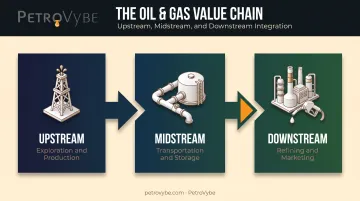
An integrated oil and gas company touches every stage of the hydrocarbon value chain: finding oil and gas, moving it, and turning it into finished products. Instead of specializing, these companies own exploration, production, refining, and distribution operations at once.
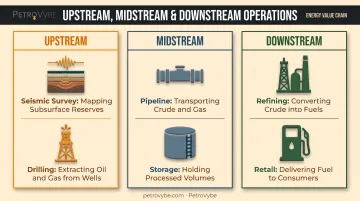
The model breaks into three divisions:
- Upstream – exploration and production of crude oil and natural gas
- Midstream – transportation and storage of crude oil and natural gas
- Downstream – refining crude into products and marketing them to consumers
This structure traces back to Standard Oil. The 1911 Supreme Court breakup split Standard Oil into multiple companies, including Jersey Standard, which eventually became Exxon, and Socony-Vacuum, which became Mobil. The two merged again in 1999 to form ExxonMobil.
ExxonMobil produced 4.736 million oil-equivalent barrels per day in fiscal year 2025, its highest full-year production level in more than four decades. Running at that scale takes massive capital across drilling rigs, refineries, and distribution networks.
Integration gives large companies control over costs and margins at every link in the chain, rather than depending on third parties.
How Integrated Companies Operate Across the Value Chain
Integrated companies own or control assets at every stage, from the reservoir to the retail pump. That span breaks into three segments.
Upstream Operations
Upstream is where hydrocarbons are found and extracted. Core activities include:
- Seismic surveys to locate reserves
- Drilling exploratory and production wells
- Well completion to prepare wells for efficient oil or gas production
Midstream Operations
Once oil or gas reaches the surface, it has to move somewhere useful. Midstream operations handle:
- Gathering pipelines that move raw production from wellheads
- Long-distance transmission pipelines and tankers
- Storage terminals that balance supply against fluctuating demand
Downstream Operations
Downstream is the consumer-facing end of the chain:
- Refineries convert crude into gasoline, diesel, and jet fuel
- Marketing arms distribute products through retail stations and commercial channels
This is the segment most people associate with "Big Oil," even though it is only one-third of the integrated model.
Integrated vs. Independent Oil and Gas Companies
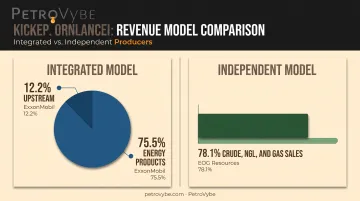
Where integrated majors span the full value chain, independent companies stay narrow. Sometimes called "pure plays," they specialize in a single segment, almost always upstream exploration and production. They don't refine crude or run gas stations. They find hydrocarbons, produce them, and sell the raw commodity. The case for integration: When upstream margins compress because oil prices fall, downstream refining margins often improve, since cheaper crude lowers input costs for refiners. This built-in offset can smooth earnings across commodity cycles. The case against integration: Blended segments make a company harder to value. Investors can't easily isolate whether upstream production, refining margins, or chemical sales are driving performance without digging through segment-level disclosures. Revenue mix shows the split clearly. In fiscal year 2025, ExxonMobil's Upstream segment generated 12.2% of external revenue, while Energy Products (its downstream arm) drove 75.5%. Compare that to EOG Resources, a pure-play independent producer, where crude, NGL, and gas sales made up 78.1% of total revenue. EOG's filing states its operations are entirely exploration-and-production related, with no refining or retail. That concentration is the point. Independents give investors a cleaner read on well economics and production performance, without chemicals, refining, or marketing layered on top.
Examples of Major Integrated Oil and Gas Companies
The conventional "supermajors," sometimes called Big Oil, include:
- ExxonMobil (United States)
- Chevron (United States)
- Shell (United Kingdom)
- BP (United Kingdom)
- TotalEnergies (France)
Saudi Aramco and PetroChina also operate fully integrated models but are typically excluded from the "supermajor" label because of state ownership and different capital market structures.
Not every well-known U.S. exploration name is integrated. ConocoPhillips, EOG Resources, and Devon Energy are all independents, focused entirely on upstream production despite their size and public profile. Scale and brand recognition alone do not mean a company spans upstream through downstream.
Why This Distinction Matters for Investors
Integrated supermajor stocks are large-cap, liquid, and easy to buy. But that liquidity comes at a cost for investors chasing specific tax advantages. Buying shares of ExxonMobil doesn't make you an operator. It makes you a shareholder in a corporation that claims its own deductions. You receive that benefit indirectly, if at all, through earnings and dividends.
Direct participation in upstream development works differently. Investors who hold a working interest in a qualifying oil and gas project can access intangible drilling cost (IDC) deductions and depletion allowances directly against their own income. This treatment requires the investor to elect general partner status in the Subscription Agreement and may be limited in a given year by the excess business loss limitation under IRC §461(l).
That is the core difference between project-level upstream investing and buying integrated stocks. PetroVybe, a private Texas-based natural gas development company, structures direct partnerships for accredited investors around this distinction. Partners received a 94% tax deduction against active income in 2025, tied to IDC allowances on a 58,000-acre position in Lavaca County's Gulf Coast Basin. Prior result; not a promise of any future deduction. This treatment requires the investor to elect general partner status in the Subscription Agreement and may be limited in a given year by the excess business loss limitation under IRC §461(l).
Beyond tax treatment, direct upstream participation lets investors evaluate specific project math:
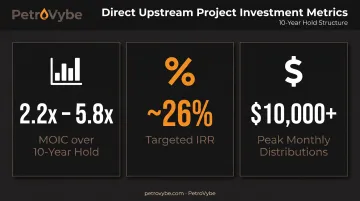
- MOIC (Multiple on Invested Capital) – targeted range of roughly 2.2x to 5.8x over a 10-year hold
- IRR (Internal Rate of Return) – targeted around 26% over the same window
- Quarterly distributions – projected to peak at $10,000+ per month during peak production
Those are isolated, project-specific figures. A supermajor's consolidated income statement blends upstream production, refining margins, and chemical sales, so that same line-of-sight is hard to find. The practical choice is owning a sliver of a diversified conglomerate versus a direct stake in a single natural gas development project—with tax treatment and project math you can underwrite yourself.
Frequently Asked Questions
What is an integrated oil and gas company?
An integrated oil and gas company operates across upstream, midstream, and downstream at once—exploration and production, transportation and storage, and refining and marketing. ExxonMobil and Chevron are classic examples of this full-chain model.
What is the difference between upstream, midstream, and downstream?
Upstream covers exploration and production, midstream handles transportation and storage, and downstream involves refining crude into products and marketing them to consumers. Integrated companies operate in all three.
Are integrated oil and gas companies a good investment?
They offer diversification and stability since downstream margins can offset upstream volatility. However, their blended segments make it harder to isolate exactly what's driving returns.
What is an independent oil and gas company?
An independent company focuses on a single segment, usually upstream exploration and production, without refining or retail operations. EOG Resources and Devon Energy are examples.
Why do some investors prefer independent upstream companies over integrated majors?
Independents offer clearer project-level economics, direct exposure to specific developments, and access to tax deductions like IDCs that don't pass through to public shareholders. This appeals to accredited investors managing high active income. This treatment requires the investor to elect general partner status in the Subscription Agreement and may be limited in a given year by the excess business loss limitation under IRC §461(l).
Which companies are considered "supermajors"?
The conventional list includes ExxonMobil, Chevron, Shell, BP, and TotalEnergies. Saudi Aramco is also integrated at massive scale but is usually excluded from this narrower label due to state ownership.
Informational requests only. PetroVybe projects are offered solely to verified accredited investors. Submitting this form does not create an investment or advisory relationship.