This article is general education, not investment, tax, or legal advice. High-income earners are running out of room in traditional tax shelters. Retirement accounts cap contributions. Real estate depreciation only goes so far. Meanwhile, W-2 income and capital gains keep getting taxed at full rates.
That's pushed many accredited investors toward alternative structures that offer something stocks and bonds simply can't: direct pass-through access to tax deductions and cash flow from a real, tangible asset.
Direct Participation Programs, or DPPs, are one of the oldest vehicles for this. They let investors buy directly into a business venture, oil wells, real estate, equipment leasing, and receive both the income and the tax treatment as if they owned the asset themselves.
This article breaks down what DPPs are, how they're taxed, what risks they carry, and how oil and gas DPPs like PetroVybe's projects fit into this model.
Key Takeaways
- DPPs pass income, losses, and tax deductions directly to investors without entity-level tax
- Oil and gas DPPs can deliver large first-year deductions that may offset active income
- Illiquid and long-term: built for capital committed in years, not months
- General partners manage the asset; limited partners provide capital and bear limited liability. This treatment requires the investor to elect general partner status in the Subscription Agreement and may be limited in a given year by the excess business loss limitation under IRC §461(l).
What Is a Direct Participation Program (DPP)?
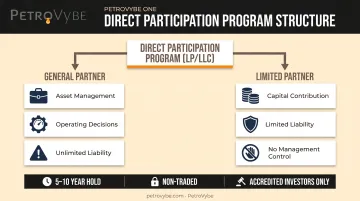
A Direct Participation Program is a pooled investment, typically structured as a limited partnership, LLC, or S-corporation, that passes income, losses, gains, and tax credits straight through to investors rather than paying tax at the entity level.
FINRA Rule 2310 defines DPPs by their flow-through tax consequences, not by their legal wrapper. The rule specifically names oil and gas, real estate, and equipment programs as examples.
Every DPP has two roles:
- General partner (GP): Manages the asset, makes operating decisions, and typically carries unlimited liability
- Limited partner (LP): Provides capital, has no management control, and carries limited liability
That pass-through structure usually comes with limited liquidity. In practice:
- DPPs are non-traded—no exchange ticker, no daily price quote, and no guaranteed early exit
- Most offerings limit participation to accredited investors (some exemptions allow a small number of non-accredited, sophisticated investors)
- Holding periods are set in the partnership agreement, often in a 5- to 10-year window that tracks the asset’s development cycle
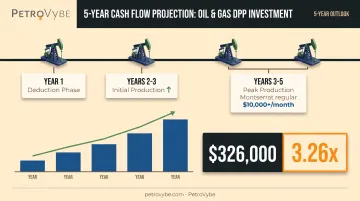
Oil and gas programs often wait at least 2 to 3 years from initial capital deployment to the first distribution, reflecting the time needed to bring wells online. Actual timing still depends on the specific offering.
Key Features of Direct Participation Programs
Pass-Through Taxation, Not Tax-Free Income
A DPP itself doesn't pay federal income tax. Instead, it files Form 1065 and issues each investor a Schedule K-1 reporting their share of income, deductions, and credits. That income still gets taxed, just at the investor level instead of the entity level.
This matters because taxable income can sometimes exceed actual cash distributed in a given year. Investors need to plan for that mismatch.
Direct Ownership in a Physical Asset
Unlike buying shares of a public company, a DPP investor holds a direct interest in the underlying asset itself, whether that's an apartment complex, leased equipment, or a producing oil well. Unlike buying shares of a public company, a DPP investor holds a direct interest in the underlying asset itself—whether that's an apartment complex, leased equipment, or a producing oil well. Performance tracks the asset's economics, not a separate corporate balance sheet.
The Oil and Gas Deduction Advantage
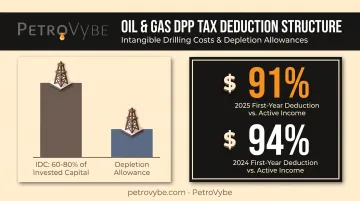
Oil and gas DPPs carry a unique tax feature: Intangible Drilling Costs (IDC). These costs, covering labor, fuel, site prep, and drilling supplies, can typically be expensed in the year they're incurred rather than depreciated over time.
- IDCs commonly represent a first-year deduction target of approximately 70–80% of invested capital in a new drilling project
- Depletion allowances add further deductions tied to resource extraction
- Under IRC Section 469(c)(3), a working interest without limited liability may qualify as nonpassive—so losses can offset W-2 wages, subject to basis, at-risk, and other limits. This treatment requires the investor to elect general partner status in the Subscription Agreement and may be limited in a given year by the excess business loss limitation under IRC §461(l).
**PetroVybe's partners saw this play out directly: 94% in 2025, driven by IDC and depletion allowances on its Lavaca County, Texas development projects. Prior result; not a promise of any future deduction.
One caveat: there's no fixed statutory percentage. Every project's deduction depends on its specific cost structure, and every investor's ability to use it depends on their individual tax situation. A CPA review before committing capital isn't optional.
Passive Structure, Active Returns
Once capital is committed, DPP investors typically have zero day-to-day involvement—no property management calls, drilling decisions, or operational headaches. Returns still come from the asset: production revenue, scheduled distributions, and eventual exit economics flow through without requiring investor labor.
Do DPPs Provide Passive Income and Pass Through Gains and Losses?
Yes, but with nuance. Limited partners receive periodic distributions from the underlying asset’s cash flow—oil production revenue, lease payments, or rental income—without managing day-to-day operations.
How the pass-through actually works:
- Income, deductions, and losses flow proportionally to each partner's ownership units
- The structure avoids double taxation since the entity itself pays no federal tax
- Actual distribution amounts fluctuate with asset performance, commodity prices, and development stage
In practice, that pass-through shows up as scheduled cash distributions. PetroVybe’s Quarterly Passive Distributions (MPD) under the PetroVybe ONE program target more than $10,000 per month during peak production, with a projected $326,000 in total distributions over five years—roughly a 3.26x multiple per unit.
These figures are forward-looking projections, not guarantees. Results depend on drilling success and commodity pricing.
Common Types of DPPs and How MLPs Compare
DPPs span several asset classes:
- Oil and gas exploration and development partnerships — fund drilling and production in exchange for revenue share and deductions
- Equipment leasing programs — pool capital to purchase and lease equipment, passing lease income to investors
- Non-traded REITs — real estate income vehicles, though FINRA regulates these separately from its core DPP definition
- Non-listed business development companies (BDCs) — closed-end funds investing in private companies, structured differently from traditional DPPs
Where MLPs Diverge
Master Limited Partnerships (MLPs) share the pass-through tax treatment of DPPs. Beyond that structure, the two vehicles work very differently.
| Feature | Oil & Gas DPP | MLP |
|---|---|---|
| Liquidity | Illiquid; private and unlisted | Publicly traded, exchange liquidity |
| Access | Accredited investors typically | Any investor with a brokerage account |
| Tax reporting | K-1, pass-through | K-1, pass-through |
| Price discovery | No public pricing | Market-driven share price |
MLPs trade like stocks. DPPs don't. If you need the ability to exit on a Tuesday afternoon, an MLP fits better. If you want project-level tax deductions from direct exploration and drilling—and can accept a multi-year hold with no exchange exit—an oil and gas DPP is the clearer fit.
What Are the Risks of Oil and Gas Direct Participation Programs?
The SEC has been clear: private oil and gas offerings can involve total loss of capital and indefinite holding periods. These aren't theoretical risks.
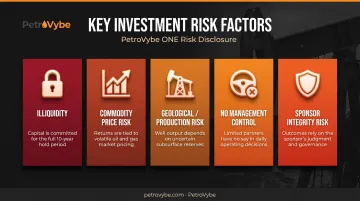
Core risk categories:
- Illiquidity — No secondary market exists. Capital is locked up until the program's planned wind-down or exit.
- Commodity price risk — Revenue is tied directly to oil and natural gas prices, which swing based on global supply and demand.
- Geological and production risk — Dry holes happen. Wells underperform. Independent engineering reports help validate reserves, but they don't eliminate uncertainty.
- No management control — Limited partners can't override the general partner's decisions. Due diligence on the GP's track record is essential.
- Sponsor integrity risk — The SEC has flagged real cases of misused investor funds in this space. Third-party validation of reserves, use of proceeds, and operator background matters more here than in almost any other alternative asset class.
Eligibility is separate from risk. Most oil and gas DPPs require SEC accredited investor status: $200,000 individual income (or $300,000 joint) for two consecutive years, or $1 million net worth excluding primary residence.
Why PetroVybe's Structure Reflects the DPP Model
PetroVybe operates as a private oil and gas development company, giving accredited investors direct access to natural gas and NGL development assets across South Texas and the Gulf Coast Basin, specifically Lavaca County, through its PetroVybe ONE limited partnership.
The company's structure directly addresses the risk factors outlined above:
- Third-party validation: A licensed independent engineering firm placed proved reserves at $48 million on a PV-09 basis, prepared by Lee Keeling & Associates, Tulsa, March 2026, backed by roughly 400 acquired wells across 58,000 acres, with 57-plus new wells planned
- Independent audit: PetroVybe's 2025 financials received a clean audit opinion from Weaver, an independent auditing firm
- Track record scrutiny: Chief Geophysicist Michael Stamatedes holds a 75.2% career hit rate for profitable well-location selection over 48 years, vs. Disclaimer: these results were achieved at prior companies. a sub-40% industry average for exploration success
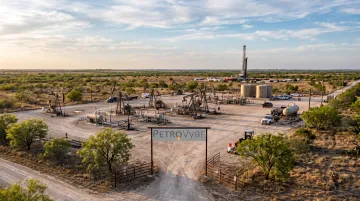
Returns are structured through an 80/20 profit split favoring investors. PetroVybe targets a 10-year MOIC of roughly 2.2x to 5.8x, an approximate 26% IRR, and a Year 5 cash-on-cash figure near 213%. These are forecasts tied to drilling performance, commodity prices, and capital deployment—not promises.
Combined with the 94% first-year tax deduction against active income that partners saw in 2025, PetroVybe shows the DPP model in practice: pass-through tax benefits, direct asset ownership, and passive income potential, with third-party accountability built into the structure. Prior result; not a promise of any future deduction.
Frequently Asked Questions
What is a direct participation program (DPP)?
A DPP is a pooled investment vehicle, often a limited partnership, that passes income, losses, and tax benefits directly to investors. Investors receive the venture’s cash flow and tax items directly, with no entity-level taxation.
What are the key features of direct participation programs?
DPPs use pass-through taxation, provide direct ownership in a tangible asset, and require no active management from investors. Oil and gas DPPs add unique deduction potential through intangible drilling costs (IDC) and depletion allowances.
What are common examples of direct participation programs (DPPs)?
Common types include oil and gas exploration partnerships, equipment leasing programs, non-traded REITs, and non-listed business development companies. Each passes income and tax items directly to investors.
What is an MLP in oil and gas?
A Master Limited Partnership is a publicly traded partnership offering pass-through taxation with stock-like liquidity. Unlike private DPPs, MLPs trade on exchanges and don't require accredited investor status.
What are oil and gas partnerships?
These are DPPs that fund drilling, exploration, or production activity in exchange for a share of revenue and tax deductions like IDC and depletion. Investors become limited partners with no operational role.
What are the risks of oil and gas direct participation programs (DPPs)?
Key risks include illiquidity, commodity price swings, and geological uncertainty around drilling success. Limited partners also rely heavily on the general partner’s track record, since they have no management control.
Informational requests only. PetroVybe projects are offered solely to verified accredited investors. Submitting this form does not create an investment or advisory relationship.