Many investors struggle with a basic question: where do you actually start? Oil investing spans public stocks, ETFs, futures contracts, and private development deals — each with wildly different capital requirements, risk levels, and tax treatment.
This guide breaks down each investment type, how they differ, and how to match one to your goals. Whether you're opening a brokerage account for the first time or you're an accredited investor exploring direct development partnerships, you'll find a clear starting point below.
Key Takeaways
- Oil exposure splits into direct paths (futures, private deals) and indirect paths (stocks, ETFs, funds)
- Risk, liquidity, and tax treatment vary by vehicle — no single option fits everyone
- Beginners typically choose stocks or ETFs; accredited investors often explore futures or direct deals
- Your capital, risk tolerance, timeline, and tax situation determine the right fit
Why Invest in Oil?
Oil fuels transportation, powers manufacturing, and moves through global trade in volumes few other commodities can match. That said, its dominance is shifting, according to the IEA's Global Energy Review 2025:
- Oil's share of global energy demand fell below 30% in 2024, the first time in 50 years, down from a historical peak of 46%
- Global oil demand still grew, just more slowly: up 0.8% in 2024 versus 1.9% the year before
Oil's relationship with stocks isn't as tight as many assume. A Federal Reserve Bank of Cleveland study found no statistically significant correlation between crude prices and the S&P 500 at the 95% confidence level. The EIA notes this relationship shifts depending on economic conditions: sometimes stocks and oil move together, sometimes they don't. That inconsistency is part of oil's appeal as a portfolio diversifier.
The AI Electricity Angle
Here's the forward-looking piece: data centers consumed about 415 terawatt-hours globally in 2024, roughly 1.5% of world electricity. The IEA projects that figure could more than double to 945 TWh by 2030, growing at roughly 15% annually.
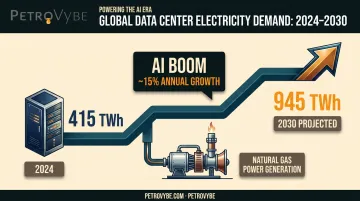
That growth is fueling interest in natural gas-fired power generation specifically. Chevron and ExxonMobil have both pursued arrangements to supply data centers with gas-powered electricity paired with carbon capture. This trend is less about crude oil demand and more about gas as a foundational energy source for the AI buildout.
This is precisely the lane private developers like PetroVybe operate in: positioning natural gas assets to serve AI-driven electricity demand, structured as direct partnerships rather than publicly traded stock.
Types of Oil Investments
Oil investing isn't one-size-fits-all. The four main categories differ by capital required, liquidity, risk exposure, and how hands-on you need to be.
| Investment Type | Typical Capital | Liquidity | Involvement Level |
|---|---|---|---|
| Oil Stocks | Any brokerage minimum | High | Low to moderate |
| ETFs/Mutual Funds | Any brokerage minimum | High | Low |
| Futures/Options | Margin account required | High | High |
| Private Development | $100,000+ | Low (multi-year lockup) | Low (passive) |
Oil Stocks
Buying oil stocks means owning shares of companies across the value chain:
- Integrated majors like ExxonMobil and Chevron, which span upstream production, midstream, and downstream refining
- Independent E&P firms focused purely on exploration and production
- Oilfield services companies that provide drilling, cementing, and fracturing support
Integrated majors have a real track record on income. ExxonMobil raised its dividend for 42 consecutive years through 2024, distributing $16.7 billion to shareholders that year. Chevron paid $6.52 per share (totaling $11.8 billion) in 2024, marking its 37th straight year of dividend increases.
Stocks trade through any standard brokerage account, so liquidity is rarely an issue. The tradeoff: your returns depend on company-specific factors (management decisions, debt levels, reserve quality), not just where oil prices sit. That means due diligence on the company matters as much as your view on crude.
Oil ETFs and Mutual Funds
ETFs and mutual funds bundle multiple oil-related holdings into a single fund, coming in two flavors: equity-based funds (like XLE, XOP, IEO) that hold shares of energy companies, and futures-based funds (like USO) that hold oil futures contracts rather than physical crude or stock.
Equity funds are straightforward: you're buying a diversified basket of producers instead of picking one stock. Expense ratios run modest, with XOP charging 0.35%, IEO charging 0.40%, and PXE running 0.60%.
Futures-based funds are trickier. USO functions as a commodity pool, not a direct crude-oil holding. When futures markets are in contango (later contracts priced higher than expiring ones), the fund sells cheap and buys expensive every time it rolls positions, a structural drag known as negative roll yield.
Combined with fees (USO runs around 0.70%, BNO around 1.00%) and general tracking error, a futures ETF's return can diverge meaningfully from the change in spot crude prices. It's a real cost that catches beginners off guard.
Oil Futures and Options
Futures contracts are the most direct way to bet on spot oil prices. A standard NYMEX WTI contract represents 1,000 barrels, quoted in dollars and cents per barrel, with a minimum price move worth $10 per contract. Standard contracts are physically deliverable at Cushing, Oklahoma, meaning if you hold to expiration, you could technically end up owning oil.
Margin requirements for WTI futures typically run 3% to 12% of contract value, though this shifts with volatility and broker policy. That's leverage, and leverage cuts both ways.
The cautionary tale here is April 20, 2020. The expiring May WTI contract settled at negative $37.63 per barrel, the first negative settlement in the contract's history. The EIA attributed it to a collapse in pandemic-era demand, swelling inventories, near-zero available storage at Cushing, and thin liquidity right before expiration forced remaining long positions to accept physical delivery.
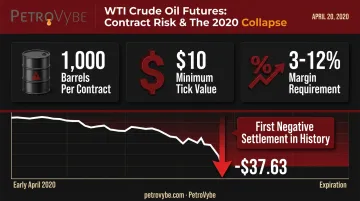
Traders who didn't understand expiration mechanics got run over. Futures suit experienced traders comfortable with margin calls and short-term volatility, not passive investors.
Direct and Private Oil & Gas Development Investments
Accredited investors have a fourth path: skip public markets entirely and fund oil and gas development projects directly, often as working interests alongside an operator. This is the model companies like PetroVybe use, offering direct positions in South Texas and Gulf Coast natural gas development rather than shares in a publicly traded company.
The structural difference matters. You're not owning a market-priced security whose value swings with sentiment; you're participating in wellhead economics and the tax treatment that comes with direct ownership.
Key strengths of this path:
- Intangible Drilling Cost (IDC) deductions that apply against active income, not just passive income, a meaningful distinction from real estate deductions
- Potential for strong MOIC (multiple on invested capital) and IRR over a multi-year hold
- Low correlation to public stock market swings
PetroVybe's 2024 partners, for example, received a 94% tax deduction against active income, while 2025 partners saw 91%, both structured through IDC treatment on new drilling costs.
Limitations to know before committing:
- Requires verified accredited investor status (net worth over $1M excluding primary residence, or income over $200K individually/$300K jointly)
- Illiquid: multi-year hold periods are standard, often 10 years
- Success depends heavily on operator track record
- Investors should verify third-party engineering validation (like a PV-09 reserves report) before wiring funds
How to Choose the Right Way to Invest in Oil
The right vehicle depends on your goals, risk appetite, and tax profile — not whichever option is trending on social media this month.
Investment goals. Are you chasing short-term trading gains, long-term growth with dividend income, or tax-advantaged passive income? Each points to a different vehicle.
Risk tolerance. Futures and options suit traders with high risk tolerance and active monitoring habits. Stocks and ETFs suit moderate risk profiles where you can ride out volatility without daily attention.
Capital and liquidity needs.
- Stocks/ETFs: start with almost any amount through a standard brokerage
- Futures: require a margin account and meaningfully more capital cushion
- Direct development deals: require accredited status and $100,000+ in liquidity, with multi-year lockups
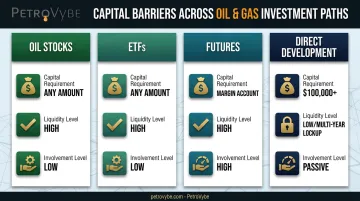
Time horizon and involvement level. Active traders gravitate toward futures. Passive, long-term investors tend to prefer ETFs or, for accredited investors, direct development partnerships that don't require daily oversight.
Tax situation. This is where things get interesting for high earners. A W-2 employee or someone sitting on capital gains may find that upfront IDC deductions from a direct development investment carry more value than a standard securities position. These deductions apply against active income rather than being boxed into passive-loss rules.
Mistakes to Avoid Before Investing in Oil
A few missteps show up again and again among first-time oil investors:
- Jumping into futures without understanding margin calls. Leverage magnifies gains and losses equally. The negative-price event of 2020 is proof that expiration mechanics can turn a routine contract into a disaster.
- Ignoring contango and tracking error in commodity ETFs. Fees and roll costs can erode returns even when spot oil prices rise.
- Overlooking demand-shift risk. The IEA projects electric vehicles will displace 5.4 million barrels per day of oil demand by 2030, with global demand plateauing near 105.5 million barrels per day by decade's end. Regulatory and geopolitical shifts add further uncertainty.
- Skipping due diligence on private deals. Before funding any direct development project, confirm the operator's track record and request independent reserve engineering reports — not just marketing projections.
Conclusion
Oil offers multiple entry points, from a simple brokerage-account stock purchase to a multi-year private development partnership. None of them is universally "better" — the right choice comes down to matching the vehicle to your capital, risk tolerance, and tax situation.
As energy demand grows alongside AI infrastructure and global development, understanding these options positions you to participate in this next phase of oil and gas development. That could mean buying a dividend stock this afternoon or scheduling a call with a development partner like PetroVybe about a multi-year position.
Frequently Asked Questions
How much money do I need to invest in oil to make $3,000 a month?
It varies by vehicle. Dividend stocks or ETFs typically need a six-figure portfolio to generate $36,000 a year in yield. Private development deals instead target passive income through MOIC and IRR over a multi-year hold, not fixed monthly payouts.
How do I start investing in oil?
For stocks or ETFs, open a brokerage account and buy shares directly. For direct development access, accredited investors can connect with a private placement operator like PetroVybe to review offering documents and schedule a discovery call.
Is investing in oil safe for beginners?
ETFs and stocks are safer starting points than futures, thanks to diversification and the absence of leverage. Futures require margin and active monitoring, which makes them riskier for newcomers.
Do oil stocks pay dividends?
Many integrated majors, including ExxonMobil and Chevron, have decades-long dividend increase streaks. Not every oil company pays dividends, though — smaller E&P firms often reinvest cash flow into drilling instead.
What's the difference between oil ETFs and oil futures?
ETFs offer diversified, lower-effort exposure through a basket of holdings, with fund managers handling the mechanics. Futures involve direct, leveraged contracts that require active management and carry margin and expiration risk.
Can non-accredited investors invest in direct oil and gas development deals?
No. Private development opportunities like PetroVybe's are reserved for accredited investors under SEC regulations. Public stocks and ETFs remain open to all investors regardless of accreditation status.