
This article is general education, not investment, tax, or legal advice. Reaching $100K in liquid capital puts you in rare company. The Federal Reserve's 2022 Survey of Consumer Finances doesn't publish a clean percentage of households holding six figures in liquid savings, but the data hints at how uncommon it is: the median transaction account balance among families that even own one sits at just $8,000. A $100K position is far above that median, which means you're already ahead of most.
But "ahead" doesn't mean "done." The best place to invest $100K depends on your risk tolerance, tax bracket, time horizon, and whether you qualify as an accredited investor. This guide walks through traditional options, alternative assets including private energy development, and tax strategies that matter most for high earners.
Key Takeaways
- Confirm accredited status first — $100K liquidity alone does not meet the SEC test.
- Keep stocks, bonds, and savings for liquidity; use alternatives for diversification and tax advantages.
- High-W2 earners can offset active-income tax exposure with structures such as oil and gas.
- Build a blended $100K portfolio instead of hunting for one "best" pick. This treatment requires the investor to elect general partner status in the Subscription Agreement and may be limited in a given year by the excess business loss limitation under IRC §461(l).
Key Considerations Before You Invest $100K
Before allocating a dollar, get clear on three things: risk tolerance, liquidity needs, and time horizon. Money you'll need in 18 months belongs somewhere very different than money you won't touch for a decade.
Next, check your accreditation status. The SEC defines an accredited investor as someone who meets any of these:
- Net worth over $1 million, excluding your primary residence (individually or with a spouse)
- Individual income over $200,000 in each of the past two years, with reasonable expectation of the same this year
- Joint income over $300,000 with a spouse or partner on the same basis
- Certain professional credentials, such as a Series 65 license
This status opens access to private market opportunities(https://www.sec.gov/resources-small-businesses/capital-raising-building-blocks/accredited-investors) — real estate syndications, private equity, and direct energy development — that aren't open to the general public.
Finally, map your tax exposure. High W2 earners and investors sitting on capital gains often need $100K deployments that shelter income—not only grow it—through structures with meaningful first-year deductions.
Traditional Ways to Invest $100K
Most $100K plans still begin with familiar public-market and cash vehicles. Return potential, liquidity, and tax treatment vary widely across them.
Stocks, ETFs, and Mutual Funds
For most people, equities are the natural starting point. They offer liquidity and, historically, strong long-term growth. Investopedia notes the S&P 500 has averaged roughly 10.56% annually since 1957, or about 6.69% after inflation.
This path works best with a 5+ year horizon. You need time to ride out volatility.
Bonds and Fixed Income
Bonds won't make headlines, but they stabilize a portfolio. When equities swing, a bond allocation smooths returns and helps preserve capital.
Investment-grade bonds and Treasuries usually trail stocks over long stretches, yet they cut drawdowns and make it easier to stay invested when markets turn.
High-Yield Savings, CDs, and Money Market Accounts
If safety is the priority, cash equivalents matter. As of November 2025:
- FDIC national savings average: 0.40% APY → about $400/year on $100K
- Bankrate's top high-yield savings offers: up to 3.85% APY → about $3,850/year
- FDIC 12-month CD national rate: 1.64% APY → about $1,640/year
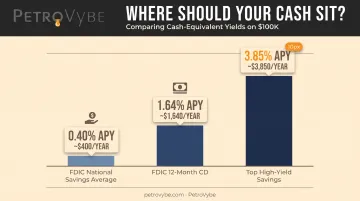
That's a huge spread between "average" and "best available" rates. Shopping around matters.
Retirement Accounts (401k/IRA)
$100K is enough to max out most tax-advantaged accounts in a single year. For 2025:
- 401(k) employee deferral limit: $23,500 (plus $7,500 catch-up if 50+)
- Combined IRA limit: $7,000 (plus $1,000 catch-up if 50+)
Contributions grow tax-deferred and compound over decades. Annual limits still leave most of a $100K balance to place elsewhere.
Alternative Investments: Diversifying Beyond Wall Street
Most private market opportunities (real estate, private equity, energy development) simply aren't advertised to the public. Access typically depends on accreditation and the offering structure, which creates a genuine edge for investors who qualify: less competition and less correlation with public markets.
One overlooked category is direct participation in oil and natural gas development. Unlike a public energy stock, this puts capital directly into physical wells and production, tied to a tangible asset rather than a ticker symbol. For accredited investors putting $100K to work, that structure can sit beside stocks and bonds as a real-asset diversifier.
The AI Power Demand Angle
Natural gas is getting fresh attention because of AI. The IEA projects data-center electricity demand will grow about 15% annually through 2030, with gas-fired generation expanding significantly to help meet that load in the U.S. It's a demand forecast, not a return guarantee, but it's reshaping where capital flows in the energy sector.
PetroVybe, a Texas-based natural gas developer, is one example of a company built around this demand. Its PetroVybe ONE project sits on a 58,000-acre Gulf Coast Basin position in Lavaca County, combining roughly 400 acquired producing wells with 57+ planned new wells. The company quotes a 10-year modeled net exit MOIC of approximately 2.2x–5.8x and a target IRR of approximately 26%. These are forward-looking projections, not promises. Actual outcomes depend on commodity prices, drilling results, and market conditions.

Due Diligence Basics
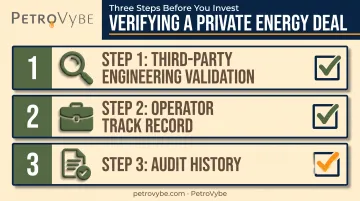
Before committing to any private energy deal, verify:
- Third-party engineering validation: Is there an independent reserves report (a PV-09 valuation, prepared by Lee Keeling & Associates, Tulsa, March 2026, for example)?
- Operator track record: Does the team have real geology, financial, and operational experience?
- Audit history: Has the company undergone independent financial review?
PetroVybe, for instance, points to a $48 million PV-09 reserve valuation from a licensed third-party engineering firm and a clean 2025 audit from Weaver as supporting documentation. That is the kind of paper trail any serious operator should be able to produce.
Tax-Efficient Strategies for High-Income Earners
This is where oil and gas investing gets interesting for high earners specifically. Under Section 263(c) of the tax code, intangible drilling costs (IDCs) (labor, fuel, and other non-salvageable drilling expenses) can be deducted in the year incurred.
Here's the part most real estate losses can't match: a direct working interest in a well isn't automatically classified as passive under Section 469. Qualifying losses, including IDCs, can potentially offset active income:
- W-2 wages
- Capital gains
- Other ordinary income — not only passive income
PetroVybe cites partners achieving 94% first-year deductions against ordinary income in 2025, largely through IDC treatment reported on K-1s. Prior result; not a promise of any future deduction. That illustrates the mechanism's scale, though individual results depend on deal structure and your personal tax situation. This treatment requires the investor to elect general partner status in the Subscription Agreement and may be limited in a given year by the excess business loss limitation under IRC §461(l).
A CPA or tax advisor isn't optional here. Eligibility and benefit size depend on your income mix, entity structure, and how the specific offering is set up.
Building a Diversified $100K Portfolio
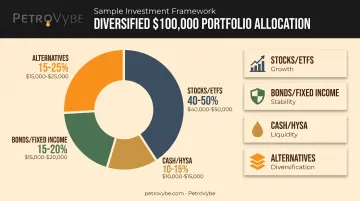
A practical $100K mix balances money you can reach quickly with money locked up for higher long-term payoff:
| Allocation | Purpose |
|---|---|
| Stocks/ETFs (40-50%) | Long-term growth, liquidity |
| Bonds/fixed income (15-20%) | Stability, lower volatility |
| Cash/HYSA (10-15%) | Emergency access, safety |
| Alternatives (15-25%) | Diversification, tax efficiency |
That still leaves plenty of room for equities. What it avoids is fake diversification: five tech ETFs that move together when markets drop. Real diversification spans asset classes, not just tickers.
On a $100K portfolio, a 15-25% alternatives sleeve is roughly $15,000–$25,000. That bucket can include private credit, real assets, or direct energy partnership units with multi-year holds and tax-advantaged structures. Those positions often trade liquidity for income and tax treatment you will not get from public ETFs.
Before you fund any illiquid slice, especially a 10-year energy development hold, run the numbers with a financial advisor and CPA. Confirm the allocation matches your tax situation, time horizon, and true liquidity needs.
Frequently Asked Questions
Where is the best place to invest $100,000 right now?
There's no single best answer. The right mix depends on your risk tolerance, tax bracket, and accreditation status. A blend of traditional and alternative assets usually beats chasing one "perfect" investment.
What is the safest way to invest $100,000 right now?
High-yield savings accounts, CDs, and government bonds carry the lowest risk. The tradeoff is limited long-term growth: safety and upside rarely come together.
How can I turn $100,000 into $1 million?
It takes consistent contributions and a long time horizon, not a single lucky pick. At a 10% average annual return, $100K crosses $1 million after roughly 25 years of compounding.
How can I quickly grow $100,000?
"Quick" almost always means higher risk. A more sustainable approach blends steady growth investments with a smaller allocation to higher-return alternatives, rather than chasing speed alone.
How much interest will $100,000 earn in a year?
At the FDIC national savings average (0.40%), that's about $400. At a top high-yield savings rate (3.85%), it's closer to $3,850. Shop around before parking cash.
Informational requests only. PetroVybe projects are offered solely to verified accredited investors. Submitting this form does not create an investment or advisory relationship.