

This article is general education, not investment, tax, or legal advice. Many investors don't realize their partnership losses may be stuck. You get a K-1, see a loss, expect it to trim your W-2 tax bill, and then your CPA delivers the news: it's passive. Suspended. Not usable this year.
This happens more than most people think. Once you understand material participation and the passive activity rules under IRC Section 469, you can predict whether a partnership loss saves you money today or gets shelved for later. That distinction matters enormously for accredited investors weighing natural gas and oil development partnerships, where tax treatment can make or break the investment thesis.
This article breaks down passive activity classification, the seven material participation tests, and the one meaningful exception that lets certain oil and gas deductions offset active income. This treatment requires the investor to elect general partner status in the Subscription Agreement and may be limited in a given year by the excess business loss limitation under IRC §461(l).
Key Takeaways
- Limited partners are presumed passive by default, regardless of actual business involvement
- Passive losses only offset passive income; excess losses carry forward indefinitely
- Working interests in oil and gas can bypass passive rules when liability is not limited
- K-1 box codes do not set your tax treatment—you classify the activity
- IDC deductions in drilling partnerships follow rules that differ from standard PAL treatment. This treatment requires the investor to elect general partner status in the Subscription Agreement and may be limited in a given year by the excess business loss limitation under IRC §461(l).
What Is a Passive Partnership Activity?
Under IRC Section 469, a passive activity is any trade or business where the taxpayer doesn't materially participate. The IRS defines material participation as involvement that's regular, continuous, and substantial.
Here's the part that surprises most investors: Section 469(h)(2) presumes limited partners are passive, period. It doesn't matter if you spend 300 hours a year reviewing drilling reports or attending investor calls. If you hold a state-law limited partnership interest, the regulations only let you use three of the seven material participation tests to prove otherwise.
Why this distinction matters:
- Passive losses can only offset passive income
- Nonpassive (active) losses can offset ordinary income, including W-2 wages
- Misclassifying your status can mean losing access to deductions you're entitled to—or claiming ones you're not
What Are the Three Main Types of Partnerships?
Partnership structure directly shapes your passive activity treatment.
| Structure | Liability | Passive Activity Impact |
|---|---|---|
| General partnership | Unlimited personal liability | Can typically use all seven material participation tests |
| Limited partnership | Limited to capital contribution | Restricted to three tests under the limited partner presumption |
| LLC/LLP | Liability protection under state law | Not automatically treated as a limited partner—analyzed case by case |
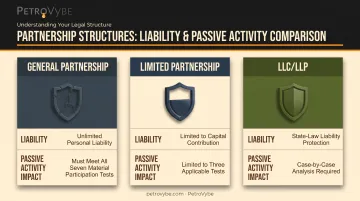
That last row matters. Courts have specifically rejected treating every LLC or LLP interest as automatically "limited" for passive activity purposes. Your entity type—not just your hours—can decide which material participation tests you may use.
Material Participation Tests: How the IRS Determines Active vs. Passive
The IRS uses seven tests under Temp. Reg. Sec. 1.469-5T to determine if you materially participate. Meeting just one qualifies you as active for that activity.
- The 500-hour test – You participate more than 500 hours during the year. This is the most straightforward and commonly used safe harbor.
- Substantially all participation – Your involvement represents substantially all participation in the activity by anyone.
- The 100-hour "maximum participant" test – You participate more than 100 hours, and no one else participates more than you.
- Significant Participation Activity (SPA) test – You participate more than 100 hours in each of several activities, and your combined hours in those SPAs exceed 500.
- Historical participation – You materially participated in 5 of the last 10 tax years.
- Personal service activity test – You materially participated in a personal service activity for any 3 prior years.
- Facts and circumstances catch-all – You show regular, continuous, and substantial involvement—but you can't use this test with 100 hours or less.
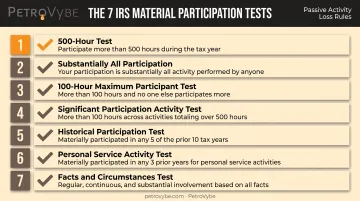
The limited partner catch: State-law limited partners face a narrower path. By default, you can only use tests 1, 5, and 6—the 500-hour test, historical participation, and personal service activity per the temporary regulations. The other four tests are off the table, which is why many limited partnership interests stay passive unless you clear one of those three gates.
Active vs. Passive Partnership: What It Means for Your Taxes
Active vs. passive classification touches more than PAL rules. It also affects self-employment tax, the QBI deduction, and NIIT exposure.
Active partnership income:
- Subject to self-employment tax for general partners
- Qualifies for the Qualified Business Income (QBI) deduction, up to 20% of qualified business income
- Allows retirement plan contributions tied to earned income
Passive partnership income:
- Generally avoids self-employment tax
- Restricted by PAL rules: losses only offset passive income
- May trigger the 3.8% NIIT when modified AGI exceeds $200,000 (single) or $250,000 (joint)
Thresholds and filing detail appear in the IRS Form 8960 instructions.
Two partners in the same partnership can face completely different tax treatment. A general partner working full-time in operations is nonpassive. A limited partner who only contributed capital and never attended a meeting is passive by default.
Same K-1, different outcomes—driven by each partner’s participation level and legal interest.
Passive Activity Loss (PAL) Rules and Loss Carryforwards
The core PAL rule is simple to state, harder to live with: passive losses can only offset passive income. Anything left over gets suspended and carries forward indefinitely until you have passive income to absorb it, or you dispose of the entire interest in a fully taxable transaction.
Grouping activities can help. The IRS allows related activities to be combined into an "appropriate economic unit" under Treas. Reg. Sec. 1.469-4. Courts have supported this approach:
- In Candelaria v. United States, the court allowed two related companies to be grouped, converting disputed losses to nonpassive treatment
- In Schumacher v. Commissioner, aircraft leasing was grouped with an operating business because the leasing activity was insubstantial on its own
The IDC Exception for Oil and Gas Working Interests
Working interests are what set many oil and gas drilling deals apart from standard passive partnership investments.
A working interest in an oil and gas well is treated as nonpassive regardless of material participation, but only if it's held directly or through an entity that doesn't limit your liability, such as a general partner interest. That nonpassive treatment means Intangible Drilling Cost (IDC) deductions can offset active income, including W-2 wages and capital gains, not just passive income. This treatment requires the investor to elect general partner status in the Subscription Agreement and may be limited in a given year by the excess business loss limitation under IRC §461(l).
The liability condition is strict. A conventional limited partnership interest or a liability-protected LLC interest generally does not qualify for this exception just because it holds working interests. How your specific interest is structured matters as much as the industry.
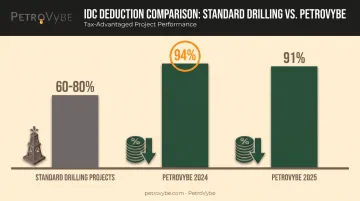
When the interest qualifies, IDCs—covering drilling, fracing, geology, engineering, and related development costs—typically represent a first-year deduction target of approximately 70–80% of invested capital in a new drilling project. Partners in PetroVybe's 2025 natural gas development projects reported deductions of 94% against active income, through IDC and depletion allowances (PetroVybe internal figures)—far above standard passive-loss treatment. Prior result; not a promise of any future deduction. This treatment requires the investor to elect general partner status in the Subscription Agreement and may be limited in a given year by the excess business loss limitation under IRC §461(l).
How to Tell If a K-1 Is Passive or Nonpassive
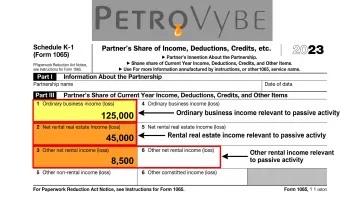
Your Schedule K-1 (Form 1065) gives clues, but it doesn't make the final call for you.
- Box 1 (ordinary business income/loss): Passive or nonpassive status depends on your material participation, not a checkbox
- Box 2 (net rental real estate): Generally passive
- Box 3 (other rental income): Also generally passive
If the partnership reports multiple activities, it attaches a statement breaking out each one. You apply the material participation tests separately to each activity.
The partner determines classification, not the partnership. This is where a lot of investors get tripped up, especially LLC members who assume liability protection automatically makes them "limited partners" for tax purposes.
It doesn't. In Garnett v. Commissioner and Thompson v. United States, courts rejected the automatic presumption that LLC or LLP members are limited partners under the passive activity regulations. If state law doesn't restrict your management rights, you may be able to use all seven material participation tests, not just three.
Review your participation history carefully, and get a CPA to confirm your classification before you file. That matters even more if you're an LLC member in a partnership like PetroVybe ONE, where reporting is partnership-style but your individual tax treatment still depends on your specific facts.
Frequently Asked Questions
What is a passive partnership and how does it differ from an active partnership?
A passive partnership is one where you do not materially participate: your involvement is not regular, continuous, and substantial. Active partnership losses can offset ordinary income; passive losses can only offset passive income.
How do I tell if a K-1 is passive or nonpassive?
Check Box 1 for business income, but the box does not decide your status. Your material participation does. Apply the IRS tests that match your ownership interest and how involved you are.
What are the three main types of partnerships?
General partners have unlimited liability and can use all seven material participation tests. Limited partners get liability protection but are limited to three tests. LLC and LLP members get liability protection and are not automatically treated as limited partners.
Can passive losses ever offset active income?
Yes, in a narrow case. Working interests in oil and gas wells held without liability protection are treated as nonpassive. That allows IDC deductions to offset W-2 income and capital gains, unlike most passive investments. This treatment requires the investor to elect general partner status in the Subscription Agreement and may be limited in a given year by the excess business loss limitation under IRC §461(l).
Are LLC members automatically treated as limited partners for passive activity purposes?
No. Courts in Garnett and Thompson rejected automatic limited partner treatment for LLC and LLP members. If state law permits management involvement, more material participation tests may apply.
What happens to passive losses I can't use this year?
They carry forward indefinitely under the same activity until you have passive income or you fully dispose of your entire interest in a taxable transaction. The losses are deferred, not permanently disallowed.
Informational requests only. PetroVybe projects are offered solely to verified accredited investors. Submitting this form does not create an investment or advisory relationship.