
This article is general education, not investment, tax, or legal advice. The Denver-Julesburg Basin produces more oil than most Americans realize. Weld County, Colorado sits at its heart, generating 83% of Colorado's crude oil, according to county figures. That kind of concentration is rare in American energy production.
Investors and industry watchers track the DJ Basin closely for good reason. It ranks among the country's most productive unconventional plays, with the broader Niobrara region pumping out 702,000 barrels of oil per day as of May 2024, per EIA data.
As electricity demand climbs, driven partly by AI data centers and grid strain, domestic oil and gas basins like the DJ matter more than ever. This article breaks down the basin's geography, geology, production trends, operators, history, and regulatory landscape, then explains what its maturity means for investors weighing where to put capital to work.
Key Takeaways
- The DJ Basin covers up to ~70,000 square miles across Colorado, Wyoming, Nebraska, and Kansas, centered on Weld County.
- Horizontal drilling and hydraulic fracturing unlocked the Niobrara and Codell formations in the late 2000s.
- Chevron, Occidental, and SM Energy now control most DJ production after heavy consolidation.
- Falling permit counts signal a mature, consolidated basin—not a growth-stage opportunity.
What Is the DJ Basin?
The Denver-Julesburg Basin is a structural sedimentary basin formed over millions of years through tectonic activity and hydrocarbon-generating deposition. It's primarily located in northeastern Colorado, stretching into Wyoming, Nebraska, and Kansas.
Size estimates vary by source. The Wyoming State Geological Survey puts the footprint at approximately 70,000 square miles, though that figure includes a South Dakota extension. Boundary lines differ by source, but the basin still spans multiple states across the central Rockies.
Weld County's Outsized Role
Weld County drives the bulk of DJ Basin production.
- Produces 83% of Colorado's crude oil
- Accounts for 56% of the state's natural gas production
- Hosts the Wattenberg Field, the basin's flagship producing area
Other notable fields include Adena in Morgan County (discovered in 1953) and Redtail, also in Weld County.
Why It Ranks Among Top U.S. Basins
The Niobrara reporting region, which closely tracks the DJ Basin's core production, ranked fourth in oil output among the seven regions EIA tracks in its Drilling Productivity Report. That places the DJ Basin among the top U.S. onshore oil regions by output.
How Deep Is the DJ Basin and What Formations Does It Contain?
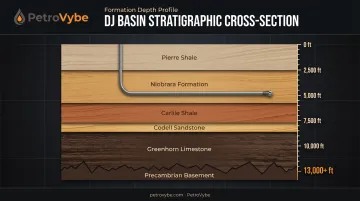
The DJ Basin is a stacked play. Multiple hydrocarbon-bearing formations sit on top of each other, shallow to deep:
- Pierre Shale (shallowest)
- Niobrara Formation (chalky limestone/shale, primary oil-gas source)
- Carlile Shale, containing the Codell Sandstone member
- Greenhorn Limestone (deepest of the primary targets)
The basin extends to more than 13,000 feet to the Precambrian basement at its deepest point, according to Wyoming survey data. Depth to any individual formation varies by location, so no single figure applies basin-wide.
Why Stacking Matters for Operators
Formation stacking lets operators drill one well pad and target multiple horizons, usually the Niobrara and Codell together. Civitas, one of the basin's major operators, has identified these two formations as its principal DJ targets.
This matters for capital efficiency. Instead of leasing separate acreage for separate formations, companies drill once and access layered reserves. It's one reason the basin became so attractive once horizontal drilling technology caught up with the geology.
From Vertical to Horizontal
Early DJ development relied on vertical wells. That changed once operators combined horizontal drilling with multi-stage hydraulic fracturing. The shift unlocked tight rock vertical wells could not produce economically and reshaped the basin's production profile.
Production Trends and Leading Operators
The DJ Basin's production numbers are substantial, and they point to consolidation and maturity.
Current output (Niobrara region proxy, May 2024):
- 702,000 barrels/day of oil
- 5,359 MMcf/day of natural gas
Civitas alone reported 60.5 million barrels of oil equivalent in total 2024 DJ sales, averaging 165,400 boe/day.
The Consolidation Wave
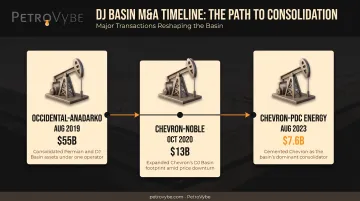
Three deals reshaped basin ownership over the past six years:
| Transaction | Closed | Value | Impact |
|---|---|---|---|
| Occidental-Anadarko | Aug. 2019 | $55B (incl. debt) | Transferred Anadarko's DJ position to Oxy |
| Chevron-Noble | Oct. 2020 | $13B enterprise value | Added Noble's core Wattenberg acreage |
| Chevron-PDC Energy | Aug. 2023 | $7.6B enterprise value | Added ~275,000 net acres, 1B+ boe reserves |
More recently, SM Energy closed its merger with Civitas in January 2026, making SM Energy the surviving company with roughly 303,000 net DJ acres.
What Declining Permits Signal
Colorado approved 48 oil and gas development plans and 801 wells in 2025, down about 20% and 30% respectively from 2024. That follows a 2024 total that itself sat 74% below the 2016-2018 pace.
The basin has matured, not declined. Consolidated operators drill more efficiently with fewer permits, extracting more value per well rather than chasing volume growth.
A Brief History of Drilling and Development
The DJ Basin's first recorded oil and gas production dates back to 1901, giving it well over a century of drilling history and decades of sustained commercial production.
The shift to unconventional development came in stages:
- 2004-2005: Noble Energy tested Niobrara completions
- Q3 2009: EOG drilled its first horizontal Niobrara well in Weld County, the "#2-01H Jake"
- 2010: Noble planned roughly 25 horizontal Niobrara wells; PDC prepared its first horizontal test
That handful of test wells kicked off a decade-long transformation from a modest conventional play into one of the country's premier unconventional basins.
Like every oil and gas region, the DJ Basin has weathered its share of downturns. The 2020 pandemic hit hard: gas output fell from a forecast 2.65 Bcf/day in April to 1.8 Bcf/day by June, with rig counts dropping more than 60% from early March levels, according to S&P Global Commodity Insights.
Production recovered to 2.23 Bcf/day by July as prices stabilized. Even a mature basin with deep infrastructure still moves sharply with commodity cycles.
Environmental and Regulatory Considerations
Colorado regulates DJ Basin operations more tightly than many other unconventional plays, and that shapes development pace.
Water use and recycling:
- DJ Basin activity drives most of Colorado's statewide produced-water recycling
- Existing infrastructure still falls short of supporting much higher reuse rates
- Colorado's Produced Water Consortium proposed reuse targets climbing to 35% by 2038
Air quality and siting rules:
- CDPHE's Regulation 7 controls methane and VOC emissions, updated almost annually since 2011
- A 2,000-foot setback from occupied buildings applies to new wells, with exceptions requiring extra approvals
These layers of oversight, combined with development-plan-based permitting, keep Colorado's approval pace well below levels seen a decade ago. Operators face a slower, more deliberate regulatory environment than in many other shale plays.
What the DJ Basin Means for Oil & Gas Investors
The DJ Basin's arc, from wildcat wells to horizontal drilling boom to heavy consolidation, shows that unconventional oil and gas development can be a genuine alternative asset class, distinct from stocks, bonds, and real estate.
But here's the catch. The DJ Basin today is dominated by Chevron, Occidental, and SM Energy. Buying exposure now means buying into a mature, consolidated basin, not a ground-floor opportunity. The growth phase has largely passed.
That's a different proposition than getting in early on development-stage assets.
An Alternative: Early-Stage Development Elsewhere
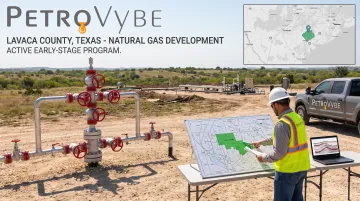
This is where PetroVybe operates differently. As a private oil and natural gas development company, PetroVybe gives accredited investors direct access to early-stage natural gas development, currently focused on South Texas and the Gulf Coast Basin rather than a mature play like the DJ.
Its current program, PetroVybe ONE, centers on a 58,000-acre position in Lavaca County, Texas, combining:
- Roughly 400 acquired legacy wells, supported through workovers and optimization
- 57 or more planned new wells, funded by reinvested cash flow
The economics come with independent validation. A licensed third-party engineering firm placed a $48 million PV-09 proved-reserves valuation on the asset base, prepared by Lee Keeling & Associates, Tulsa, March 2026, and PetroVybe's 2025 financials received a clean audit from Weaver.
On the tax side: partners who joined in 2025 received a 94% deduction against active income, including W-2 earnings and capital gains. This treatment requires the investor to elect general partner status in the Subscription Agreement and may be limited in a given year by the excess business loss limitation under IRC §461(l). Prior result; not a promise of any future deduction.
Compare that to buying a DJ Basin producer's stock or an energy ETF. Those expose you to assets that are already mature and may be past peak growth. PetroVybe's model targets development-stage economics—where value is still being built—with forecasted MOIC of roughly 2.2x to 5.8x and an IRR near 26% over a 10-year hold.
The DJ Basin remains a cornerstone of U.S. energy production. But for investors specifically seeking ground-floor development economics, stronger opportunities today are in basins that have not yet run through the DJ's consolidation cycle.
Frequently Asked Questions
What is the DJ Basin?
The Denver-Julesburg Basin is a large geological formation spanning Colorado, Wyoming, Nebraska, and Kansas, known for prolific oil and natural gas production. Weld County, Colorado sits at its productive core.
How deep is the DJ Basin?
The basin extends to more than 13,000 feet to the Precambrian basement at its deepest point. Depth to individual formations like the Niobrara and Codell varies by location within the basin.
Which companies operate in the DJ Basin?
Chevron, Occidental, and SM Energy (which absorbed Civitas in a January 2026 merger) are the leading operators following years of acquisitions. These three companies control the majority of current production.
Why has the DJ Basin seen so much consolidation?
Larger operators achieve economies of scale, infrastructure efficiency, and lower per-well costs by combining acreage. Declining permit activity, down 20-30% from 2024 to 2025, further reflects a basin that rewards scale over expansion.
Is the DJ Basin still a good area for new oil and gas investment?
The basin is mature and heavily consolidated, meaning most upside has already been captured by large operators. Investors seeking ground-floor development economics may find more opportunity in emerging natural gas plays outside the DJ.
What is the difference between conventional and unconventional drilling in the DJ Basin?
Conventional drilling uses vertical wells to tap easily accessible reservoirs. Unconventional drilling combines horizontal wells with multi-stage hydraulic fracturing. That approach unlocks tight formations like the Niobrara and Codell that vertical wells could not economically produce.
Informational requests only. PetroVybe projects are offered solely to verified accredited investors. Submitting this form does not create an investment or advisory relationship.