
Introduction
Most Americans exchange time for money. The wealthiest build systems that generate income regardless of whether they're working — and that gap compounds over time.
US CPI rose 3.5% for the 12 months ended June 2026, meaning idle cash loses purchasing power whether you act or not. That pressure alone makes the case for putting capital to work.
The tax picture adds another dimension. Salary earners face fixed brackets on every dollar earned, while investors can access structures that reduce their tax burden while generating returns.
This article covers 11 actionable passive income ideas — ranging from high-yield savings accounts (zero barrier to entry) to oil and gas development partnerships (accredited investors only). For each strategy, you'll find the key mechanics, realistic return expectations, and the investor profile it suits best.
Key Takeaways
- Passive income always costs something upfront — capital, time, or both
- Investment-based strategies (stocks, REITs, bonds) offer hands-off income once established but require capital
- Skill-based strategies like digital products, content, and affiliate marketing trade time for capital — low barrier, higher effort early on
- Tax efficiency matters as much as yield: some strategies let high earners offset W2 income directly
- The right strategy depends on your capital, risk tolerance, time horizon, and tax situation
What Is Passive Income and Why It Matters in 2026
Passive income is money earned from activities that don't require your day-to-day involvement. The moment you stop working, active income — wages, salary, freelance fees — stops too. Passive income keeps flowing.
The IRS draws a formal distinction here. IRS Publication 925 identifies two passive activity categories: trade or business activities where you don't materially participate, and rental activities (with limited exceptions). Losses from passive activities generally offset only passive income — not wages or capital gains.
That tax distinction matters more than ever in the current environment. With inflation running at 3.5%, a savings account earning below 1% is actively eroding your purchasing power — which is why building income streams outside your paycheck has moved from smart to necessary.
One expectation to set upfront: passive income is not a shortcut. Every strategy on this list requires either meaningful upfront capital or a serious time investment to build. The payoff is income that compounds over time without proportional ongoing effort — but you have to put something in first.
11 Passive Income Ideas to Boost Your Cash Flow
These 11 strategies span a wide range of capital requirements, effort levels, and return profiles. Match each to your actual financial situation rather than chasing the highest-sounding yield.
High-Yield Savings Accounts and CDs
The lowest-friction starting point. Park money in a high-yield savings account (HYSA) or certificate of deposit, earn interest automatically, do nothing else.
Current benchmarks worth knowing:
- HYSAs: approximately 4.00%–4.15% APY at competitive banks in July 2026
- 1-year CDs: approximately 4.00%–4.10% APY
- 5-year CDs: approximately 4.00%–4.28% APY
- FDIC coverage: $250,000 per depositor, per insured institution
CDs lock your funds for a fixed term in exchange for a slightly higher rate. HYSAs offer more liquidity. Both are FDIC-insured and require zero ongoing effort after opening.
Best for: Anyone starting out, building an emergency fund, or parking cash while evaluating longer-term strategies.
Dividend Stocks
Dividend-paying stocks distribute a portion of company profits to shareholders — typically quarterly. The S&P 500 index yield sat at 1.03% as of June 30, 2026, which is modest. Dividend-focused ETFs offer higher yields by comparison:
- SCHD (Schwab US Dividend Equity ETF): 3.34% 30-day SEC yield
- VYM (Vanguard High Dividend Yield ETF): 2.25% 30-day SEC yield
Dividend reinvestment plans (DRIPs) automatically use distributions to purchase additional shares, compounding returns over time.
Trade-off: Higher return potential than savings accounts, but market volatility affects both price and dividend stability. Dividend ETFs reduce single-stock risk while preserving the income stream.
Best for: Investors with moderate capital who want market exposure with regular income.
Real Estate Investment Trusts (REITs)
REITs let you earn real estate income without owning or managing property. By law, REITs must distribute at least 90% of taxable income to shareholders annually. The FTSE Nareit All Equity REITs dividend yield was 3.66% as of June 30, 2026.
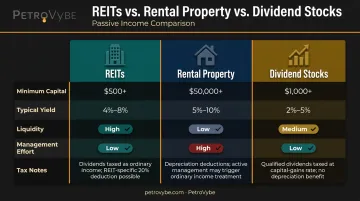
Publicly traded REITs can be purchased through any brokerage account in single-share increments — far less capital than a down payment on a physical property.
Best for: Investors who want real estate exposure with liquidity and don't want tenant or maintenance responsibilities.
Rental Property
Owning and renting residential or commercial property generates monthly cash flow, equity appreciation, and a degree of inflation protection (rents tend to rise over time).
The reality check: this isn't passive by default. Down payments for investment properties typically start at 15–25% under Freddie Mac guidelines, plus closing costs and ongoing maintenance. Cap rates on Class A multifamily in markets like Austin and Dallas ran 4.25%–4.75% in H2 2025; secondary markets like Pittsburgh showed 5.50%–6.50%.
A property manager can reduce your active involvement significantly — at a cost of roughly 8–12% of monthly rent — but the property still requires periodic attention.
Best for: Investors with substantial capital who want tangible assets and are comfortable with illiquidity.
Bonds and Bond Funds
Bonds are fixed-income instruments: you loan money to a government or corporation, they pay you regular interest. Treasury par yields as of July 15, 2026:
- 10-year Treasury: 4.55%
- 30-year Treasury: 5.08%
Bond funds offer instant diversification across many issuers. BND (Vanguard Total Bond Market ETF) carries a 4.57% 30-day SEC yield; AGG (iShares Core US Aggregate Bond ETF) runs 4.56%.
Lower risk than stocks, lower return potential than most alternatives on this list. Useful as a portfolio stabilizer.
Best for: Conservative investors or those balancing equity-heavy portfolios.
Peer-to-Peer Lending
P2P lending platforms connect individual lenders with individual borrowers. Prosper — one of the remaining US retail platforms after LendingClub exited the retail space — reported a 5.1% weighted-average three-year rolling return as of March 2025.
The upside is higher yields than bonds. The downside is real default risk: approximately 2.5% of Prosper's 24-month loan cohort was defaulted as of March 2025, with recovery rates on charged-off loans running just 7%–12%.
P2P Notes are unsecured, not FDIC-insured, and have no secondary market.
Best for: Investors comfortable with higher risk who diversify across many individual loans rather than concentrating in a few.
Digital Products and Online Courses
If you have expertise someone else will pay for, digital products and online courses offer a repeatable income model. Create once, sell repeatedly.
Options include:
- eBooks and PDFs (Gumroad, Amazon KDP — 35% or 70% royalties depending on price and territory)
- Templates and design assets (Etsy, Creative Market)
- Online courses (Teachable, Udemy, Kajabi)
The e-learning market was valued at $353B in 2025 and is projected to grow at a 19.9% CAGR through 2033. The market is large — but so is the competition. Quality and niche specificity matter more than platform choice.

Best for: Professionals, educators, or creatives who can package knowledge into a sellable format with limited startup capital.
Affiliate Marketing
Affiliate marketing earns you commissions by directing an audience to products through unique referral links. When someone buys, you get paid — typically 5–30% depending on the category.
The key word is audience. Without an existing blog, YouTube channel, newsletter, or social following, affiliate marketing income is minimal. With a well-trafficked, trust-based platform, evergreen content can generate commissions for years after publication.
Authenticity is non-negotiable. Promoting products you haven't used or don't believe in destroys trust faster than it builds revenue.
Ideal if: You already have or are actively building an engaged audience.
Content Creation (YouTube, Blogs, Podcasts)
Building an audience through video, written, or audio content can generate income through ad revenue, sponsorships, and memberships — but not quickly.
YouTube's ad revenue sharing requires:
- 1,000 subscribers plus 4,000 valid watch hours in 12 months or 10M Shorts views in 90 days
The upfront work to reach monetization thresholds is substantial. The payoff is content that continues earning long after publication — videos from three years ago still generate ad revenue for established creators.
Best for: Patient builders willing to invest 12–24 months before meaningful income appears.
Print-on-Demand and Self-Publishing
Print-on-demand (POD) lets you sell custom-designed products — t-shirts, mugs, phone cases — through platforms like Printful or Redbubble without holding inventory. Self-publishing through Amazon KDP lets you sell eBooks (35% or 70% royalty) and paperbacks (50%–60% royalty on Amazon sales).
Both require creative effort upfront. Both are effectively inventory-free once set up.
Best for: Designers and writers who want a scalable, low-overhead income stream without logistical complexity.
Oil and Gas Development Partnerships
Most passive income lists end at dividends and rentals. For accredited investors carrying heavy tax burdens, oil and gas development partnerships offer something the other ten options on this list cannot: a deduction against active income in the year it's incurred.
Accredited investors can participate directly in oil and gas development projects as working interest partners, earning income from production while accessing tax advantages unavailable through any other investment vehicle on this list.
Under IRC Section 263(c), qualifying Intangible Drilling Costs (IDCs) — the labor, fuel, and non-salvageable costs of drilling — are fully deductible in the year incurred. This alone is significant.
What makes it distinctive is IRC Section 469(c)(3): oil and gas working interests held in qualifying structures are exempt from the standard passive activity loss rules. The deduction can offset active income — W2 wages and capital gains — not just passive income.
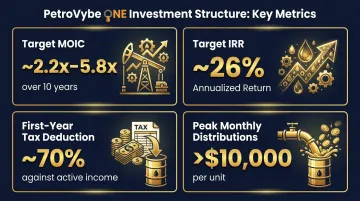
PetroVybe, a private Texas oil and gas development company, offers accredited investors direct equity participation in natural gas and NGL development projects across South Texas, Lavaca County, and the Gulf Coast Basin. Their PetroVybe ONE structure targets:
- ~2.2x–5.8x MOIC over a 10-year horizon
- ~26% IRR
- ~70% first-year tax deduction against active income
- Peak monthly distributions projected to exceed $10,000 per unit
A licensed third-party engineering firm independently validated $48MM in proved reserves (PV-09). Chief Geophysicist Michael Stamatedes has a 48-year career track record and a 75.2% well success rate — against an industry peer average below 40%.
Minimum investment is $100,000 in liquidity. Accredited investor status required.
Tax-Advantaged Passive Income: What High Earners Should Know
For high-income W2 earners and investors with capital gains, the tax efficiency of a passive income strategy often matters as much as the yield itself. Eliminating a $75,000 annual tax bill produces the same financial outcome as earning an additional $75,000 — and it carries none of the market risk that comes with chasing yield.
How IDC Deductions Work
IRC Section 263(c) allows qualifying IDCs to be fully expensed in the year they're incurred. For a typical development project, IDCs represent 60–80% of invested capital. The deduction flows through on a K-1 and — for qualifying working interest structures — offsets:
- W2 wages
- Capital gains
- Other ordinary active income
This is the opposite of how real estate deductions work for most investors. Under IRS Publication 925, rental real estate losses are generally restricted to offsetting passive income only. The $25,000 rental loss allowance phases out above $100,000 MAGI and disappears entirely at $150,000 MAGI. High earners get essentially no benefit from rental losses under standard participation rules.
Real-World Results from PetroVybe
Those mechanics translate directly into documented results. PetroVybe's investor partners achieved:
- 94% tax deduction against active income in 2025
- 91% tax deduction against active income in 2024
A redacted K-1 sample from a $600,000 capital contribution showed $401,772 in IDC and ordinary income deductions — applied against active income, not restricted to passive income.
The structure is operationally passive — no wells to manage, no operations to oversee — while delivering tax treatment that most passive investments can't touch.
Important: All tax-related decisions should be made in consultation with a qualified CPA or tax professional. Individual circumstances vary, and IRS rules on working interest classification require careful review.
How to Choose the Right Passive Income Strategy
Before choosing a strategy, work through four questions:
- How much capital can you deploy upfront?
- How much time can you realistically invest in setup?
- What's your risk tolerance — and how long can you leave capital deployed?
- What's your current tax burden — and could a strategy actively reduce it?
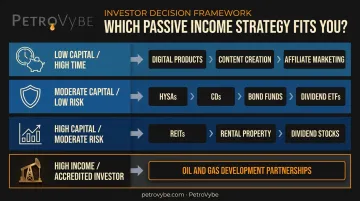
Strategy-to-Profile Mapping
| Investor Profile | Best-Fit Strategies |
|---|---|
| Low capital, high available time | Digital products, content creation, affiliate marketing |
| Moderate capital, low risk tolerance | HYSAs, CDs, bond funds, dividend ETFs |
| High capital, moderate risk | REITs, rental property, dividend stocks |
| High income, accredited investor | Oil and gas development partnerships |
The Case for Multiple Streams
No single strategy wins on every dimension. A dividend portfolio generates steady income but offers no tax offset against W2 earnings. An oil and gas partnership can reduce a six-figure tax bill while building long-term asset value — but requires illiquidity and a multi-year time horizon.
The most resilient approach: combine liquid, lower-yield income streams (dividend ETFs, HYSAs) with a concentrated position in a higher-yield, tax-advantaged vehicle for accredited investors with a multi-year horizon.
Conclusion
Passive income in 2026 is a portfolio decision — one that depends on your capital, time horizon, risk tolerance, and tax situation. No single strategy wins for everyone.
The most common mistake is waiting for perfect conditions. A $10,000 dividend portfolio today becomes the foundation for a larger position in two years. A digital product earning $200 a month teaches you the mechanics of building the next one. Start with what you have, then scale.
That said, one variable reshapes the entire calculation for a specific group of investors: tax efficiency.
If you're a high-income W2 earner or sitting on significant capital gains, the after-tax return on a natural gas development partnership looks structurally different from dividends, REITs, or digital products. The yield may not be the highest on paper — but the IRS treatment of intangible drilling costs means you're keeping more of what you earn from the moment you invest.
If you're an accredited investor with $100,000 or more in liquidity and a long-term wealth-building focus, PetroVybe's model is worth a direct look. Review the PetroVybe ONE project at petrovybe.com/one or schedule a 30-minute discovery call with CEO Peter Snell directly.
Frequently Asked Questions
How can I make $1,000 a month passively?
Reaching $1,000/month typically requires significant invested capital — a dividend portfolio of $300,000–$400,000 at a 3–4% yield, or a rental property generating positive cash flow — or a well-established digital income stream. Most people reach this milestone by combining several modest sources rather than relying on one.
What is the best source of passive income?
There is no universal best — the right answer depends on capital, tax situation, and risk tolerance. Investors with capital tend to favor dividend stocks or REITs. Those with skills but limited funds start with digital products or content, while high earners with significant tax liabilities often find the most total value in oil and gas development partnerships.
What are the 7 types of income?
The commonly cited seven are: earned income, profit income, interest income, dividend income, rental income, capital gains income, and royalty income. Passive income generally encompasses the last five categories; earned income is active by definition.
Is passive income taxable in the US?
Yes, most passive income is taxable. The IRS distinguishes between passive, active, and portfolio income, each with different treatment. Notably, oil and gas working interests can generate deductions that offset ordinary active income — making tax planning essential for investors in these structures.
How much money do I need to start earning passive income?
The entry point varies widely. Digital products and content creation require minimal capital but substantial time investment. Dividend portfolios and real estate require thousands to hundreds of thousands of dollars, while accredited investor opportunities in oil and gas development typically start at $100,000 or more.
What passive income strategies work best for high-income earners?
High earners benefit most from strategies that combine income generation with tax efficiency. The primary options worth evaluating are dividend-paying equities held long-term, real estate with depreciation deductions, and direct participation in oil and gas development. The latter generates IDC deductions applicable against W2 income and capital gains — a meaningful advantage at higher income levels.
Disclosure: PetroVybe and its team members are not licensed financial advisors, and nothing on this website constitutes financial or investment advice or a recommendation to buy, sell, or hold any investment. PetroVybe and its team members are not tax advisors, accountants, or tax strategists, and nothing on this website constitutes tax advice or a tax strategy. PetroVybe and its team members are not attorneys, and nothing on this website constitutes legal advice. All content is provided for general informational purposes only. You should consult your own independent financial advisor, tax professional, and legal counsel before making any decision.